Does Car Insurance Cover Repairs? Only the Ones Caused by an Event
What car insurance pays to repair and what it never covers, how mechanical breakdown differs, choosing a body shop, and what OEM parts mean for your claim.

Table of contents

Car insurance pays for damage. It does not pay for wear. Almost every disappointed repair claim comes from that one distinction, and it is worth learning it properly.
The rule
Insurance covers sudden and accidental damage caused by a peril your policy names.
It does not cover the vehicle deteriorating, failing, or needing maintenance.
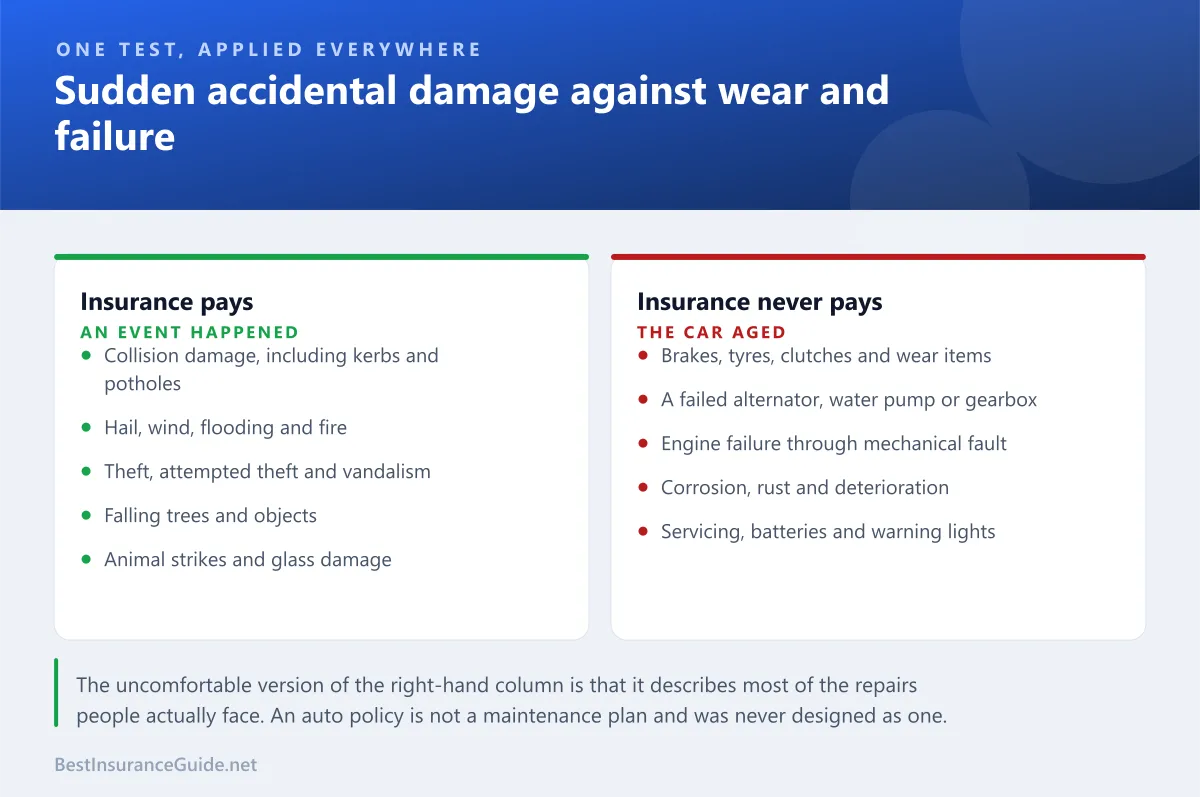
That is the whole test, and it produces a clean split.
Covered, under collision: damage from hitting another vehicle, a fixed object, a kerb or a pothole; rolling the vehicle; losing control on ice.
Covered, under comprehensive: hail, wind, flooding, fire, theft and attempted theft, vandalism, falling trees and objects, animal strikes, and glass damage.
Not covered, under any auto policy: worn brakes, tyres and clutches; a failed alternator, water pump, gearbox or engine; corrosion and rust; a service; a warning light; a battery; anything described in the manufacturer’s maintenance schedule.
The uncomfortable version of that list is that the repairs most people actually face are the uncovered ones. Insurance is not a maintenance plan and was never designed to be.
The boundary cases
Four situations sit close to the line and produce most of the arguments.
An accident that damages a worn component. Generally covered for the accident damage, with the insurer entitled to account for the pre-existing wear. A collision that destroys tyres already at the wear limit will not be settled as though they were new.
A mechanical failure that causes a crash. The crash damage is covered under collision. The failed part that caused it is not.
Flooding that destroys an engine. Covered under comprehensive, because the flooding is the peril. This is one of the clearest cases where an engine repair is insured.
Rodents chewing wiring. Frequently covered under comprehensive as animal damage, and frequently argued. Where the chewing causes a fire, the fire is covered in its own right regardless.
Mechanical breakdown cover
For the uncovered half of the list, a separate product exists.
Mechanical breakdown insurance is offered by some auto insurers, usually on newer vehicles with lower mileage, and covers failure of major components. It functions more like an extended warranty than like insurance.
Extended warranties and vehicle service contracts do the same job through a different route, sold by manufacturers, dealers and third parties, and vary enormously in quality.
Three things worth knowing before buying either.
Check what is excluded, since wear items, maintenance and pre-existing conditions are always outside the cover and the definition of each varies.
Check who pays the shop, because a product that reimburses you afterwards is a very different proposition from one that pays the garage directly.
Check the claims record of the provider, because this is a market with a wide spread in how readily claims are met.
How a covered repair actually works
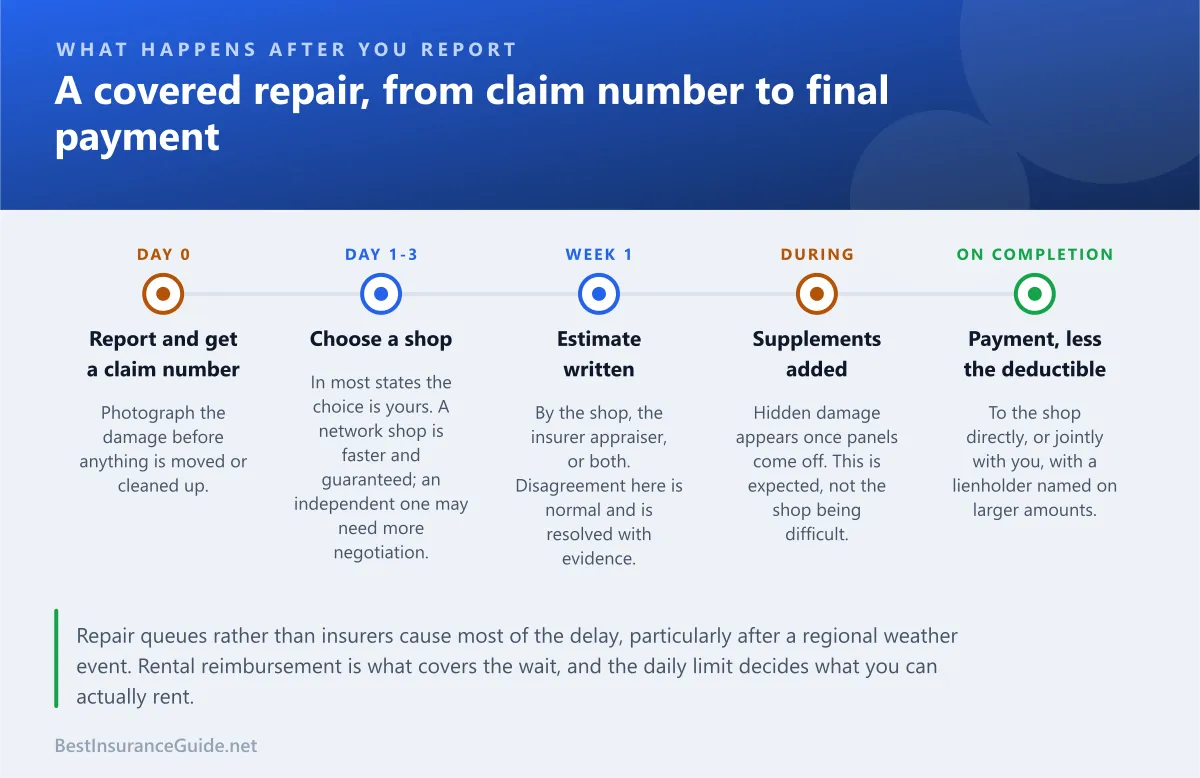
Report the claim and receive a claim number.
Choose a shop. In most states you may use any shop you like, and insurers may not require a particular one. A network shop is usually faster and comes with a repair guarantee; an independent shop may involve more negotiation over the estimate.
The estimate is written, by the shop, by the insurer’s appraiser, or both.
Supplements are added as hidden damage appears once the vehicle is stripped. This is normal and is not the shop being difficult; nobody can see behind a bumper until it comes off.
The insurer pays, less your deductible, either to the shop directly or to you and the shop jointly.
A lienholder may be named on payments over a threshold if the vehicle is financed.
Two points on timing. Repair queues are the main cause of delay, not insurers, particularly after a regional weather event. And rental reimbursement is what covers you during the wait, with the daily limit determining what class of vehicle you can actually rent.
Parts, and why it matters
The parts question decides more disputes than the labour question.
Original equipment manufacturer parts are made by or for the vehicle manufacturer.
Aftermarket parts are made by third parties to fit.
Recycled parts come from other vehicles.
Many policies permit aftermarket or recycled parts, particularly on older vehicles, and several states regulate what must be disclosed. Some insurers offer an OEM parts endorsement for an additional premium.
If original parts matter to you, whether for a newer vehicle, a lease return, or advanced driver assistance systems that require precise calibration, that is worth settling when you buy the policy rather than arguing about during a repair.
When repair becomes total loss
Insurance repairs a vehicle up to a point and then stops.
Once the repair cost reaches a threshold percentage of the vehicle’s actual cash value, the insurer declares a total loss and pays the value instead. That threshold varies by state and insurer and is commonly somewhere between 70% and 80%, with some states setting it by statute.
Two consequences.
On an older vehicle, quite modest damage totals it. A $4,500 repair on a car worth $5,200 is a write-off, even though the car drove in.
The settlement is the vehicle’s value, not the repair estimate, and it is negotiable on evidence. Comparable listings, service history and recent work all support a higher figure.
When not to claim at all
The same rule applies here as everywhere.
Below roughly one and a half times your deductible, absorb it. A $900 repair on a $500 deductible recovers $400 and puts a claim on your record for several years.
Pothole and kerb damage are the classic examples. Both are collision claims, both are generally treated as at-fault, and both are frequently in the range where claiming costs more over three years than the repair.
Glass is the exception. Many policies carry a reduced or waived glass deductible and treat glass claims very gently, so a windscreen is usually worth claiming.
The short version
Car insurance covers repairs to damage caused by a sudden accidental event: collisions, hail, theft, flooding, fire, animals and falling objects. It never covers wear, mechanical failure or maintenance, however large the bill.
For the uncovered half, mechanical breakdown insurance and vehicle service contracts exist, and they are a separate purchase with a wide range of quality.
On a covered repair, you can generally choose your own shop, supplements for hidden damage are normal, and the parts your policy permits are worth checking before you need them.
And on anything close to your deductible, absorbing the cost usually beats filing a claim that follows you for years.
For what a claim does to your premium, see how much car insurance goes up after an accident, and for theft specifically, does insurance cover a stolen car.
Choosing a shop, practically
You generally have the right to choose, and the choice has real consequences.
Network shops, sometimes called direct repair programme shops, are pre-agreed with the insurer. The estimate process is faster, supplements are handled between the shop and the insurer without you in the middle, and the work usually carries a guarantee for as long as you own the vehicle.
Independent shops give you a free choice of who touches the car, which matters for a specialist, a marque expert, or somebody you trust. The estimate may take longer to agree and you may have to mediate between the shop and the appraiser.
Dealer body shops matter most on newer vehicles with advanced driver assistance systems, where calibration of cameras and radar after a bumper or windscreen repair is a genuine technical requirement rather than an upsell.
Four questions worth asking any shop before work starts.
Will you handle the supplement process directly with the insurer?
What parts will you use, and will you tell me before fitting them?
Do you calibrate driver assistance systems in house or subcontract it?
What guarantee comes with the work, and for how long?
What the deductible actually does here
The deductible applies per claim, not per repair and not per year.
Two practical points follow.
A single event with several kinds of damage is one claim. A collision that damages the bonnet, a wing and a headlight is one deductible, not three.
Two events are two deductibles, even in the same week. A hail claim on Monday and a kerb strike on Friday are separate.
Two situations reduce or remove it.
Glass claims frequently carry a reduced or waived deductible, which is why a windscreen is usually worth claiming even at a modest cost.
A collision deductible waiver is available in some states and from some insurers, waiving your collision deductible when an uninsured driver is at fault and identified. It is inexpensive where offered and is worth asking about.
When the repair goes wrong
Raise it with the shop first, in writing, with photographs. A network shop’s guarantee is the fastest route to a fix.
Then raise it with the insurer, particularly where they directed you to the shop, because a direct repair programme carries an obligation on their side too.
Then your state insurance department, which handles complaints about claims handling and publishes the outcomes.
Keep every document: the estimate, every supplement, the parts list, the invoice, and photographs before and after. Almost every dispute about a repair turns on what was agreed and when, and the paperwork is the answer.
Total loss, and what to do if you disagree
The point at which a repair becomes a write-off is worth understanding because it arrives sooner than people expect on an older vehicle.
The threshold varies, commonly between roughly 70% and 80% of the vehicle’s actual cash value, and some states set it by statute rather than leaving it to the insurer.
The settlement is negotiable on evidence. Comparable local listings for the same year, trim and mileage; service records; recent significant work such as tyres, brakes or a timing belt; and the correct trim and option list are all legitimate grounds for a higher figure.
Sales tax and title or registration fees are payable as part of a total loss settlement in many states, and are sometimes missing from an initial offer.
You can sometimes keep the vehicle, taking a reduced settlement with a salvage title attached. That is occasionally sensible on a car with cosmetic damage and rarely sensible otherwise, since a salvage title makes future insurance harder and resale much worse.
Two habits that make every repair claim easier
Photograph the vehicle annually, all four sides plus the interior and the odometer. It documents condition and mileage, which is exactly what a total loss valuation argues about, and it takes two minutes.
Keep the service history in one place, ideally digitally. Recent significant work supports a higher valuation, and reconstructing it after a loss is considerably harder than saving the invoices as they arrive.
The three questions before you file
Is the cause a covered event or is it wear? If a component simply failed, no auto policy responds and the question is whether you hold a mechanical breakdown product instead.
Is the repair worth more than about one and a half times the deductible? Below that, absorbing it is usually the better decision, because the claim follows you for years and the recovery is small.
Is anybody else involved? If another party or an injury is in the picture, report it regardless of whether you intend to claim, because late notice can prejudice cover on a claim that surfaces months later.
Answer those three and the decision is usually obvious. Where it is not, the deciding factor is normally whether you would rather hold the repair cost or the claim record, and on anything close to the line the record is worth more than people assume.
Related reading
Does insurance cover a stolen car covers the other comprehensive outcome, where the vehicle is not repaired but settled. Comprehensive deductible explained covers which deductible applies to which kind of damage, which decides what a repair actually costs you.
A note on scope
Total loss thresholds, parts requirements, shop choice rules and glass deductible treatment are set by state regulation and individual insurer filings, and vary considerably. Figures here are illustrative rather than quotes.
Your state insurance department publishes consumer guidance on repair rights, parts disclosure and total loss settlements, and your own policy wording is the authoritative statement of what is covered. This site is independent and not affiliated with any insurer.