Do Prescriptions Count Towards Your Deductible? It Depends on the Plan
How prescription spending interacts with a health insurance deductible, the three plan structures, drug tiers, and how to lower what you pay at the pharmacy.

Table of contents

This question has three correct answers depending on your plan, and finding out which one applies to you is a five-minute task that changes what you should do at the pharmacy.
The three structures
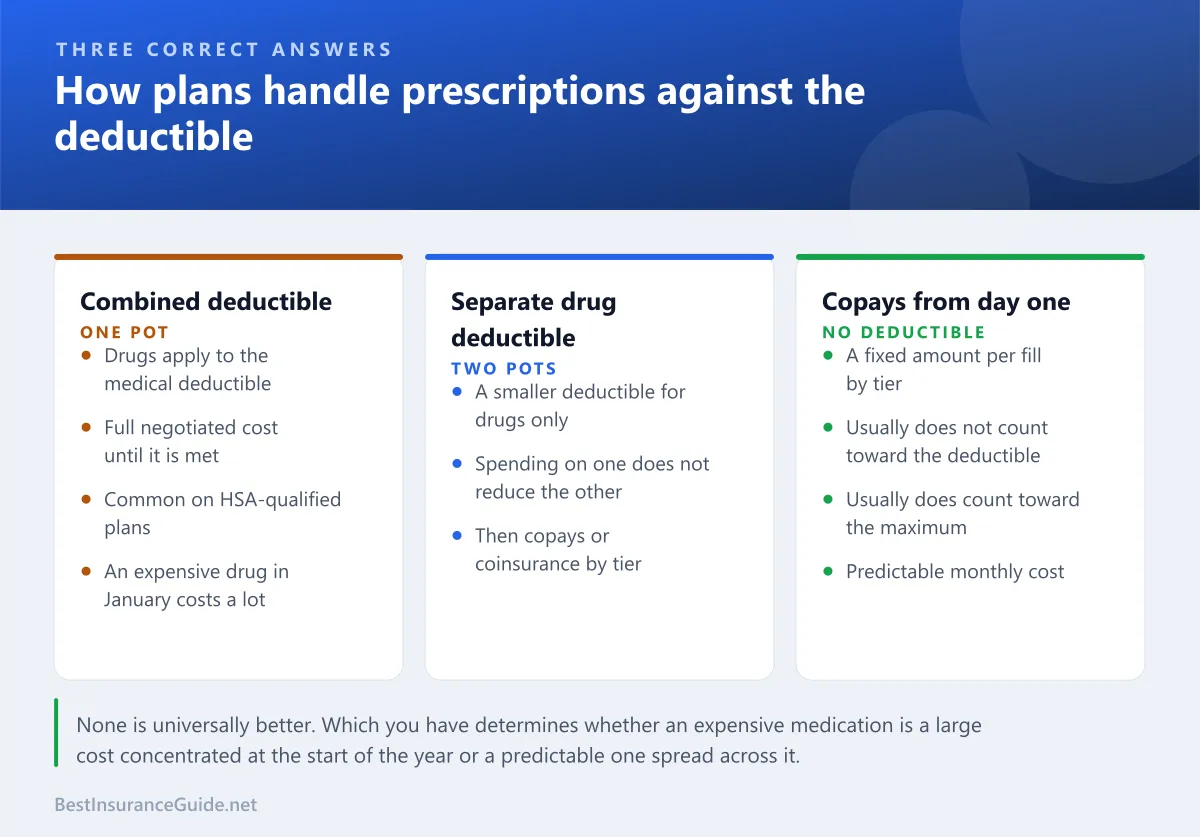
Combined deductible. Prescription spending applies to the same deductible as medical care. You pay the full negotiated drug cost until the deductible is met, then coinsurance. Common on high-deductible plans and on plans paired with health savings accounts.
Separate prescription deductible. A smaller deductible applying only to drugs, running alongside the medical one. Spending on one does not reduce the other.
Copays from day one. A fixed copay per prescription regardless of deductible status, frequently structured by tier. On many of these plans the copays do not count toward the deductible at all, though they usually do count toward the out-of-pocket maximum.
All three are common, and none is universally better. What matters is knowing which you have, because it determines whether an expensive medication early in the year is a large one-off cost or a predictable monthly one.
The out-of-pocket maximum protection
One piece of genuinely good news that applies almost everywhere.
Prescription cost sharing counts toward the out-of-pocket maximum on most plans, even where it does not count toward the deductible.
That matters enormously for anyone on expensive long-term medication, because it means there is a ceiling. Once the maximum is reached, covered prescriptions cost nothing for the rest of the plan year.
Worked example: an expensive medication, three plans
A specialty medication with a negotiated cost of $2,400 a month.
| Combined deductible | Separate drug deductible | Copay from day one | |
|---|---|---|---|
| Month one cost to you | Full cost to deductible | Drug deductible, then coinsurance | Tier copay |
| Counts toward medical deductible | Yes | No | Usually no |
| Counts toward out-of-pocket maximum | Yes | Yes | Yes |
| When your costs stop | At the maximum | At the maximum | At the maximum |
The path differs and the destination is the same. For somebody facing this, the practical question is cash flow in the early months, which is exactly what the three structures differ on.
Drug tiers
Within any structure, what you pay depends on the formulary, which is the plan’s list of covered drugs organised into tiers.

A typical structure:
Tier 1, generics. Lowest cost, and the tier most prescriptions can be moved into.
Tier 2, preferred brands. Moderate cost.
Tier 3, non-preferred brands. Higher cost.
Tier 4 and above, specialty drugs. Highest cost, frequently coinsurance rather than a copay, and usually requiring prior authorisation and a specialty pharmacy.
Three things to know about tiers.
The same drug sits in different tiers on different plans. There is no universal tier assignment, which is why comparing plans on premium alone is a mistake for anyone on regular medication.
Formularies change, usually at the plan year, and a drug covered this year may move tier or come off the list next year. Plans notify members, and the notice is easy to miss.
Exceptions exist. Where a lower-tier alternative is not clinically appropriate, a prescriber can request a tier exception or a formulary exception. These are granted with reasonable frequency and are rarely requested.
Copay assistance and accumulator programmes
A development worth understanding because it can silently change what a coupon is worth.
Manufacturer copay assistance reduces what you pay at the counter for certain brand drugs.
Copay accumulator programmes operated by some plans mean that manufacturer assistance does not count toward your deductible or out-of-pocket maximum. You benefit at the counter and your progress toward the ceiling stops.
Copay maximiser programmes work differently again, spreading the assistance across the year.
The practical consequence: somebody using a coupon may find that after the assistance is exhausted, their deductible is nowhere near met and the full cost lands at once.
Rules on these vary by state and by plan type and have been the subject of litigation and state legislation. If you use manufacturer assistance, ask the plan directly whether it counts toward your accumulations, and get the answer in writing.
Reducing what you pay
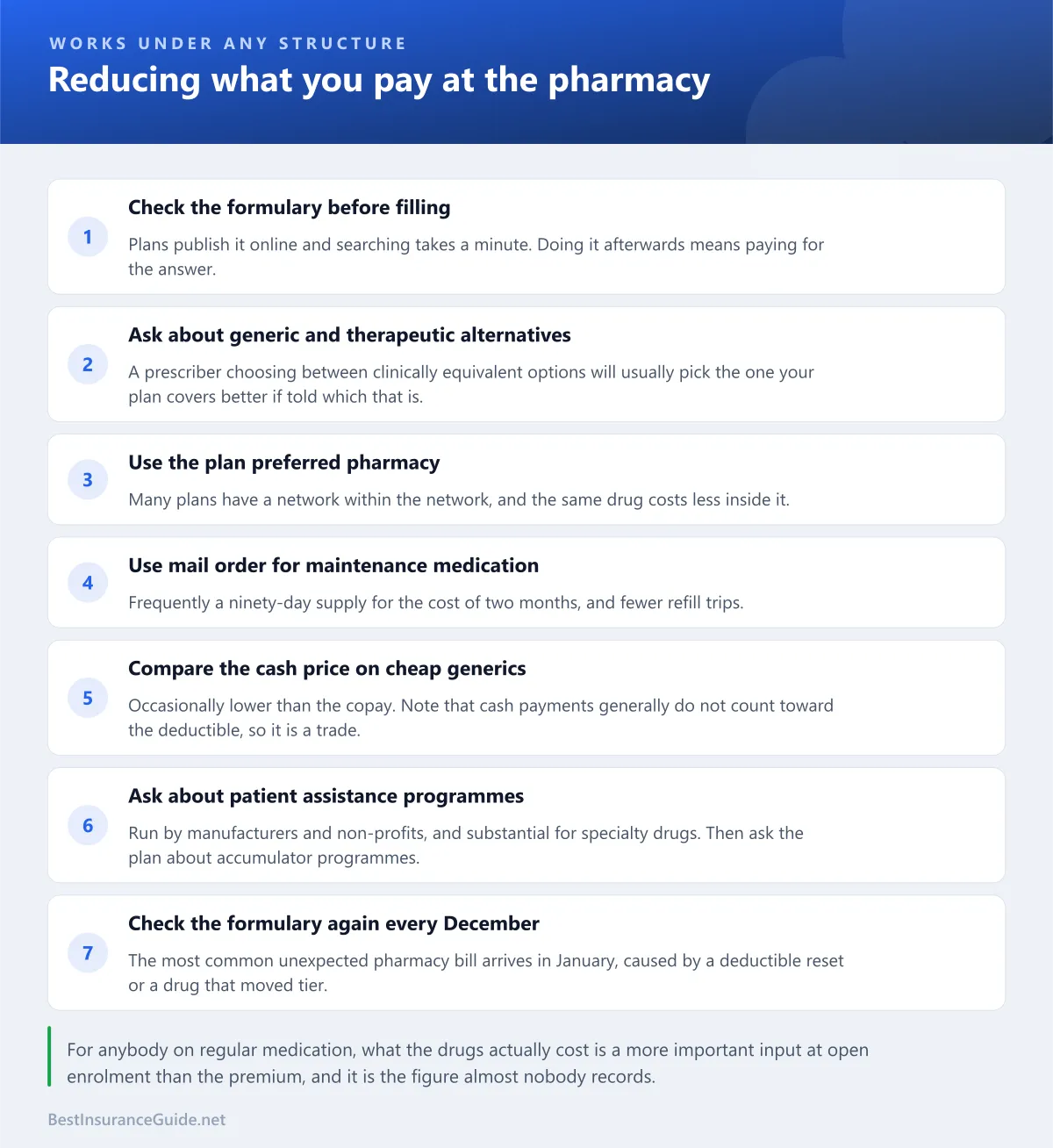
Check the formulary before filling, not after. Plans publish it online and searching it takes a minute.
Ask about generics and therapeutic alternatives. A prescriber choosing between two clinically equivalent options will usually pick the one your plan covers better if you tell them which that is.
Use the plan’s preferred pharmacy. Many plans have a network within a network, and the same drug costs less at a preferred pharmacy.
Use mail order for maintenance medication. Frequently a ninety-day supply for the cost of two months.
Ask for ninety-day supplies where clinically appropriate, which reduces both cost and the number of refill trips.
Compare the cash price. Occasionally, particularly for cheap generics, paying cash with a discount card is less than your copay. Note that cash payments generally do not count toward your deductible, so this is a trade rather than a free win.
Ask about patient assistance programmes, run by manufacturers and by non-profits, particularly for specialty drugs.
Ask the prescriber about a tier or formulary exception where the covered alternatives are not appropriate.
Time refills around the plan year where you are close to a threshold, since a refill after the deductible is met costs less.
What to check on your own plan
Five specific questions, answered from the summary of benefits or by member services with a reference number.
Do prescriptions apply to the medical deductible, a separate drug deductible, or neither?
What are the tiers and what does each cost?
Is my specific medication on the formulary, and at what tier?
Does prescription spending count toward the out-of-pocket maximum?
Does the plan operate a copay accumulator programme?
Anyone taking regular medication should be able to answer all five, and most people cannot answer any of them.
The short version
Whether prescriptions count toward your deductible depends entirely on the plan. Some run drugs through the medical deductible, some use a separate and smaller drug deductible, and some charge copays that never touch the deductible at all.
Almost universally, prescription spending does count toward the out-of-pocket maximum, which means there is a ceiling even on expensive long-term medication.
Within any structure, the formulary tier decides what you pay, the same drug sits at different tiers on different plans, and exceptions can be requested and rarely are.
If you use manufacturer copay assistance, ask specifically whether your plan operates an accumulator programme, because that determines whether the help is also moving you toward your ceiling.
For the mechanism generally, see what is a deductible for health insurance, and for what changes at the threshold, what happens when you meet your deductible.
Specialty drugs, where the structure matters most
For anybody prescribed a specialty medication, the plan structure stops being an abstraction.
Specialty drugs are usually on the highest tier, frequently with coinsurance rather than a fixed copay, which means your cost scales with the drug price rather than being capped per fill.
They usually require prior authorisation, and frequently step therapy, meaning the plan requires a less expensive alternative to have been tried first.
They are usually dispensed through a specialty pharmacy designated by the plan rather than a retail one.
Four things worth doing immediately on a specialty prescription.
Confirm the tier and the cost sharing before the first fill, because a coinsurance percentage on a very expensive drug is a large number.
Ask the prescriber to start prior authorisation early, since it takes time and a first fill can otherwise be delayed.
Ask about manufacturer patient assistance, which for specialty drugs is frequently substantial, and then ask the plan whether it operates a copay accumulator programme.
Work out where the out-of-pocket maximum sits, because on a drug of this cost you are likely to reach it, and knowing when changes the whole year’s financial picture.
Two things to check on your own plan
Which of the three structures applies to you, from the summary of benefits, and whether prescriptions count toward the medical deductible.
Whether every medication you take regularly is on the current formulary and at what tier. Formularies change at the plan year and the notice is easy to miss, and a drug that moved tier is the most common cause of an unexpected pharmacy bill in January.
The January problem
The most common unexpected pharmacy bill in the year arrives in the first weeks of January, and it has three causes.
The deductible reset. On a combined-deductible plan, a medication that cost a modest coinsurance amount in December costs full price in January until the deductible is met again.
A formulary change. Plans update formularies at the plan year, and a drug can move up a tier, require prior authorisation it did not previously need, or come off the list entirely. Notices are sent and are easy to miss.
A plan change. Where you switched plans at open enrolment, the new formulary is a different document entirely.
Three things prevent it.
Check the new formulary in December for every regular medication, before the year turns.
Ask the prescriber about alternatives immediately if something has moved, rather than at the next appointment.
Consider filling a ninety-day supply in December where the deductible is already met and the medication is stable, which is a legitimate and straightforward saving.
Two questions for the pharmacy counter
Is there a lower-cost equivalent my plan prefers? Pharmacists know the formulary landscape and are frequently able to suggest a therapeutic alternative for the prescriber to consider.
Is the cash price lower than my copay today? Occasionally it is, particularly for inexpensive generics. Note that a cash payment generally does not count toward your deductible, so it is a trade rather than a straightforward win, and on a plan where you expect to reach the deductible anyway the copay may be the better route.
What to keep a record of
Two habits make the pharmacy side of a plan far easier to manage.
Keep a current list of every medication, with dose and prescriber, somewhere reachable from your phone. It makes formulary checks quick at open enrolment and it is genuinely useful in an emergency.
Note what each medication cost each month, which takes seconds at the counter and produces the single most useful input when comparing plans at open enrolment. Somebody choosing a plan without knowing what their drugs actually cost is choosing on premium alone, which for anybody on regular medication is the wrong basis entirely.
Two things to ask the plan directly
Which structure applies to prescriptions, in writing or with a reference number, since the summary of benefits occasionally states it ambiguously and the answer changes what an expensive month costs.
Whether a copay accumulator programme operates, if you use any manufacturer assistance. That determines whether the help is also moving you toward your out-of-pocket maximum, and the answer materially changes what the assistance is worth over a year.
Related reading
Two adjacent questions complete the picture. What happens when you meet your deductible covers what changes once the threshold is crossed, which for anybody on regular medication is the point at which costs drop. Can I cancel my health insurance at any time covers the alternatives when medication costs make a plan feel unaffordable.
A note on scope
Nothing here is medical or financial advice. Formularies, tier structures, deductible arrangements, accumulator programme rules and state legislation on copay assistance vary between plans and states and change over time, and the figures used are illustrative.
Your plan’s summary of benefits and coverage and its published formulary are the authoritative statement of what applies, and your prescriber and pharmacist are the appropriate sources on clinical alternatives. This site is independent and not affiliated with any insurer.