Comprehensive Deductible: The One You Should Probably Keep Low
What a comprehensive deductible covers, how it differs from collision, why glass is often treated separately, and how to choose the right level.

Table of contents
Most drivers set their comprehensive and collision deductibles to the same number without thinking about it. That is usually the wrong answer, and comprehensive is the one to reconsider.
What comprehensive covers
Comprehensive covers non-collision losses. It is sometimes called “other than collision”, which is a better name.
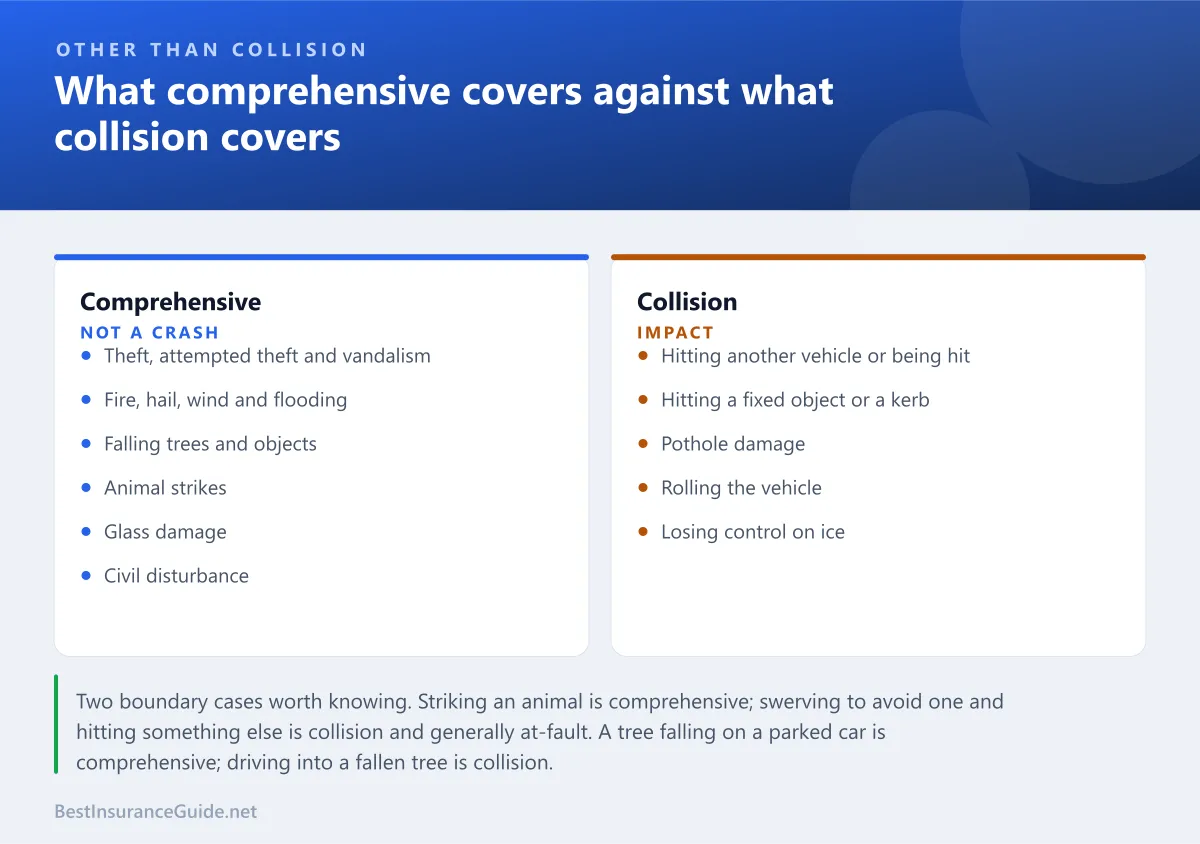
Comprehensive: theft and attempted theft, vandalism, fire, hail, wind, flood, falling trees and objects, animal strikes, civil disturbance, and glass damage.
Collision: hitting another vehicle, hitting a fixed object, hitting a kerb or a pothole edge, rolling the vehicle, and losing control on ice.
Two boundary cases worth knowing.
Striking an animal is comprehensive. Swerving to avoid one and hitting a fence, a ditch or another vehicle is collision, and generally treated as at-fault. The driving advice and the insurance advice point the same way: brake rather than swerve.
A tree falling on a parked car is comprehensive. Driving into a fallen tree is collision.
Why the deductibles should differ
Three reasons comprehensive deserves a lower deductible than collision on most policies.
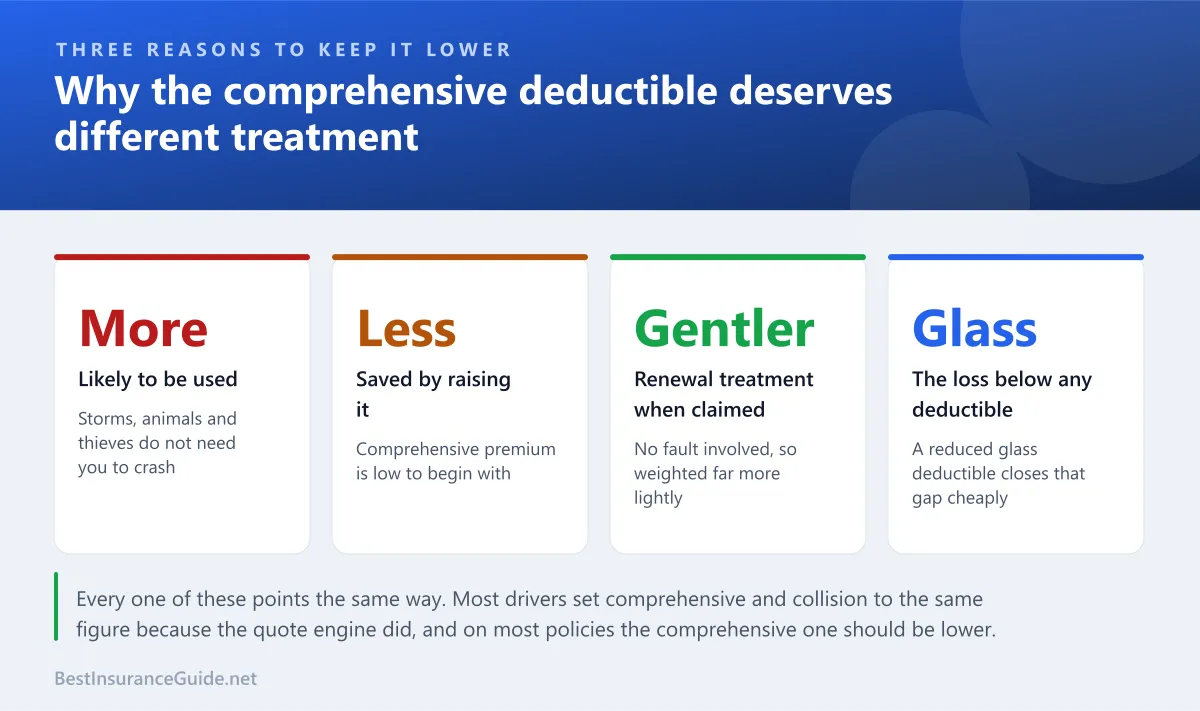
Comprehensive claims are the ones you are most likely to make. In hail states, deer states, flood-exposed areas and high-theft metros, the frequency is real. Collision claims require a crash; comprehensive claims require a storm, an animal or a stranger.
Comprehensive premium is low, so the saving from raising its deductible is correspondingly small. You are giving up meaningful protection for a few dollars a year.
Comprehensive claims are treated more gently at renewal. Because no fault is involved, insurers weight them far less heavily than at-fault collisions. That means the claims-record argument against filing, which is genuinely strong for collision, is much weaker here.
Worked example: the same $500 shift, two coverages
Illustrative figures on a mid-range policy.
| Collision, $500 to $1,000 | Comprehensive, $500 to $1,000 | |
|---|---|---|
| Annual premium saving | $96 | $34 |
| Additional exposure per claim | $500 | $500 |
| Years to break even | 5.2 | 14.7 |
| Likelihood of using it | Lower | Higher |
| Renewal effect if used | Significant | Modest |
Every row favours keeping the comprehensive deductible lower. The saving is smaller, the claim is more likely, and the consequence of claiming is milder.
The glass question
Glass deserves its own paragraph because it is where the deductible level most often makes the coverage useless.
A windscreen replacement frequently costs less than a $500 or $1,000 deductible, which means the coverage pays nothing at all.
Three things to know.
Many insurers offer a reduced or waived glass deductible as an inexpensive endorsement. Where available it is close to free money in any state where road debris is common.
Several states require insurers to offer full glass coverage, and a few require it to be provided without a deductible on certain policies. Rules vary considerably.
Repair is usually cheaper than replacement, and many policies waive the deductible entirely for a chip repair, because repairing a chip prevents a full replacement later.
Modern windscreens are more expensive than they were, because cameras and sensors mounted to them require recalibration after replacement. That has moved windscreen costs from a nuisance to a genuine claim in many vehicles.
When to raise it anyway
Two situations argue the other way.
A vehicle whose value no longer justifies the coverage. Once the annual comprehensive premium plus the deductible approaches the vehicle’s actual cash value, the maths stops working. At that point the question is whether to carry comprehensive at all rather than at what deductible.
Low exposure. A garaged vehicle in an area with little hail, few deer and low theft, driven rarely, is a genuinely lower comprehensive risk, and a higher deductible costs less in expected terms.
Even then, the saving is small, which is the recurring theme.
Setting both deductibles
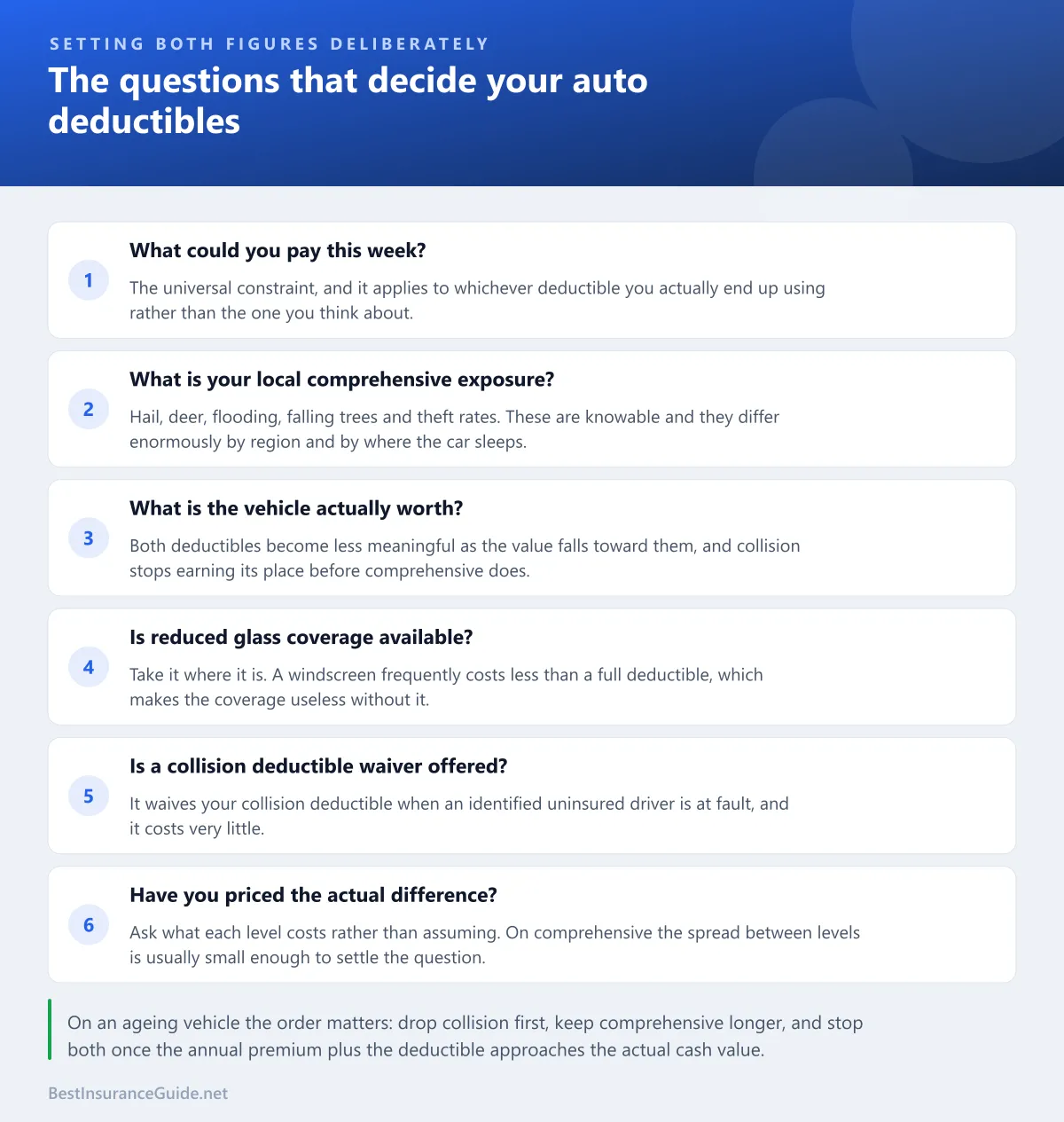
What could you pay this week? The universal constraint, and it applies to whichever deductible you actually end up using.
What is your local comprehensive exposure? Hail, deer, flooding, falling trees, theft rates. These are knowable and they differ enormously by region.
What is the vehicle worth? Both deductibles become less meaningful as the vehicle’s value falls toward them.
Is glass coverage available separately? If so, take it, because it removes the one loss most likely to fall below any deductible.
Is a collision deductible waiver available? A separate endorsement waiving your collision deductible when an uninsured driver is at fault. Our guide to the collision deductible waiver covers it.
Have you priced the actual difference? Ask the insurer what each level costs rather than assuming the saving is large. On comprehensive it usually is not.
Comprehensive on an older vehicle
The most common real decision, and the answer differs from collision.
Drop collision first. It is the more expensive of the two, and on a vehicle worth a few thousand dollars the premium plus deductible approaches the payout quickly.
Keep comprehensive longer. It is cheap, and it answers theft, fire, flood, hail and animals, none of which care about the vehicle’s age. A ten-year-old car destroyed by a falling tree is still a total loss to its owner.
The threshold to watch is when the annual comprehensive premium plus the deductible reaches roughly the vehicle’s actual cash value. At that point the coverage cannot return more than it costs over a couple of years.
The short version
Comprehensive covers everything that is not a collision: theft, hail, fire, flood, falling objects, animals and glass. Those are the claims most drivers actually make.
Because comprehensive premium is low, raising its deductible saves very little, while removing protection against the losses you are most likely to suffer. And because comprehensive claims are not fault-based, they are treated far more gently at renewal than collisions.
So the sensible structure on most policies is a lower comprehensive deductible than collision deductible, plus a reduced glass deductible where it is offered.
On an older vehicle, drop collision before comprehensive, and keep comprehensive until the premium plus the deductible approaches what the car is worth.
For the general principle, see why higher deductibles lower premiums, and for the uninsured-driver endorsement, the collision deductible waiver.
Total loss on a comprehensive claim
The deductible matters differently when a vehicle is written off rather than repaired, and comprehensive produces total losses more often than people expect.
A hail event can total a driveable car. Repair cost across panels, roof and glass frequently exceeds the vehicle’s actual cash value on anything more than a few years old.
A flooded vehicle is almost always a total loss, regardless of how it looks afterwards.
A stolen and unrecovered vehicle is settled as a total loss after the insurer’s waiting period.
In each case, the settlement is the actual cash value less your deductible, and two consequences follow.
The deductible comes off the settlement, so a higher deductible reduces what you receive on the write-off as well as on a repair.
The settlement is negotiable on evidence, and the same approach applies as anywhere: comparable local listings for the same year, trim and mileage, service records, recent significant work, and the correct option list. Sales tax and title fees are payable as part of a total loss settlement in many states and are sometimes omitted from an initial offer.
Worked example: hail write-off, two deductibles
A vehicle with an actual cash value of $12,600, damaged beyond economic repair.
| $500 comprehensive deductible | $1,500 comprehensive deductible | |
|---|---|---|
| Settlement basis | $12,600 | $12,600 |
| Less deductible | $500 | $1,500 |
| Paid | $12,100 | $11,100 |
| Annual premium saving from the higher deductible | — | Roughly $50 to $80 |
The higher deductible saved perhaps $200 over three years and cost $1,000 on the one claim that mattered. That is the pattern in comprehensive generally.
Two things to check on your own policy
Whether your comprehensive and collision deductibles are the same figure, and if so, whether that was a decision or a default. On most policies they are the same because the quote engine set them together.
Whether a reduced or waived glass deductible is available, and what it costs. On a modern vehicle with sensors mounted to the windscreen, this has moved from a minor endorsement to a genuinely valuable one.
Where local exposure changes the answer
Comprehensive risk is unusually geographic, and the right deductible in one place is wrong in another.
Hail corridors, running from Texas through the Plains into the upper Midwest and reaching into the Southeast, where a comprehensive claim is close to an expectation rather than a possibility.
Deer belts, concentrated in the upper Midwest, the Appalachians, the Northeast and the mountain west, peaking sharply in autumn.
Flood-exposed metros and coastal counties, where a single event can total large numbers of vehicles at once.
High-theft metros, where the exposure is concentrated by neighbourhood and by vehicle model.
Heavily wooded areas, where falling limbs after storms are routine.
Gravel and chip-sealed road networks, where windscreen damage is frequent enough that glass coverage matters more than the deductible level does.
A driver in a garage in a low-hail, low-deer, low-theft area has a genuinely different comprehensive exposure from one parked on a street in the hail belt, and setting the same deductible in both cases is the default rather than a decision.
Two things to ask your insurer
What does each deductible level actually cost on comprehensive? Ask for the figures rather than assuming. On most policies the spread between a $500 and a $1,000 comprehensive deductible is small enough that the lower one is straightforwardly better value.
Is a reduced glass deductible available, and what does it cost? In several states insurers must offer full glass coverage, and even where they need not, the endorsement is inexpensive. On any vehicle with a camera or sensor mounted to the windscreen, replacement costs have risen enough that this is no longer a minor consideration.
The decision, summarised
Keep comprehensive lower than collision on most policies. The saving from raising it is small, the claim is more likely, and the renewal consequence of using it is mild.
Add reduced glass cover where offered, since a windscreen frequently costs less than the deductible without it.
Drop collision before comprehensive on an ageing vehicle, because collision is the more expensive coverage and the first to stop making sense.
Keep comprehensive until the annual premium plus the deductible approaches the vehicle value, at which point neither coverage can return more than it costs.
Related reading
Collision deductible waiver covers the endorsement that removes the other deductible entirely when an uninsured driver is at fault. Does insurance cover a stolen car covers the largest comprehensive claim most drivers will ever make and how the deductible affects the settlement.
A note on scope
Figures here are illustrative rather than quotes, and the relationship between deductible level and premium varies substantially by insurer, state, vehicle and driver. Glass coverage requirements and comprehensive claim treatment differ by state and change over time.
Your state insurance department publishes consumer guidance on auto coverages and any state-specific glass rules, and your own declarations page is the authoritative statement of your deductibles. This site is independent and not affiliated with any insurer.