The Cheapest Car Insurance in Georgia: How the Number Is Actually Built
How Georgia car insurance is priced, the Atlanta premium, the state minimum limits, the UM election that catches people, and how to find a genuinely cheap quote.

Table of contents

The cheapest car insurance in Georgia is not a company. It is a set of decisions, and most of them are made before you ever open a comparison site.
What the state requires
| Coverage | Georgia minimum |
|---|---|
| Bodily injury liability, per person | $25,000 |
| Bodily injury liability, per accident | $50,000 |
| Property damage liability | $25,000 |
| Uninsured motorist | Must be offered, can be rejected in writing |
Those minimums have not kept pace with vehicle values or medical costs. $25,000 of property damage does not replace a mid-range modern car, and the driver who buys only the minimum is buying compliance rather than protection.
The geography problem
Georgia has one of the widest intra-state premium spreads in the country, and it is the single largest factor in what you will pay.
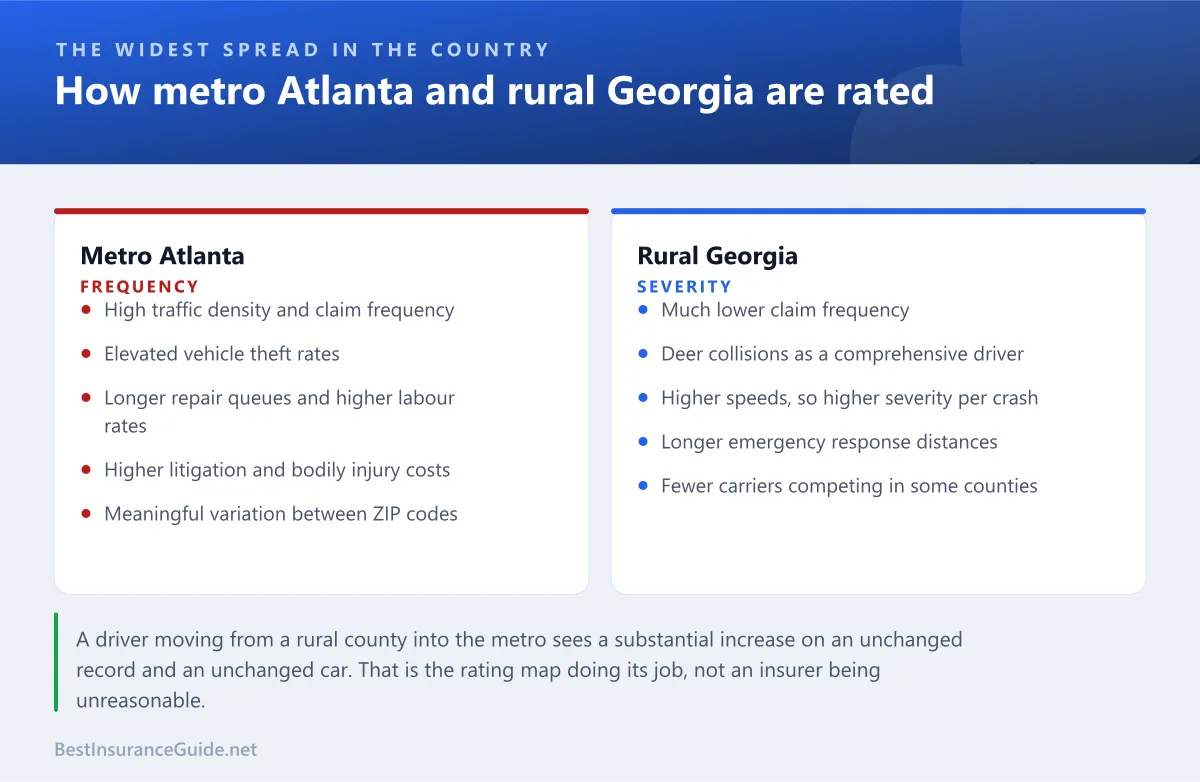
Metro Atlanta carries high traffic density, high claim frequency, elevated vehicle theft, longer repair queues and higher litigation cost. Premiums here run materially above the state average and vary meaningfully by ZIP code within the metro itself.
Mid-sized cities — Savannah, Augusta, Columbus, Macon — sit between the metro and rural rates, with Savannah carrying additional coastal comprehensive exposure.
Rural Georgia rates considerably lower on frequency, though deer collisions and long emergency response distances push severity up.
The practical point: a driver moving from a rural county into the Atlanta metro will see a substantial increase on an unchanged record and an unchanged car. That is the rating map, not the insurer.
The uninsured motorist election
This is the Georgia-specific decision that most affects what you actually recover, and most drivers make it without understanding it.
Georgia offers uninsured and underinsured motorist coverage in two forms:
Added-on, sometimes called excess. Your UM limit sits on top of the at-fault driver’s liability limit. If they carry $25,000 and you have $100,000 added-on, the total available is $125,000.
Reduced-by, sometimes called offset. Your UM limit is reduced by what the at-fault driver’s insurer pays. With the same numbers, the total available is $100,000, of which their insurer pays $25,000 and yours pays $75,000.
Added-on costs more and provides meaningfully more. On a serious injury the difference is exactly the at-fault driver’s limit, which in a state with 25/50 minimums is the difference that matters.
Our guide to motorcycle insurance in Georgia works through the same election in the context of a rider, where the stakes are higher again.
What actually makes a quote cheap
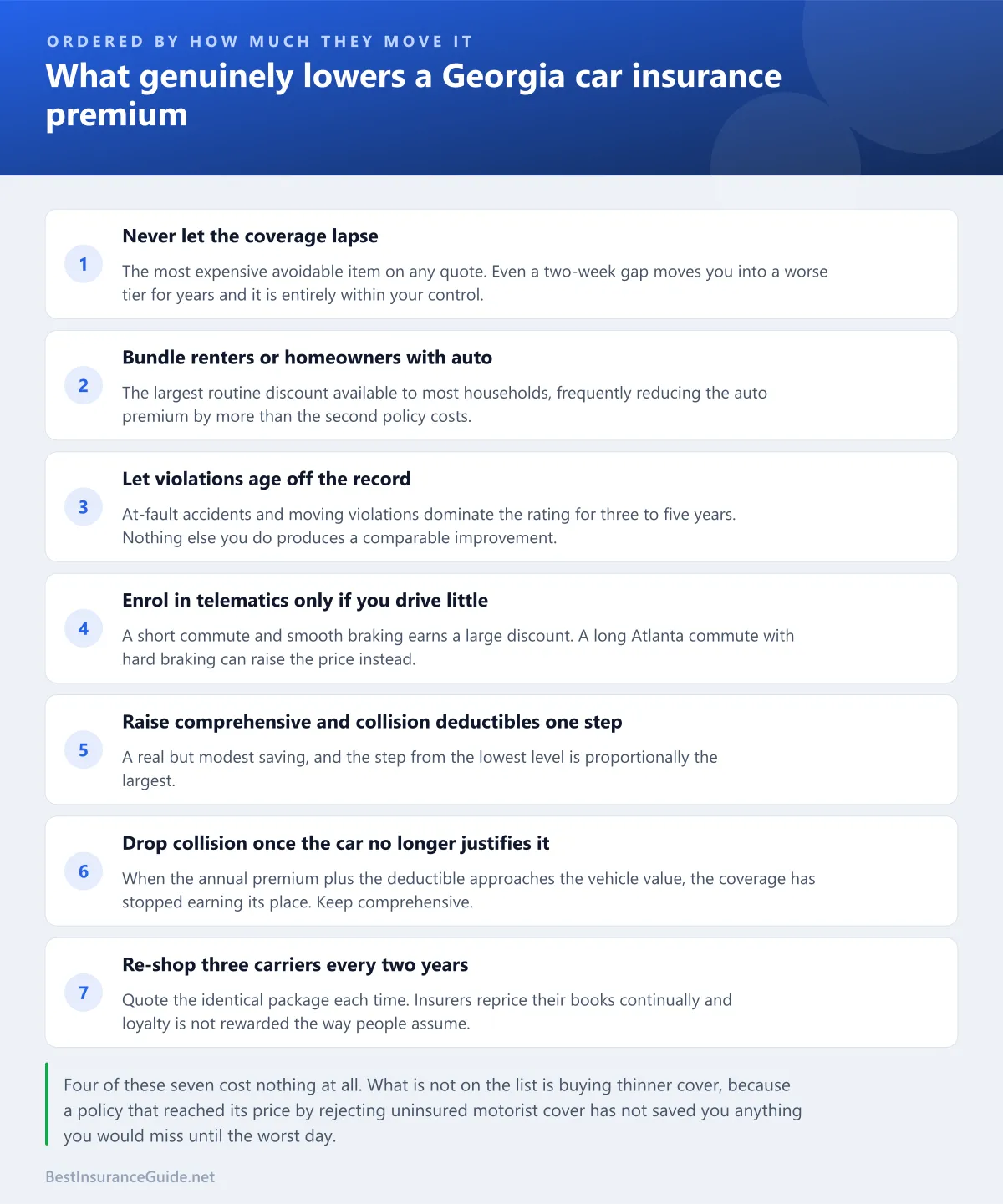
Continuous coverage with no lapse. The single most expensive avoidable thing on a quote. Even a two-week gap moves you into a worse tier for years, and it is entirely within your control.
Bundling. Adding renters or homeowners to the same insurer produces the largest routine discount available to most households, and it frequently reduces the auto premium by more than the second policy costs.
Your record, over time. At-fault accidents and moving violations dominate the rating and fall off after three to five years. Nothing else you can do produces a comparable change.
Telematics, if you are genuinely low-risk. A short commute, few night trips and smooth braking can produce a large discount in Georgia. A long Atlanta commute with hard braking can produce a surcharge, so it is not a free option.
Deductible choice on comprehensive and collision, where moving one step up saves a real but modest amount.
Dropping collision on a low-value vehicle, once the annual premium plus deductible approaches what the car is worth.
Your credit-based insurance score, which Georgia permits and which improves slowly with ordinary financial behaviour.
Shopping at matched coverage, every couple of years and after any life event.
Worked example: two Atlanta drivers, same car, same record
| Driver A | Driver B | |
|---|---|---|
| Coverage lapse in last three years | Yes, six weeks | No |
| Bundled with renters insurance | No | Yes |
| Telematics enrolled | No | Yes, low mileage |
| Annual mileage | 14,000 | 6,000 |
| Deductibles | $500 comp and collision | $1,000 comp and collision |
| Indicative annual premium | $2,740 | $1,520 |
Same car, same age, same clean driving record. The gap is entirely made of decisions, and four of the five rows are free to change.
What to carry, not just what to pay
Cheapest is only meaningful once the coverage is right, and in Georgia three lines deserve attention.
Liability well above 25/50/25. Something around 100/300/100 is the usual sensible floor, and the premium step up from the state minimum is far smaller than the protection step up.
Uninsured and underinsured motorist on the added-on basis, at limits matching your liability.
Comprehensive, because Georgia’s hail, wind, falling tree, flood and theft exposure all land here rather than on collision.
Beyond those, rental reimbursement and roadside assistance are cheap and useful if you have one vehicle, and an umbrella policy above the auto liability is the cheapest large protection available to anyone with assets.
Shopping it properly
Set the coverage before you quote. Write down the limits, the UM basis and the deductibles, and quote that exact package everywhere. A cheaper number produced by silently dropping UM to reduced-by is not a cheaper policy.
Get at least three quotes, and include an independent agent who can access carriers that do not advertise.
Ask for the full discount list, not the ones the quote engine applied automatically.
Re-shop every two years, and immediately after moving, marrying, changing jobs, buying a house or adding a teenage driver.
Check complaint records with the Georgia Office of Commissioner of Insurance and Safety Fire before binding.
The short version
The cheapest car insurance in Georgia is mostly determined before you shop: whether you have a lapse, whether you bundle, where you park the car, and what your record looks like.
Georgia’s wide metro-to-rural spread means the address does more work here than in most states, and the uninsured motorist election between added-on and reduced-by is the coverage decision that most affects what you actually recover.
Fix the coverage first, then compare three quotes on identical terms. Comparing prices on different policies is not comparing anything.
For the full discount list, see auto insurance discounts, and for switching without creating a lapse, how to switch car insurance.
The Georgia claim rules that affect what you recover
Two features of Georgia law change the value of a claim, and neither is visible on a comparison site.
Modified comparative negligence with a 50% bar. You may recover damages only if you were less than 50% responsible, and your recovery is reduced by your share. At exactly 50% you recover nothing.
That threshold makes fault allocation unusually consequential in Georgia. In a state with a pure comparative system, being found 55% at fault still produces a recovery. Here it produces nothing, which is why the evidence gathered in the first ten minutes at a scene matters more than most drivers realise.
Statutory time limits differ for property damage and personal injury claims, and missing one ends the claim on its own regardless of merit.
What to do at the scene
Call the police and obtain a report number. In a 50% bar state this is the most valuable document you can create.
Photograph before anything moves: vehicle positions, damage to both cars, road markings, signals, skid marks, debris, weather and the wider scene.
Photograph the other driver’s licence and insurance card rather than writing details down.
Collect witness contact details. Contested fault is decided by witnesses far more often than by argument, and nobody collects them.
Say nothing about fault to anyone at the scene or to the other insurer afterwards.
Report to your own insurer promptly even if you do not intend to claim.
Get medical attention the same day if there is any question of injury.
The cheapest policy that is still worth having
There is a version of cheap that is genuinely cheap and a version that is a deferred cost, and they look identical on a comparison page.
Genuinely cheap comes from: no lapse in coverage, bundling, a clean record, telematics where you actually drive little, sensible deductibles, dropping collision on a car that no longer warrants it, and shopping across several carriers at matched terms.
Deferred cost comes from: state minimum liability, uninsured motorist on the reduced-by basis or rejected entirely, no comprehensive in a hail and tree state, and a deductible you could not produce.
The difference between those two policies is a few hundred dollars a year. The difference between them after a serious crash is six figures.
Worked example: what the state minimum leaves behind
A Georgia driver at fault in a crash causing $180,000 of injuries and a $46,000 vehicle write-off.
| Minimum limits | 100/300/100 | |
|---|---|---|
| Bodily injury paid | $25,000 | $180,000 |
| Property damage paid | $25,000 | $46,000 |
| Total paid by insurer | $50,000 | $226,000 |
| Personally owed | $176,000 | $0 |
The premium difference between those two columns is commonly in the region of $200 to $400 a year in Georgia. Everything else about the policy is identical.
Georgia cities, and what changes between them
Atlanta and the inner metro carry the state’s highest rates. Traffic density, claim frequency, vehicle theft, repair queues and litigation costs all sit above the state average, and the spread by ZIP code within the metro is itself large.
The outer metro counties rate lower than the core while still sitting above the state average, which is why a move of fifteen miles can change a premium noticeably.
Savannah carries mid-range frequency rates plus meaningful coastal comprehensive exposure from tropical systems and flooding.
Augusta, Columbus and Macon sit below the metro on frequency and above rural Georgia.
Rural Georgia rates lowest on frequency and carries higher severity, driven by deer collisions, higher speeds and longer emergency response distances.
When to re-shop, and how
The right cadence is every two years and immediately after any of these:
A move, particularly across a metro boundary or into or out of Atlanta.
A change in household composition, including marriage, a young driver reaching driving age, or a driver leaving for university more than a set distance away, which usually attracts an away-at-school discount.
A vehicle change, since repair cost and theft rate matter more than purchase price and the ranking of vehicles is not intuitive.
A violation or at-fault accident falling off your record, typically after three to five years, which is the moment your rating band improves and your current insurer may not reprice you automatically.
A significant improvement in your credit file, which Georgia permits insurers to use as one rating factor.
Any renewal that arrived materially higher than the last one without an obvious cause.
Each time, fix the coverage package first and quote that exact specification. The most common way drivers convince themselves they have saved money is by comparing a properly specified policy against a thinner one.
How neighbouring states differ
Georgia’s added-on and reduced-by election for uninsured motorist cover is unusual, and its neighbours address the same problem in other ways.
South Carolina mandates the cover outright rather than offering an election. Alabama leaves it optional in a contributory negligence state, which is a poor combination. Connecticut offers conversion coverage, which achieves the added-on effect through different wording.
For the Atlanta metro specifically, see car insurance quotes in Atlanta.
A note on scope
Premium figures here are illustrative rather than quotes, and Georgia pricing varies substantially by ZIP code, driving record, vehicle, coverage selected and individual insurer. Minimum limits, uninsured motorist rules and rating practices change over time.
The Georgia Office of Commissioner of Insurance and Safety Fire publishes the current requirements, consumer guidance and complaint records for licensed insurers, and the NAIC publishes comparative data by state. This site is independent and not affiliated with any insurer.