Business Insurance in Georgia: Three Employees, Two Climates, One Contract List
Georgia workers compensation thresholds, the coastal and inland property split, contract-driven liability limits, and what a small business programme needs.

Table of contents

Georgia gives a business two things to get right: a workers compensation threshold that moves with hiring, and a property market that behaves completely differently depending on which half of the state you are in.
The three-employee threshold
Georgia generally requires workers compensation once a business regularly employs three or more people.
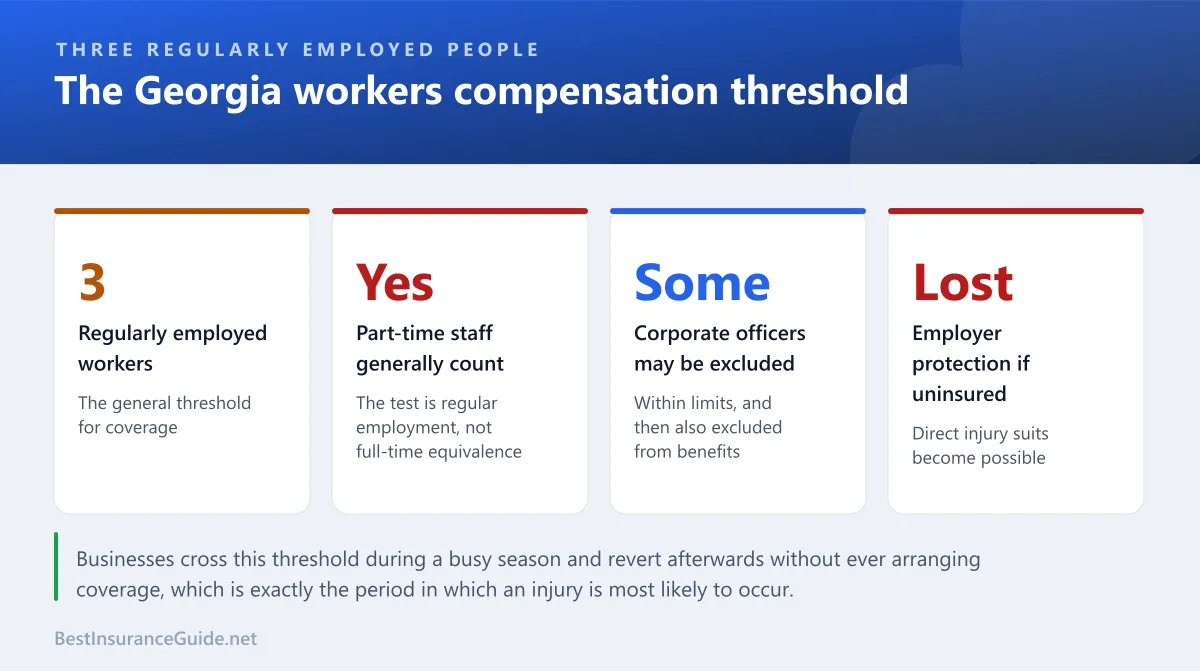
Four points that matter in practice.
Part-time employees generally count. The test is regular employment rather than full-time equivalence, so a business with two full-time and one part-time worker is frequently over the threshold.
Certain corporate officers may be excluded from the count within limits, and where they are excluded they are also excluded from benefits.
Crossing the threshold is not announced. A business hires a third person and the obligation attaches, with no notification and no grace period.
Going without removes the employer’s protection. Workers compensation is a trade: employees receive benefits without proving fault, and employers receive protection from direct injury suits. An uninsured employer loses the second half.
Subcontractors matter here too. An uninsured subcontractor’s injured worker can become the responsibility of the business that engaged them, which is why certificates of insurance from every subcontractor, collected before work starts, are the single most useful administrative habit in this area.
The two property markets
Georgia’s property side splits geographically in a way that changes both cost and availability.
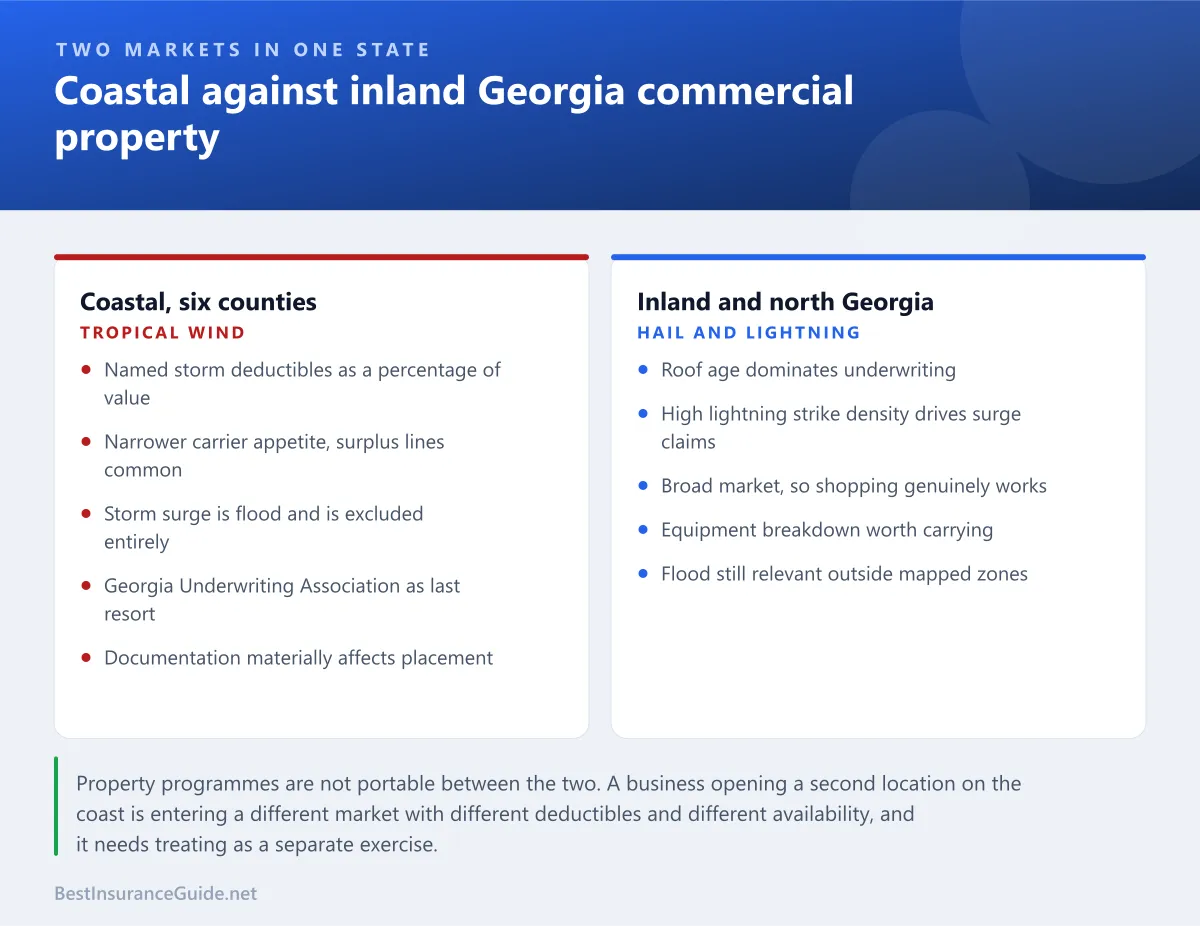
Coastal Georgia, meaning the six counties along the Atlantic, is rated for tropical wind. Named storm deductibles expressed as percentages of insured value are standard, carrier appetite is narrower, and the Georgia Underwriting Association operates as a market of last resort. Storm surge is flood and is excluded from the property policy entirely.
Inland and north Georgia is rated for severe convective storms. Hail drives roof-focused underwriting, and Georgia’s unusually high lightning strike density produces frequent surge and fire claims. The market is broad and shopping works.
Two consequences for a business.
Property programmes are not portable between the two. A business opening a second location on the coast is entering a different market with different deductibles and different availability.
Business income cover matters in both, for different reasons. On the coast it is regional event exposure; inland it is fire and storm damage to a single location.
Lightning, which is a business problem too
Georgia’s lightning exposure is the risk that appears in claims files and never in marketing, and for a business it is more consequential than for a household.
Surge damage to electronics, servers, point-of-sale systems and HVAC control boards. Individually modest, collectively substantial in a commercial building.
Direct strike fire, the severe case.
Equipment breakdown, which sits at the boundary between covered lightning damage and excluded mechanical failure and is worth carrying as a specific coverage.
Business interruption from a systems failure, which is where the real cost frequently sits.
Two practical measures. Whole-building surge protection at the panel, which is inexpensive relative to the equipment behind it. And equipment breakdown coverage, which is a cheap endorsement closing exactly the argument an insurer would otherwise raise.
What the contracts require
The liability side of a Georgia programme is contract-driven rather than statutory.
Commercial landlords require $1,000,000 per occurrence with additional insured status, near universally.
General contractors require the same plus umbrella limits, completed operations coverage, waivers of subrogation and primary and non-contributory wording.
Municipalities and public authorities publish their own schedules and check certificates properly.
Larger clients increasingly require cyber liability, and professional liability where any advice is given.
Franchisors set requirements in the franchise agreement, frequently including specific limits and named parties.
The instruction is the same everywhere and worth repeating: read the insurance clause before signing. A certificate of insurance summarises coverage and proves nothing; the policy and its endorsements are the substance.
Building the programme
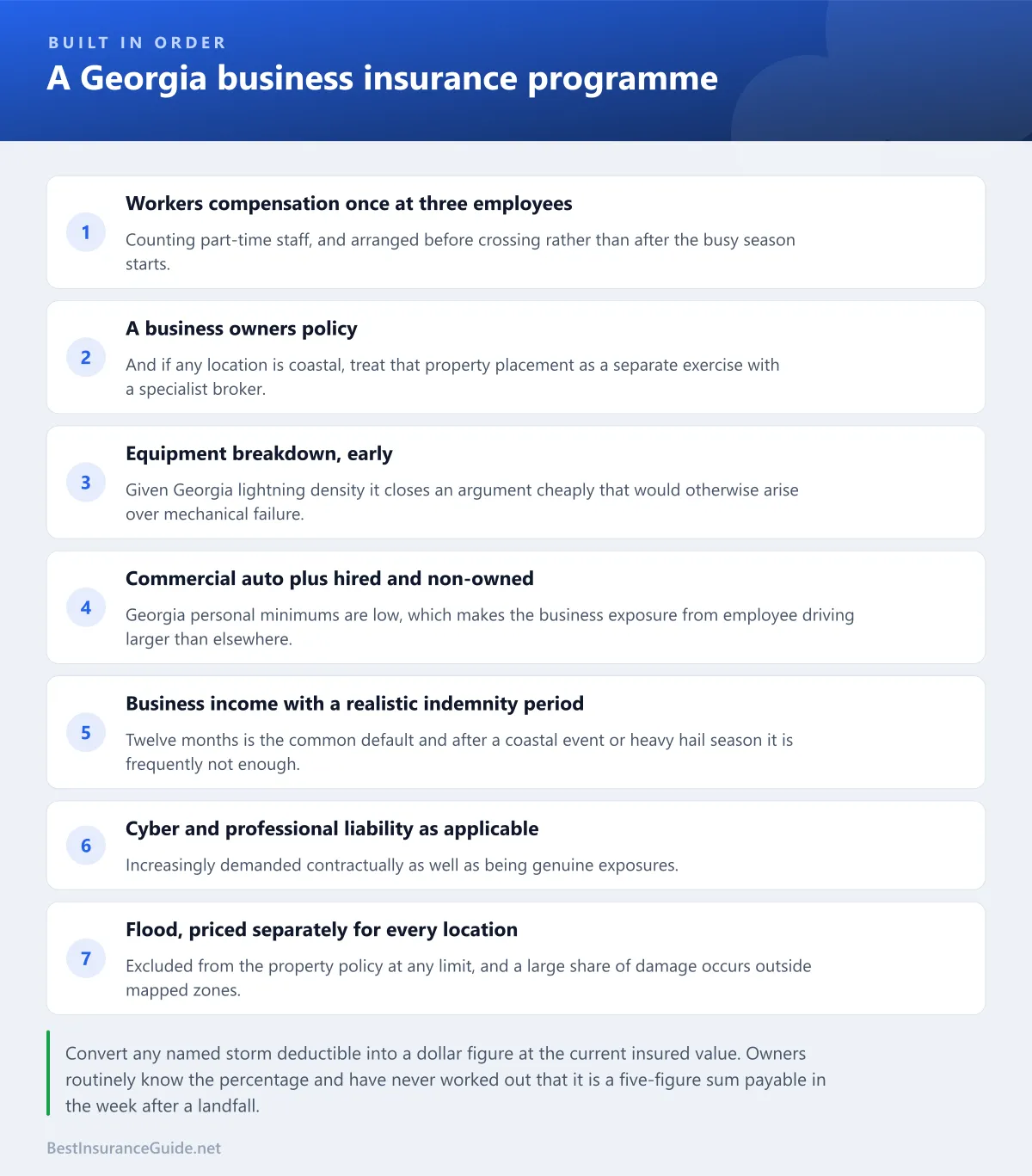
Workers compensation, once the threshold is met, arranged before the hire that crosses it.
A business owners policy, packaging general liability, commercial property and business income.
Commercial auto, plus hired and non-owned auto for employees driving their own vehicles on company business. Note that Georgia’s own liability minimums are low, as our guide to the cheapest car insurance in Georgia sets out, which makes the business exposure larger.
Business income and extra expense, with a realistic indemnity period.
Equipment breakdown, given the lightning exposure.
Inland marine, for tools and equipment away from premises.
Cyber liability, for anybody taking payments or holding data.
Professional liability, where advice is provided.
Employment practices liability, once there are employees.
A commercial umbrella, sized against the highest contract requirement.
Flood, separately, for any location with meaningful exposure, which includes a great many inland properties outside mapped zones.
Managing the cost
Get the workers compensation classifications right, since misclassified payroll produces both premium and audit problems.
Manage the experience modification factor, which multiplies workers compensation premium directly and improves over several years of good loss performance.
Address roof age proactively on owned property, since it dominates property underwriting in a hail state.
Document mitigation and maintenance, which affects both availability and price.
Collect subcontractor certificates without exception.
Review limits against contracts annually, since requirements ratchet upward and businesses discover non-compliance at renewal.
Use a broker with Georgia coastal experience if any location is on the coast, because that market requires knowing who is writing what this quarter.
The short version
Georgia requires workers compensation once a business regularly employs three or more people, counting part-time staff, and crossing that threshold is not announced. Going without removes the employer’s protection against direct injury suits, which is a larger consequence than the penalty.
The property side splits at the coast. The six coastal counties are a tropical wind market with percentage named storm deductibles and narrower availability; inland Georgia is a hail and lightning market with a broad market and roof-focused underwriting.
Lightning deserves specific attention for a business, because surge damage to systems and the interruption that follows is a frequent claim here, and equipment breakdown cover closes the argument cheaply.
Everything on the liability side comes from contracts, which makes your signed agreements the effective requirements list.
For the excess layer, see business umbrella insurance, and for the programme generally, the business insurance checklist.
The Georgia Underwriting Association, and the coastal market
For any business with a coastal Georgia location, the property placement is a different exercise from the inland one and it is worth knowing the structure.
The voluntary market writes what it wants to write. Carrier appetite in the six coastal counties changes, and a risk that was straightforward to place last year may not be this year.
Surplus lines carriers fill much of the gap, writing risks the standard market declines, at higher cost and on their own forms. This is normal in coastal property and is not a sign that anything is wrong.
The Georgia Underwriting Association operates as the residual market, providing basic property cover to risks that cannot be placed otherwise. Coverage is narrower and it should be a fallback rather than a first call.
Four things improve a coastal placement.
Roof documentation, including age, material and any recent replacement, with invoices.
Wind mitigation features, documented: opening protection, roof-to-wall connections and code compliance.
Loss history presented properly, with context on any prior claims and what was done afterwards.
A broker with coastal Georgia experience, because knowing who is writing this quarter is most of the value.
Worked example: two identical buildings
Two coastal restaurants, same construction, same insured value.
| Detail | Documented | Undocumented |
|---|---|---|
| Roof age evidence | Invoice, four years old | Unknown |
| Wind mitigation features | Documented and inspected | Present but unevidenced |
| Loss history narrative | Explained with remediation | Bare loss runs |
| Market access | Several standard carriers | Surplus lines only |
| Outcome | Competitive terms | Higher cost, narrower cover |
The buildings were the same. The submission was not.
Two things to do this year
Count your employees properly, including part-time and seasonal staff, against the three-person threshold. Businesses cross it during a busy season and revert afterwards without ever arranging coverage, which is exactly the period in which an injury is most likely.
Convert any named storm deductible into a dollar figure at the current insured value, if you have a coastal location. Business owners routinely know the percentage and have never worked out what it means, and it is frequently a five-figure number payable in the week after a landfall.
What to ask a broker
Am I over the workers compensation threshold on the current headcount?
Does my general liability include products and completed operations?
What is my named storm deductible in dollars, and what triggers it?
Do I carry equipment breakdown, given the lightning exposure?
Is my business income indemnity period realistic for a regional event?
Do I have flood cover, and what would it cost outside a mapped zone?
What drives the cost in Georgia
Industry classification first, with the usual spread between professional services and the trades.
Location, and specifically whether any property is in one of the six coastal counties, which changes the property market entirely.
Roof age and condition, which dominates property underwriting across the state given the hail exposure.
Payroll and revenue, driving workers compensation and general liability.
Loss history, including the workers compensation experience modification factor.
Lightning protection and equipment breakdown cover, which given Georgia’s strike density affects both the claims experience and what a carrier is willing to write.
Fleet safety measures, where vehicles are involved, since commercial auto severity is where a small business is most exposed.
The order to build it in
Count the employees against the three-person threshold and arrange workers compensation before crossing it.
A business owners policy next, and if any location is coastal, treat the property placement as a separate exercise with a broker who knows that market.
Equipment breakdown early, given the lightning exposure, since it is cheap and it closes an argument that would otherwise arise.
Commercial auto and hired and non-owned, noting Georgia’s low personal minimums make the business exposure larger.
Then the contract requirements, then the umbrella above them.
And flood separately, priced even for inland locations outside mapped zones.
Two more things worth knowing
Business income cover deserves a realistic indemnity period. Twelve months is the common default, and after a coastal event or a widespread hail season, regional reconstruction capacity is exhausted for considerably longer than that.
Certificates from subcontractors need to cover the period worked, not just the date they were issued. A certificate obtained in January for a subcontractor who worked in September proves nothing about September, and at a workers compensation audit that gap becomes your payroll.
How other states set the threshold
Georgia’s three-employee threshold is shared with North Carolina, which applies the same count in a much faster-growing market.
At the stricter end, Pennsylvania, New Jersey and Illinois all attach from the first employee. Florida is the closest comparison on the property side, sharing the coastal wind and flood split.
A note on scope
Nothing here is legal advice. Georgia workers compensation thresholds, officer exclusions, exemptions and enforcement practice are set by state law and regulation and change over time, and the rules include qualifications not covered here.
The Georgia State Board of Workers’ Compensation publishes the authoritative coverage requirements, the Georgia Office of Commissioner of Insurance and Safety Fire publishes commercial guidance, and FEMA publishes flood zone determinations. Your contracts and policy documents are the authoritative statement of what you must hold and what you hold. This site is independent and not affiliated with any insurer.