What Is Towing Insurance? Two Very Different Things Share the Name
Towing and labour coverage on a car policy, what it pays and what it excludes, plus what towing insurance means for a tow truck business.

Table of contents
Two completely different products share this name, and searching for one usually returns the other. It is worth separating them at the start.
On a personal auto policy, towing insurance means towing and labour coverage, a small add-on costing a few dollars a year.
In a commercial context, towing insurance means the package a tow truck business needs, which is a substantial commercial programme.
This article covers both, starting with the one most people are looking for.
Towing and labour coverage on a car policy
An inexpensive endorsement, commonly a few dollars per vehicle per six-month term, that pays for two things.
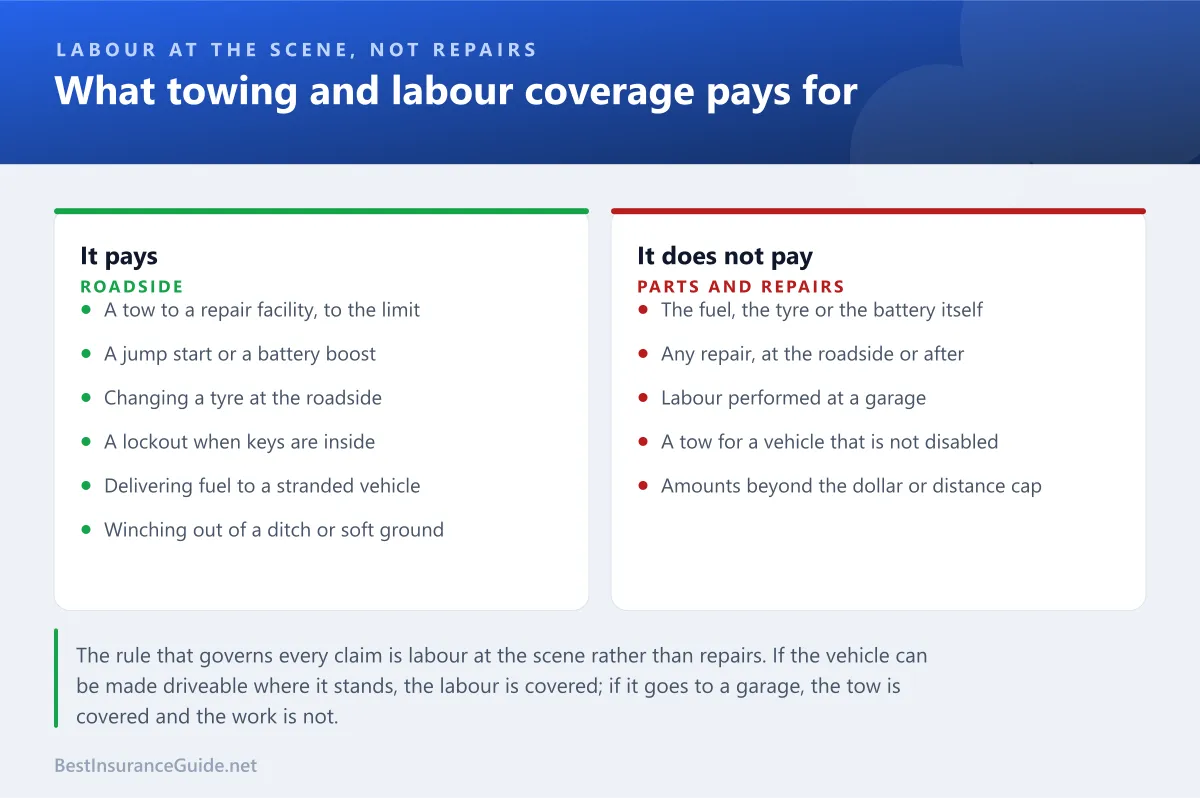
Towing a disabled vehicle to a repair facility, up to a stated limit which may be a dollar amount or a distance.
Labour performed at the roadside, including a jump start, a tyre change, a lockout, fuel delivery and winching out of a ditch.
The distinction that governs every claim is labour at the scene, not repairs. If the vehicle can be made driveable at the roadside, the labour is covered. If it goes to a garage, the tow is covered and the repair is not.
What it does not pay for
Parts and fluids. Fuel delivery covers the call-out and not the fuel. A tyre change covers the labour and not the tyre.
Repairs, at the roadside or afterwards.
Labour at a repair facility, which is a repair rather than roadside assistance.
A tow for convenience, meaning a vehicle that is not disabled.
Amounts above the limit. Where the coverage is capped in dollars, a long tow can exceed it. Where it is capped in distance, a tow to a facility further away leaves a balance.
Vehicles not listed on the policy, in most wordings.
Is it worth carrying
For most drivers, yes, on straightforward arithmetic.
Worked example: the cost against a single tow
| Amount | |
|---|---|
| Typical annual cost of the coverage | $12 to $30 per vehicle |
| Typical cost of one local tow | $100 to $250 |
| Typical cost of a longer tow | $300 and upward |
| Years of coverage funded by one tow | Several |
Three situations where it is worth less.
You already have equivalent cover. A motoring club membership, a credit card benefit, or a manufacturer roadside programme on a newer vehicle. Paying for the same thing twice is common, and worth checking before adding it.
Your vehicle is under warranty with a manufacturer roadside programme included, which is frequently more generous than the insurance endorsement.
You never drive further than a short distance from home and have a straightforward alternative.
One caution on claim frequency. A roadside claim is treated far more gently than an at-fault collision, but repeated roadside claims in a short period do draw attention with some insurers. Occasional use is what it is for; using it monthly as a substitute for maintenance is not.
Where it matters most
Long distances between services, which is why it is worth more in rural and mountain states than in a dense metro.
Older vehicles, for obvious reasons.
Single-vehicle households, where being stranded has no fallback.
Winter climates, where a battery failure or a slide into a verge is a seasonal event rather than an unusual one.
Households with new drivers, who lock keys in cars and run out of fuel more often than experienced ones.
The other meaning: insurance for a towing business
If you operate tow trucks, the word means something else entirely, and the package has four parts that are frequently confused.
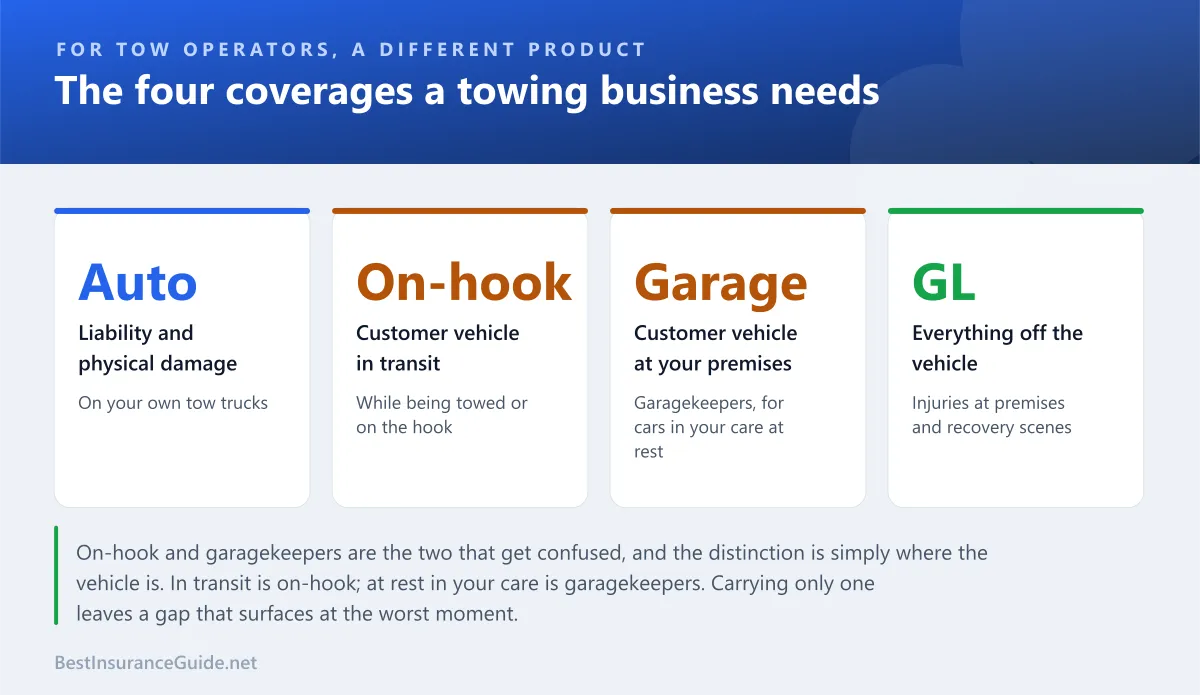
Commercial auto liability and physical damage, on the tow trucks themselves. What you do to other people, and damage to your own vehicles.
On-hook coverage, insuring the customer’s vehicle while it is being towed or is on the hook. This is not part of the auto policy and not part of garagekeepers. It is the coverage that answers a vehicle damaged in transit.
Garagekeepers coverage, insuring customers’ vehicles in your care, custody or control at your premises. A vehicle in your yard overnight is a garagekeepers exposure, not an on-hook one.
General liability, for everything else: injuries at your premises, damage at a recovery site, contractual exposures.
Add workers compensation wherever there are employees, which in most states is mandatory.
The two that get confused are on-hook and garagekeepers, and the distinction is simply where the vehicle is. In transit is on-hook. At rest in your care is garagekeepers. An operator carrying only one of them has a gap that will surface at the worst possible moment.
Worked example: two claims, two coverages
| Situation | Answered by |
|---|---|
| Customer vehicle damaged while on the hook | On-hook coverage |
| Customer vehicle damaged in your yard overnight | Garagekeepers |
| Your tow truck damaged in a collision | Commercial auto physical damage |
| Injury to another driver in that collision | Commercial auto liability |
| Injury to a bystander at a recovery scene | General liability |
| Injury to your own employee | Workers compensation |
Six situations, five different coverages, and no single policy answers more than one of them. Our guide to commercial auto insurance costs covers how the auto lines are priced.
Buying either one properly
On a personal policy, check three things: whether you already have equivalent cover elsewhere, whether the limit is stated in dollars or distance, and whether it applies to every vehicle on the policy or only some.
On a commercial policy, check that on-hook and garagekeepers are both present, that the limits reflect the value of vehicles you actually handle, and that the garagekeepers form is on a direct primary basis if your customers expect their vehicles covered regardless of your fault. That last distinction is significant and is frequently sold at the cheaper legal liability basis without explanation.
The short version
On a personal auto policy, towing insurance means towing and labour coverage: a few dollars a year that pays for a tow and for roadside labour, not for parts or repairs. For most drivers it pays for itself with a single call, unless you already have the same cover through a motoring club, a card benefit or a manufacturer programme.
For a towing business it means something else entirely: commercial auto, on-hook cover for vehicles in transit, garagekeepers cover for vehicles at rest in your care, general liability and workers compensation. Confusing on-hook and garagekeepers is the most common gap in that market.
For the commercial side more broadly, see commercial auto insurance costs, and for the personal add-on list, auto insurance discounts.
Checking what you already have
Before adding towing and labour coverage, it is worth establishing whether you are already covered, because duplication here is extremely common.
A motoring club membership typically includes several call-outs a year with a mileage allowance, and it follows the member rather than the vehicle, which is broader than the insurance endorsement.
A manufacturer roadside programme comes with most new vehicles and frequently runs for several years. It is usually generous and usually forgotten.
A credit card benefit, on some cards, which may cover the call-out or offer a discounted service.
A breakdown service bundled with a mobile phone plan or a bank account, which is more common than people realise.
If two or three of those apply, the insurance endorsement is redundant. If none do, it is one of the better value few dollars on the policy.
Worked example: which one to use
A vehicle will not start on a weekday morning, twelve miles from home.
| Insurance towing cover | Motoring club | |
|---|---|---|
| Covers the call-out | Yes, to the limit | Yes |
| Follows the vehicle or the person | The vehicle | The person |
| Counts as an insurance claim | Yes, a minor one | No |
| Effect on renewal | Minimal, unless frequent | None |
| Annual cost | $12 to $30 per vehicle | Higher, covers all vehicles |
For a single-vehicle household the insurance endorsement is usually cheaper. For a multi-vehicle household, or where somebody drives other people’s cars, the club membership frequently wins.
For tow operators: the garagekeepers detail
One distinction inside garagekeepers cover is worth understanding, because it is sold both ways and the cheaper version is materially narrower.
Legal liability basis pays for damage to a customer vehicle only where you were legally liable for it. If a storm damages a vehicle in your yard and you were not negligent, this form pays nothing and the customer looks to their own insurer.
Direct primary basis pays for damage to a customer vehicle regardless of fault, up to the limit. More expensive, and it is what most customers assume they are getting when they leave a car with you.
Which you need depends on the promises you make to customers and on what your contracts say. Buying the cheaper form while telling customers their vehicle is covered is a reputational problem waiting to happen.
Using the coverage well
Three habits make the difference between the endorsement being useful and being a source of friction.
Call the number on your policy rather than the first tow service you find. Insurers have arrangements with providers, and using them means the bill is settled directly rather than reimbursed. Where you do arrange your own tow, keep the receipt and expect reimbursement up to the limit rather than payment in full.
Know the limit before you need it. A tow capped at a distance rather than a dollar figure behaves very differently when the nearest suitable garage is further away than the cap.
Do not use it as a substitute for maintenance. Repeated roadside claims for the same recurring fault draw attention at renewal, and the underlying problem is cheaper to fix than to keep calling out.
Which coverage answers which situation
| Situation | Answered by |
|---|---|
| Flat battery on a driveway | Towing and labour, or a club membership |
| Tyre change at the roadside | Towing and labour, labour only |
| Tow to a garage after a breakdown | Towing and labour, to the limit |
| Tow after a collision | Usually the collision or comprehensive claim |
| Out of fuel | Towing and labour, delivery only |
| Locked out with keys inside | Towing and labour, labour only |
The fourth row is worth noting. A tow following a covered accident is generally handled as part of that claim rather than under the towing endorsement, which means it is not a separate claim and the endorsement limit does not apply to it.
Two things to check on your policy
Whether towing and labour coverage is present at all, and on which vehicles. It is frequently added to one vehicle and not the others on a multi-car policy.
Whether the limit is stated in dollars or in distance, because the two behave very differently. A dollar cap in an area with expensive tows runs out; a distance cap in a rural area with the nearest garage forty miles away runs out.
Neither requires shopping anything and both take five minutes on the declarations page.
Related reading
Zero down car insurance covers the other small print that determines what a cheap-looking policy actually includes. Does car insurance cover repairs covers what happens after the tow, and specifically the line between damage a policy pays for and mechanical failure it does not.
A note on scope
Coverage limits, exclusions and the exact scope of towing, on-hook and garagekeepers forms vary between insurers and between states, and change over time. Figures here are illustrative rather than quotes.
Your own declarations page states whether towing and labour coverage is present and at what limit, and your policy wording is the authoritative statement of what it pays for. Commercial towing operators should confirm requirements with their state authority. This site is independent and not affiliated with any insurer.