What Is a Deductible for Health Insurance? The Number Before the Sharing Starts
How a health insurance deductible works, what counts toward it, what does not, how it interacts with copays and coinsurance, and how to choose one.

Table of contents

A deductible is a simple idea attached to four complications, and the complications are where the money is.
The definition
A deductible is the amount you pay for covered care in a plan year before your plan begins sharing costs.
On a $2,000 deductible, you pay the first $2,000 of covered services yourself. After that, cost sharing begins: you pay coinsurance, typically 20% or 30%, and the plan pays the rest, until you reach the out-of-pocket maximum, after which the plan pays everything.
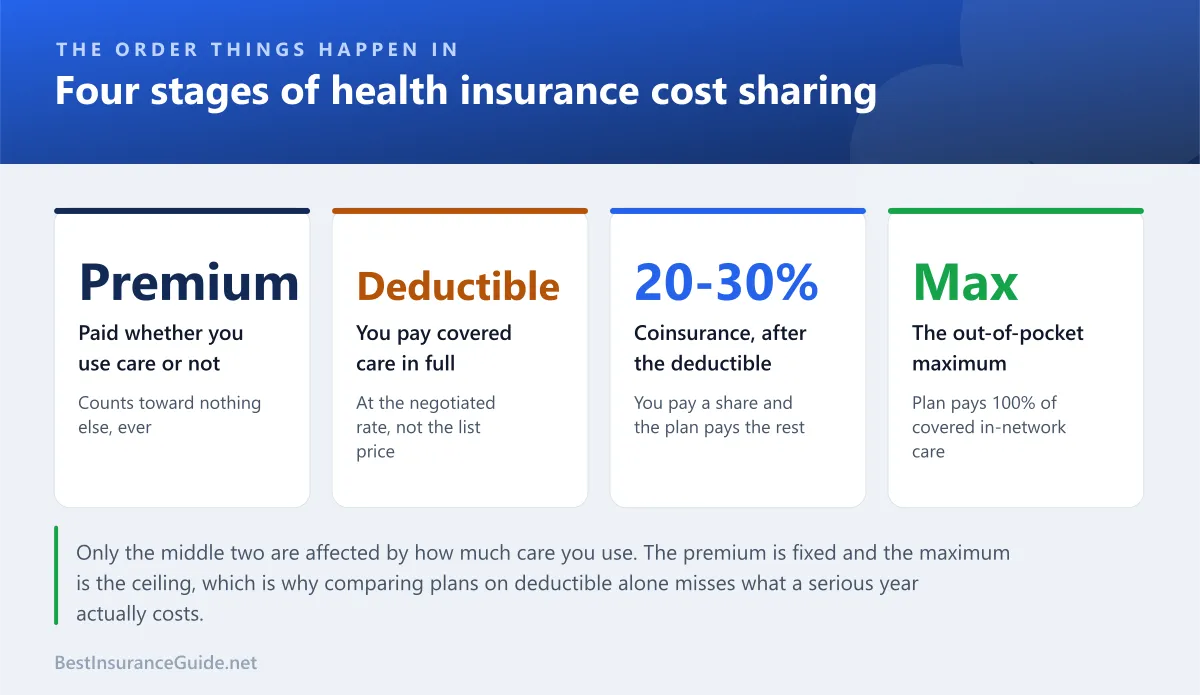
The sequence, in order:
The premium, paid monthly whether you use care or not, and never counted toward anything else.
The deductible, paid by you for covered services until it is met.
Coinsurance, a percentage split between you and the plan.
The out-of-pocket maximum, the ceiling, after which the plan pays 100% of covered in-network care.
What counts, and what does not
This is where most misunderstandings live.
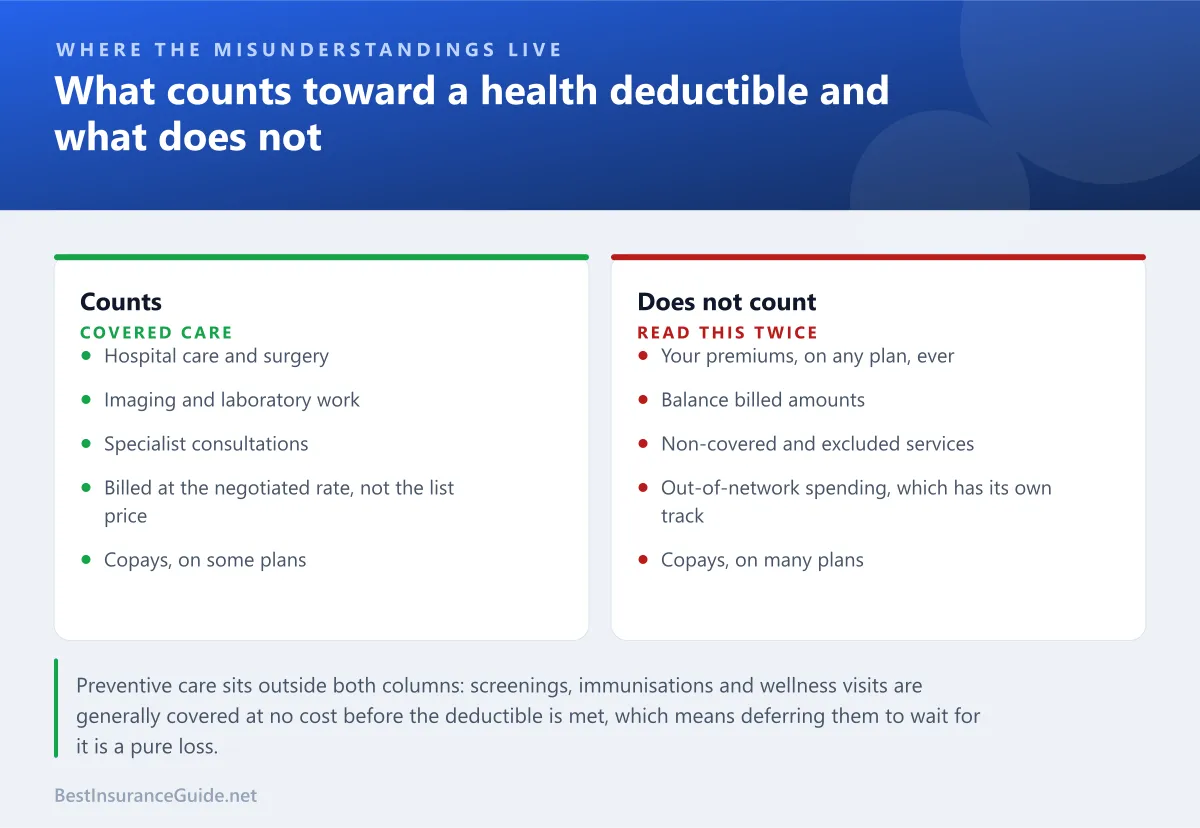
Counts: covered services billed at the plan’s negotiated rate, including hospital care, surgery, imaging, laboratory work and specialist visits.
Never counts: your premiums. This is the most common misunderstanding and the answer is absolute. A premium buys the coverage; it is not spending on care.
Generally does not need to be met first: preventive care. Screenings, immunisations and annual wellness visits are typically covered at no cost before the deductible under federal requirements.
Depends on the plan: copays. Some plans count copays toward the deductible and many do not, and it is stated in the summary of benefits.
Sits on a separate track: out-of-network spending, which usually has its own higher deductible. Our guide to what out of network means sets out how that two-track structure works.
Does not count at all: balance-billed amounts, non-covered services, and anything the plan excludes.
The negotiated rate, which works in your favour
A point that surprises people and is genuinely good news.
You pay the plan’s negotiated rate, not the provider’s list price, even while you are below the deductible.
A service listed at $900 with a negotiated rate of $340 costs you $340, and $340 is what counts toward your deductible. You are getting the benefit of the insurer’s contract from the first day of the year.
That is why using in-network care matters just as much before the deductible is met as after it, which is not intuitive and is worth internalising.
Worked example: a year with a $2,000 deductible
Coinsurance 20%, out-of-pocket maximum $6,000.
| Service | Negotiated cost | You pay | Deductible remaining |
|---|---|---|---|
| Annual wellness visit | $220 | $0, preventive | $2,000 |
| Blood tests | $310 | $310 | $1,690 |
| Specialist consultation | $290 | $290 | $1,400 |
| Imaging | $1,400 | $1,400 | $0, met |
| Minor procedure | $3,600 | $720, coinsurance | Met |
| Follow-up visits | $480 | $96, coinsurance | Met |
| Total paid | $2,816 |
Two things to notice. The preventive visit cost nothing and did not need the deductible met. And once the deductible was met, the $3,600 procedure cost $720 rather than $3,600.
Individual and family deductibles
Most family plans run two figures at once.
An individual deductible for each covered person.
A family deductible, larger, which the household’s combined spending counts toward.
Two structures exist and the difference matters.
Embedded. Each person has an individual deductible. Once one person meets theirs, the plan starts sharing costs for that person, even if the family deductible is not met. This is the more common and more favourable structure.
Aggregate. The whole family deductible must be met before the plan shares costs for anyone. More common on some high-deductible plans, and much harsher when one family member has a large claim.
Check which you have, because it changes what a single serious illness costs the household.
Choosing a deductible
The trade is simple and the right answer is personal.
A lower deductible means a higher premium and less exposure when you need care.
A higher deductible means a lower premium and more exposure.
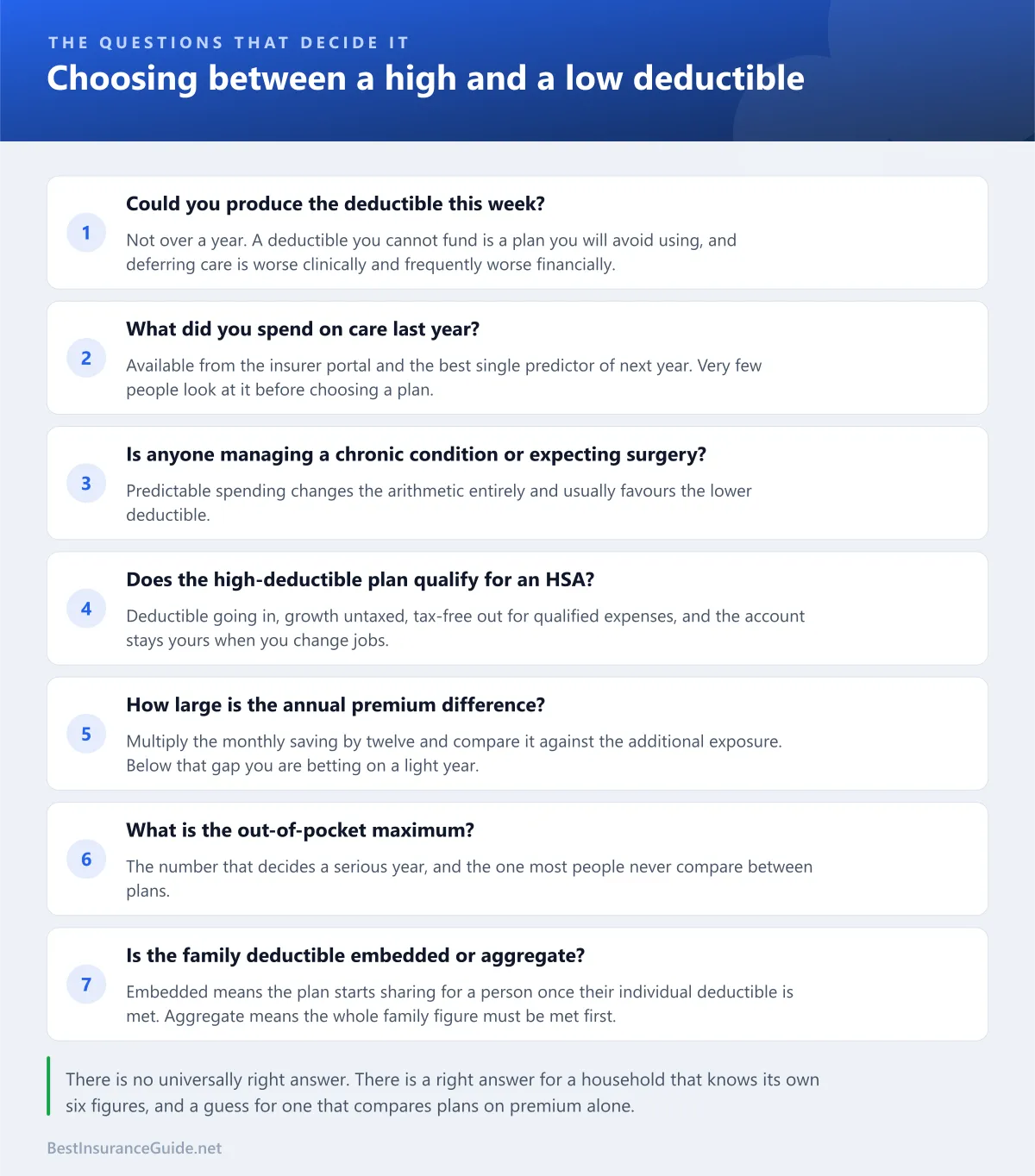
The questions that actually decide it:
Could you produce the deductible at short notice? Not over a year; this week. A deductible you cannot fund is a plan you cannot use, and people with unaffordable deductibles delay care, which is worse clinically and frequently worse financially.
What did you spend on care last year? The best available predictor of next year.
Is anyone in the household managing a chronic condition, pregnant, or expecting surgery? Predictable spending changes the arithmetic entirely.
Does the high-deductible plan qualify for a health savings account? That is a genuine advantage: contributions are tax-advantaged, unused funds roll over, and the account is yours if you change jobs.
How large is the premium difference, annually? Multiply the monthly saving by twelve and compare it against the additional deductible exposure. If the annual premium saving is $900 and the deductible is $2,500 higher, you are betting on a light year.
What is the out-of-pocket maximum? This matters more than the deductible in a bad year, because it is the actual ceiling.
The plan year reset
Deductibles reset at the start of the plan year, which is not always January.
Two practical consequences.
Timing elective care. If your deductible is met in October, completing planned care before the reset costs considerably less than doing it in January.
Carryover provisions. Some plans count spending in the last months of a year toward the next year’s deductible. It is not universal and it is worth knowing whether yours does.
The short version
A deductible is what you pay for covered care before the plan starts sharing costs. Premiums never count toward it, preventive care generally does not require it to be met, and out-of-network spending sits on a separate and higher track.
You pay the plan’s negotiated rate rather than the list price even before the deductible is met, which is why staying in network matters from the first day of the year.
On a family plan, check whether the structure is embedded or aggregate, because that determines what one person’s serious illness costs the household.
And choose the level by what you could actually produce at short notice, not by the premium saving alone. A deductible you cannot fund is a plan you will avoid using.
For what changes once you reach it, see what happens when you meet your deductible, and for the ceiling, deductible versus out-of-pocket maximum.
Reading your own plan in five minutes
Everything above is general. Your own numbers are on one document and finding them takes five minutes.
Open the summary of benefits and coverage. Every plan must provide one in a standardised format, which makes comparing plans considerably easier than comparing brochures.
Find six figures.
The individual deductible and the family deductible.
Whether the family deductible is embedded or aggregate.
The coinsurance percentage after the deductible.
The individual and family out-of-pocket maximums.
Whether copays count toward the deductible.
Whether prescription drugs run through the medical deductible, a separate one, or neither. Our guide to whether prescriptions count towards the deductible sets out the three structures.
Write those six down. They answer almost every question anybody asks about their own plan, and very few people can state them.
The high-deductible plan question, honestly
High-deductible health plans attract strong opinions in both directions and the sensible position is conditional.
They work well for a household that can comfortably fund the deductible, uses relatively little routine care, and will actually contribute to a health savings account and leave it invested. The tax treatment on an HSA is unusually good: deductible going in, growth untaxed, and tax-free coming out for qualified expenses.
They work badly for a household that cannot produce the deductible at short notice, or that has predictable ongoing costs. The failure mode is not financial in the first instance; it is people deferring care because of the cost, which frequently produces a worse and more expensive outcome later.
The question to ask is not whether high-deductible plans are good. It is whether you would actually use the plan when you needed to, and whether the premium saving would genuinely be banked rather than spent.
Comparing plans properly
Two plans are only comparable once six figures line up, and premium is not one of the six that decides a bad year.
The premium, annualised, which is certain spending.
The deductible, individual and family.
The coinsurance percentage, which decides what the middle of a bad year costs.
The out-of-pocket maximum, individual and family, which is the ceiling and matters most when things go wrong.
The network, and whether your existing providers are in it.
The formulary position of every medication you take, which for anybody on regular prescriptions can outweigh every other line.
Worked example: two plans, two years
| Plan A, low deductible | Plan B, high deductible | |
|---|---|---|
| Annual premium | $6,600 | $3,900 |
| Deductible | $750 | $3,200 |
| Out-of-pocket maximum | $8,400 | $6,000 |
| Cost in a healthy year | $6,600 | $3,900 |
| Cost in a serious year | $15,000 | $9,900 |
Plan B is cheaper in both columns here, which is the opposite of the intuition that a low deductible means better protection. It is not a general result, and it is the reason the comparison has to be done with your own numbers rather than by reputation.
Two things worth doing this year
Write down your six figures from the summary of benefits, and keep them somewhere you can find them.
Check what you actually spent on care last year, from the insurer portal. That figure is the best available predictor of next year and it is the input most people never look at before choosing a plan.
The vocabulary in one place
Five words do all the work in a health plan and they are frequently used loosely.
Premium. What you pay monthly to hold the coverage. Never counts toward anything else.
Deductible. What you pay for covered care before the plan starts sharing.
Copay. A fixed amount for a specific service, such as $30 for an office visit. May or may not count toward the deductible; usually counts toward the out-of-pocket maximum.
Coinsurance. A percentage split after the deductible, such as you paying 20% and the plan 80%.
Out-of-pocket maximum. The ceiling on your spending for covered in-network care in the plan year.
Every plan document uses those five terms and the differences between plans are almost entirely differences in these numbers. Our guide to health insurance terms covers the wider vocabulary.
Two things people get wrong most often
Believing premiums count toward the deductible. They never do, on any plan, anywhere. A premium buys the coverage; the deductible measures spending on care under it. This single misunderstanding produces more confused calls to insurers than any other.
Choosing a plan on deductible alone. The deductible describes the start of a bad year and the out-of-pocket maximum describes the end of one. In a year with a serious event, the second number determines what you actually pay, and a low deductible attached to a high maximum can cost more than the reverse.
A note on scope
Nothing here is medical, tax or legal advice. Plan designs, what counts toward a deductible, preventive care requirements, family deductible structures and health savings account rules vary between plans and change over time, and the figures used are illustrative.
Your plan’s summary of benefits and coverage is the authoritative statement of your deductible, what counts toward it and how family deductibles are structured. HealthCare.gov publishes general consumer guidance. This site is independent and not affiliated with any insurer.