What Happens When You Meet Your Deductible? Less Than You Hope
What changes once your health insurance deductible is met, what coinsurance costs, when the plan pays everything, and how to use the rest of the year well.

Table of contents

The moment your deductible is met feels like a finish line and it is a gear change. Understanding exactly what changes prevents both disappointment and a missed opportunity.
What actually changes
Cost sharing begins. That is the whole of it.
Before: you pay the full negotiated cost of covered services.
After: you pay coinsurance, commonly 20% or 30%, and the plan pays the remainder.
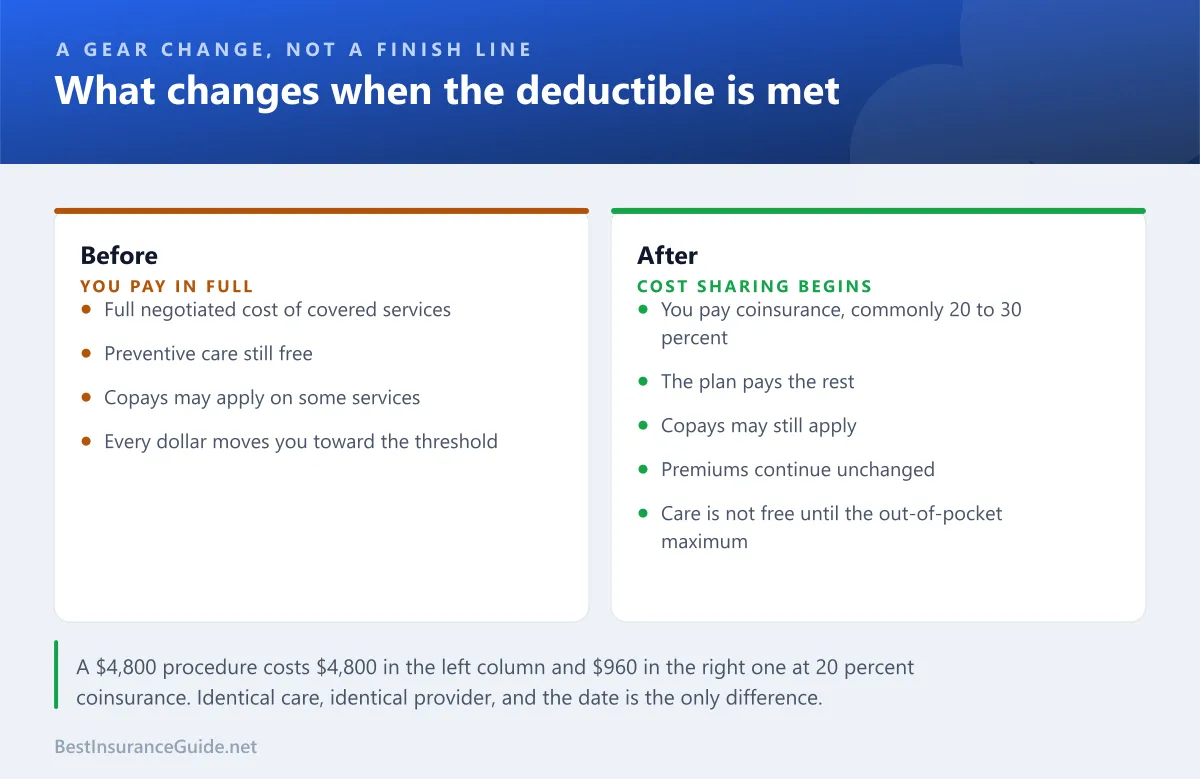
Worked example: the same procedure, two moments
A procedure with a negotiated cost of $4,800, on a plan with 20% coinsurance.
| Deductible not met | Deductible met | |
|---|---|---|
| Negotiated cost | $4,800 | $4,800 |
| You pay | $4,800, applied to deductible | $960, coinsurance |
| Plan pays | $0 | $3,840 |
Identical care, identical provider, identical plan. The date is the only difference.
What does not change
Four things frequently surprise people.
Care does not become free. That happens at the out-of-pocket maximum, which is a separate and higher figure. Meeting the deductible is the first of two milestones, not the last.
Copays may still apply. Copays and coinsurance are separate mechanisms. Many plans charge a fixed copay for office visits and prescriptions regardless of deductible status, and on some plans those copays do not count toward the deductible either.
Premiums continue. Obvious when stated and frequently forgotten in the moment.
Out-of-network care is unaffected. The out-of-network deductible is a separate track and meeting the in-network one does nothing for it.
Exclusions remain exclusions. A service the plan does not cover is not covered at any point in the year.
The two milestones
The structure has two thresholds and understanding both is what makes a plan predictable.
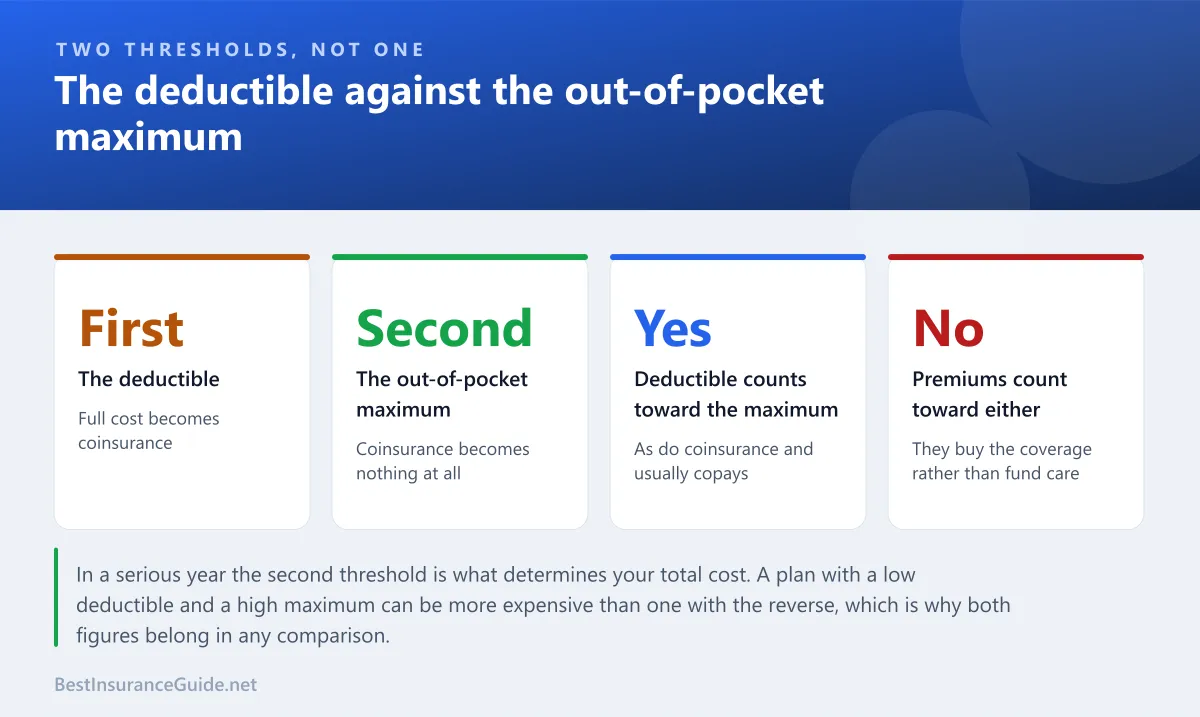
The deductible. You stop paying full cost and start paying coinsurance.
The out-of-pocket maximum. You stop paying anything for covered in-network care for the rest of the plan year.
The deductible counts toward the maximum, as do coinsurance and, on most plans, copays. Premiums do not.
In a serious year the second number matters far more than the first, which is why comparing plans on deductible alone is a mistake. A plan with a low deductible and a high out-of-pocket maximum can cost more in a bad year than one with the reverse.
Using the rest of the year well
This is the practical opportunity and most people miss it.
Once the deductible is met, everything covered costs a fraction of what it did. If your plan year runs to December and you met the deductible in June, you have six months of substantially cheaper care.
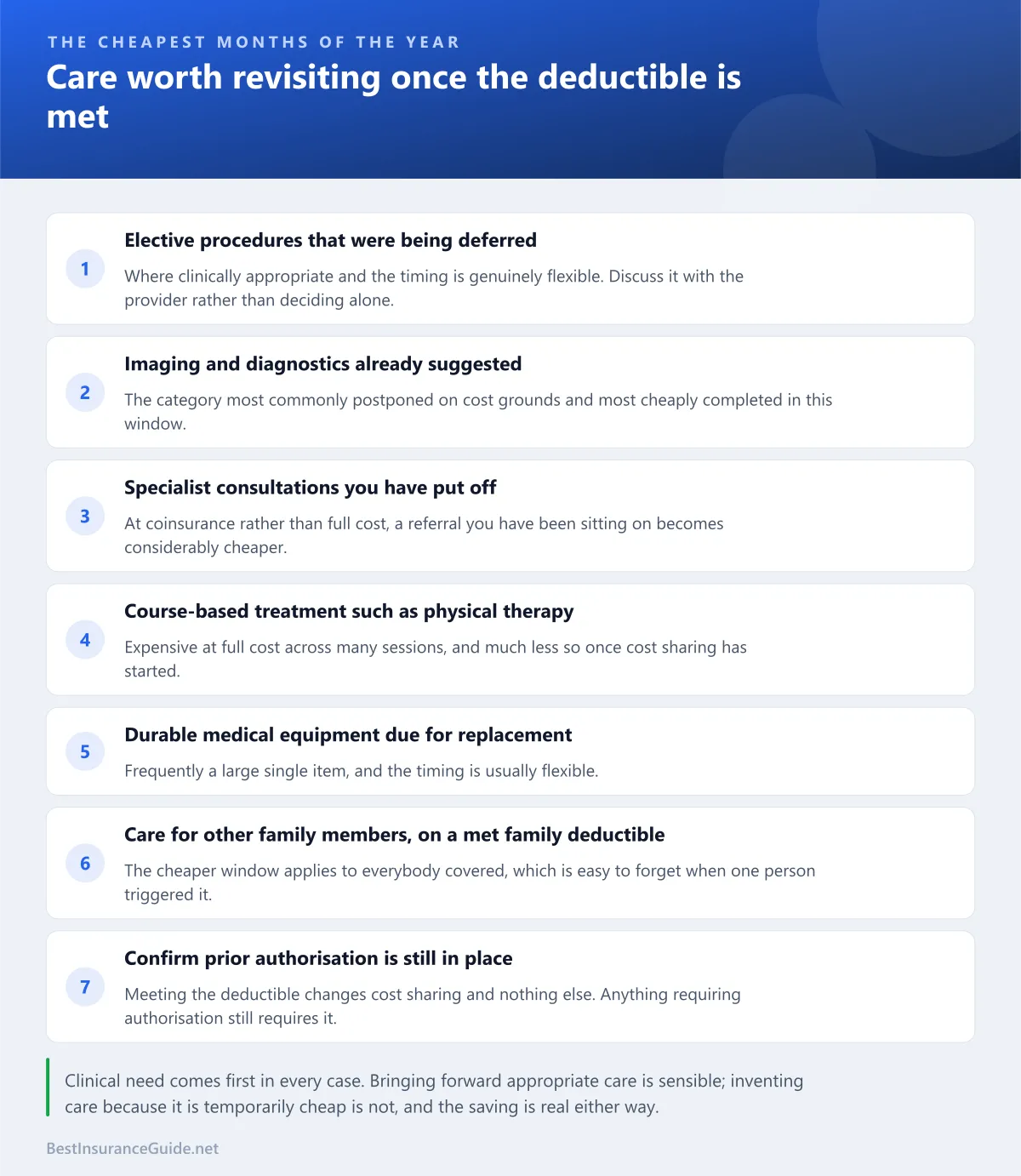
Elective procedures that were being deferred, where clinically appropriate.
Imaging and diagnostics that a provider has suggested but not urged.
Specialist consultations you have been putting off.
Physical therapy or other course-based treatment, which is expensive at full cost and much less so at coinsurance.
Durable medical equipment, where a replacement is due.
Dental or vision care, if covered under the medical plan, which varies.
Three cautions on all of that.
Clinical need comes first. Bringing forward care that is appropriate is sensible; inventing care because it is cheap is not.
Prior authorisation still applies. Meeting the deductible does not remove it.
Check the plan year end date. It is not always December, and assuming it is has caught people out.
Tracking it properly
Do not calculate this yourself.
Use the insurer’s portal or app, which tracks the deductible, the out-of-pocket maximum and the remaining balance on each.
Read every explanation of benefits, which shows what was applied to the deductible for that claim. The explanation is not a bill; it is the record of what counted.
Expect a lag. Claims take time to process, so the tracker reflects what has been adjudicated rather than what has happened. Care in the last week of a year may not appear until the next.
Check the family and individual figures separately on a family plan, since one person’s deductible can be met while the family’s is not.
Question anything that looks wrong. Claims processed as out of network, or as a non-covered service, are common errors and they do not count toward your deductible until corrected.
If you have met it late in the year
Two things are worth doing.
Ask providers whether anything planned for early next year can reasonably be completed now. Many will accommodate it if clinically appropriate.
Check whether your plan has a carryover provision, which some do for spending in the final months of a plan year. It is not common and it is worth knowing.
And one thing worth not doing: rushing unnecessary care into December purely for financial reasons. The saving is real and it is not a reason to have a procedure you do not need.
The short version
Meeting your deductible starts cost sharing rather than ending your costs. You move from paying the full negotiated rate to paying coinsurance, commonly 20% or 30%.
Care becomes free only at the out-of-pocket maximum, which is a separate and higher threshold, and in a serious year that number matters far more than the deductible.
Copays may continue, premiums certainly do, and out-of-network spending runs on an entirely separate track that is unaffected.
The opportunity is the months between meeting the deductible and the plan year reset, when everything covered costs a fraction of what it did. Deferred elective care, imaging and course-based treatment are all substantially cheaper in that window.
For the underlying mechanism, see what is a deductible for health insurance, and for the ceiling, deductible versus out-of-pocket maximum.
The out-of-pocket maximum, which is the real ceiling
Since meeting the deductible is only the first threshold, the second one deserves proper attention because it is the number that matters in a serious year.
The out-of-pocket maximum is the most you will pay for covered in-network care in the plan year. Once reached, the plan pays 100% of covered in-network services.
What counts toward it: the deductible, coinsurance, and on most plans copays.
What does not: premiums, out-of-network balance bills, non-covered services, and anything the plan excludes.
Federal rules cap it for most plans, and the cap is adjusted annually.
Family plans have both an individual and a family maximum, and an individual member’s spending is capped at the individual figure even on a family plan.
Worked example: a serious year
A $2,000 deductible, 20% coinsurance, $7,000 out-of-pocket maximum, and $94,000 of covered in-network care.
| Stage | You pay | Running total |
|---|---|---|
| First $2,000, deductible | $2,000 | $2,000 |
| Next $25,000, at 20% coinsurance | $5,000 | $7,000 |
| Remaining $67,000 | $0 | $7,000 |
The plan paid $87,000 and your exposure stopped at $7,000. That is what the structure is for, and it is why comparing plans on deductible alone misses the point. A plan with a $500 deductible and a $9,000 maximum can cost more in a year like this than one with a $2,000 deductible and a $7,000 maximum.
Two things to check right now
Where you currently stand, on both the deductible and the out-of-pocket maximum, using the insurer portal rather than your own arithmetic.
When your plan year ends, which is not always December and which determines how much of the cheaper window you have left.
Common mistakes in the window afterwards
Four things go wrong in the months between meeting a deductible and the plan year resetting.
Assuming everything is now free. It is not; coinsurance applies until the out-of-pocket maximum. A large procedure at 20% coinsurance is still a substantial bill.
Forgetting prior authorisation. Meeting the deductible changes cost sharing and nothing else. A procedure requiring authorisation still requires it, and proceeding without it can leave the whole cost with you.
Going out of network because cost feels solved. It is not solved on that track at all, and out-of-network care after meeting the in-network deductible can be the most expensive care of the year.
Losing track of the plan year end date. People assume December, and a substantial minority of plans run to a different month. Care scheduled for what you thought was the cheap window can fall after a reset.
Worked example: the cost of one assumption
A $9,000 procedure, deductible met, 20% coinsurance, out-of-pocket maximum not yet reached.
| In network | Out of network | |
|---|---|---|
| Allowed amount | $9,000 | $4,200 insurer determined |
| Plan pays | $7,200 | $2,520 at 60% |
| Your coinsurance | $1,800 | $1,680 |
| Balance billed | $0 | Potentially thousands |
| Your total | $1,800 | Considerably more |
Meeting the deductible did nothing for the second column, and that is the mistake worth avoiding in an otherwise cheap month.
A simple checklist for the rest of the year
Confirm the deductible is actually recorded as met, on the insurer portal rather than from your own records, because claims lag.
Find out how much of the out-of-pocket maximum remains, since that is the second threshold and the more important one.
Check the plan year end date.
List anything clinically appropriate that has been deferred, and ask providers whether the timing is flexible.
Confirm prior authorisation for anything scheduled, which has not changed.
Stay in network, which matters as much now as before.
Six items, ten minutes, and for a household that has had an expensive year it is frequently worth several thousand dollars.
Two things worth telling the household
The window is shared on a family plan. Where the family deductible is met, the cheaper period applies to everybody on it, which makes deferred care for other family members worth revisiting at the same time.
The reset is a cliff, not a slope. Nothing tapers at the plan year end; the counters go back to zero on a specific date. Anybody with care they intended to complete should know that date rather than assuming December.
A note on preventive care, which never needed it
One category sits outside all of this and is worth remembering in either half of the year.
Preventive services are generally covered at no cost regardless of the deductible. Screenings, immunisations, annual wellness visits and a defined list of other services are covered before the deductible under federal requirements on most plans.
Two practical points follow.
Do not defer preventive care waiting for a deductible to be met. It was already free, and delaying it is the most common self-inflicted cost in a health plan.
Watch how the visit is coded. A wellness visit that turns into a discussion of a specific problem can be billed as a diagnostic visit rather than a preventive one, which moves it under the deductible. That is legitimate and it is worth knowing, and where a bill arrives for something you expected to be free, it is worth asking how it was coded before paying it.
A note on scope
Nothing here is medical or financial advice. Plan designs, coinsurance percentages, copay structures, carryover provisions and plan year dates vary between plans and change over time, and the figures used are illustrative.
Your plan’s summary of benefits and coverage is the authoritative statement of your deductible, coinsurance and out-of-pocket maximum, and your insurer’s portal is the authoritative record of what has been applied. Clinical decisions about timing care belong with your provider. This site is independent and not affiliated with any insurer.