Renters Insurance in Indiana: Cheap Cover, Thin Tenant Protections
What renters insurance costs in Indiana, the storm and basement water risks that drive claims, and why Indiana tenant law makes your own policy matter more.

Table of contents

Indiana is a cheap state to insure a rented home in and a hard state to be a tenant in when something goes wrong. Those two facts are connected, and together they decide what a Hoosier renter should actually buy.
What it costs
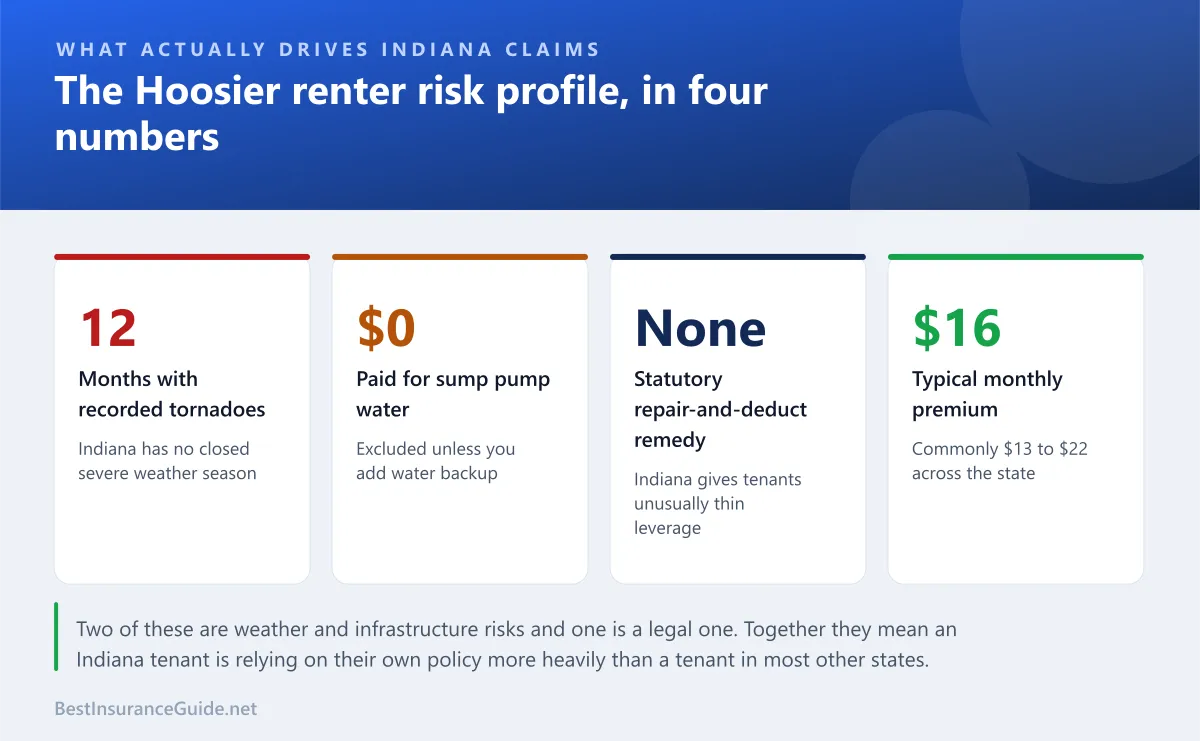
Indiana premiums sit comfortably below the national picture. Typical figures fall in the region of $13 to $22 a month, which is roughly $160 to $265 a year, and the spread within the state is driven more by building than by city.
Three things move the number.
The building’s age and construction. Indianapolis, Gary, South Bend and Evansville all carry substantial pre-war housing stock converted into flats. Older wiring, older plumbing and older heating raise the rate.
Your deductible. Moving from $500 to $1,000 saves meaningfully in percentage terms and very little in dollars on a policy this cheap, which is usually the wrong trade.
Whether you have added water backup. In a state where basement and garden-level units are common, this endorsement is worth more here than in most places, and it costs very little.
The single biggest saving available is not shopping at all. It is bundling with an existing auto policy, where the multi-policy discount on the auto side frequently offsets most of the renters premium.
The storm exposure
Indiana sits at the eastern edge of the corridor that produces the country’s most damaging severe convective weather, and the state records tornadoes in every month of the year.
For a tenant that matters in a specific way. Wind and tornado damage to the building is not your loss. The landlord insures the structure. What is yours is:
Your belongings, destroyed by wind, by the rain that follows the roof coming off, or by debris.
Your accommodation while the building is repaired, which after a serious storm is measured in months rather than nights. That is loss of use coverage, and our guide to whether renters insurance pays for a hotel sets out how the limits work.
Your liability, if something of yours causes damage to someone else during or after the event.
One Indiana-specific point on timing: after a widespread severe weather event, contractor availability collapses across the whole region at once. A repair that would normally take six weeks takes six months, and a loss of use limit expressed as a percentage of your contents cover runs out well before you can move back.
The water that is not covered
This is the coverage gap that catches Indiana renters more than any other, and it is a function of how the housing stock is built.
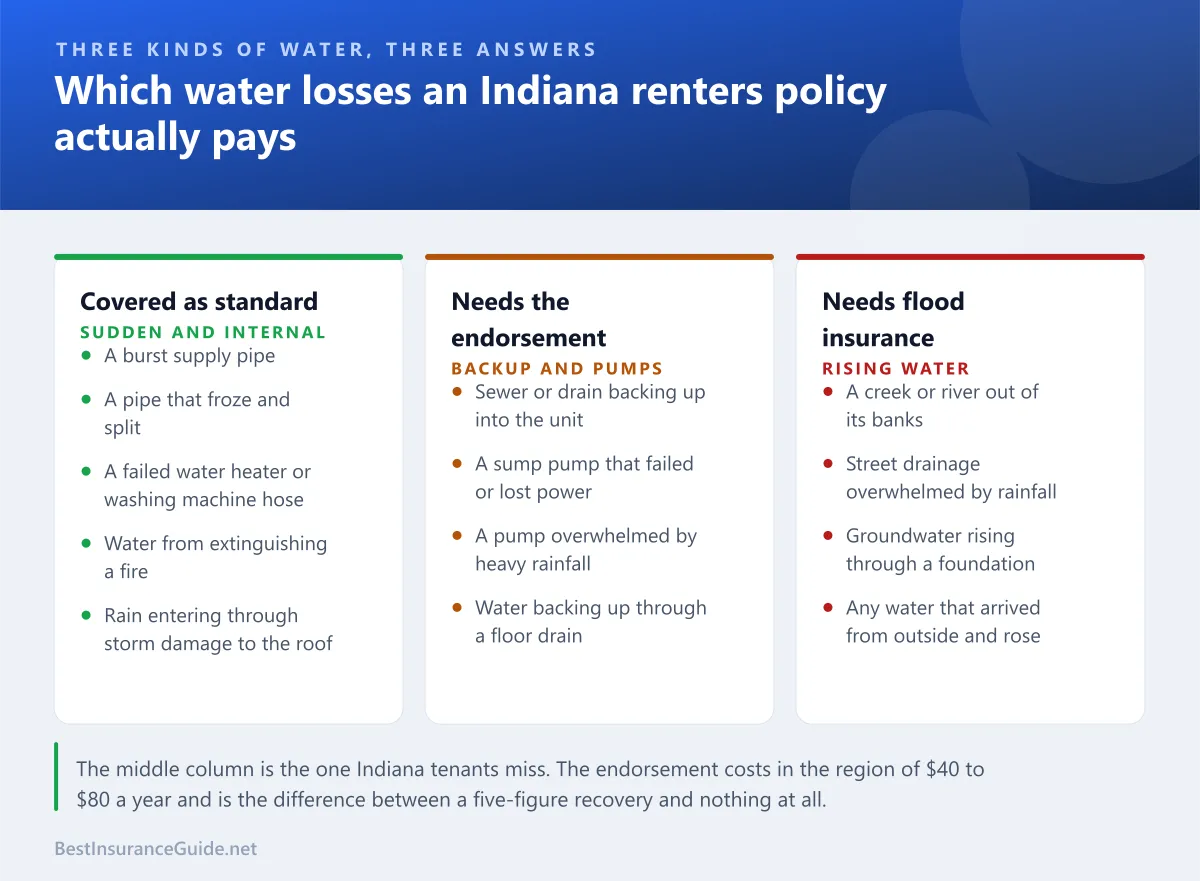
A burst supply pipe is covered. Sudden, accidental, a named peril.
Sewer and drain backup is not, unless you have added the endorsement. That includes a sump pump that fails or is overwhelmed, which in a state with this much basement housing and this much rainfall is a routine event rather than an exotic one.
Surface flooding is not covered at all by any renters policy. Rising water from a creek, a river or an overwhelmed street drain is flood, and flood needs a separate policy through the National Flood Insurance Program or a private flood insurer.
Worked example: a sump pump failure in a garden-level flat
Two feet of water after a storm knocks out power and the pump with it.
| Loss | Without water backup | With water backup |
|---|---|---|
| Furniture, bed and sofa | $0 | $4,200 |
| Electronics stored at floor level | $0 | $1,900 |
| Clothing and soft furnishings | $0 | $2,400 |
| Books, tools and stored boxes | $0 | $1,100 |
| Hotel for eleven nights | $0 | $1,540 |
| Recovered | $0 | $11,140 |
| Less deductible | $500 | |
| Settled | $0 | $10,640 |
The endorsement that makes the difference between those two columns commonly costs somewhere in the region of $40 to $80 a year. It is the single best-value addition available to a tenant in a basement or garden-level unit anywhere in Indiana.
Why Indiana law raises the stakes
Here is the part that makes this state different, and it has nothing to do with weather.
Indiana recognises an implied warranty that a rented home is fit to live in, and Indiana statute obliges landlords to maintain the property in a habitable condition. So far, so ordinary.
What Indiana does not provide is the enforcement machinery most states give tenants. There is no general statutory repair-and-deduct remedy and no statutory rent-escrow or rent-withholding procedure. A tenant whose landlord will not fix something is largely left with a court action for breach, which is slow, costs money and does not house you in the meantime.

The practical consequence is straightforward. In Indiana, your own policy is doing more work than it would elsewhere, because the alternative route of forcing the landlord to make you whole is harder here than in most states.
That argues for three things specifically.
A loss of use limit you have actually looked at, because if the building is uninhabitable and the landlord is slow, your policy is what pays for somewhere to sleep.
Replacement cost rather than actual cash value, because you will be replacing things yourself rather than recovering them from anyone.
Everything in writing, dated. Report problems by email rather than phone. Photograph conditions at move-in and move-out. Keep the correspondence. In a state with weak procedural remedies, the evidentiary record is most of your position.
Liability, and why the default is too low
Indiana renting skews toward multi-unit buildings in the urban counties and toward converted older houses elsewhere. Both are shared-structure situations.
Personal liability on a renters policy starts at $100,000 by default. In a building where a water escape from your unit reaches two others, or where a kitchen fire spreads through a shared attic space, that is thin.
Raising it to $300,000 typically costs a few dollars a year. It is one of the cheapest upgrades in personal insurance and it is the coverage that actually prevents a financial catastrophe, as our guide to whether you need renters insurance works through in detail.
One more Indiana-relevant point: if a fire or water escape starts in your unit, the landlord’s insurer will pay the landlord and then pursue you to recover it. That is routine practice, not a threat, and your liability coverage is what answers it.
What to buy
Replacement cost on contents, always. The difference on a five-year-old sofa is the difference between $300 and $1,200.
Liability at $300,000, not the $100,000 default.
Water backup coverage, without hesitation if you are in a basement, a garden-level unit or an older building with a sump pump.
A contents limit built from an actual inventory, which means walking each room filming on your phone. Most people underestimate what they own by roughly half.
A deductible you could pay this week, because a high deductible saves almost nothing on a cheap policy and stops you claiming for the mid-sized losses that actually occur.
Scheduling for anything above a category sublimit, particularly jewellery, bikes and cameras. Our guide to theft coverage sets out where the caps sit.
Reading an Indiana lease
Two clauses matter before you buy.
The insurance clause, which usually specifies a minimum liability limit and may require the landlord be named. Match the number before you bind a policy, because a $100,000 policy will not satisfy a lease demanding $300,000.
The interested party versus additional insured distinction. Naming the landlord as an additional interested party costs nothing and simply notifies them if the policy lapses. Naming them as an additional insured extends your liability coverage to protect them, which is a materially different thing and should only be done where the lease explicitly requires it.
Also read the maintenance and pest clauses. Given how little procedural leverage Indiana law gives tenants, what the lease says is closer to the whole answer here than it would be in a state with stronger statutory remedies.
The short version
Indiana renters insurance is cheap, commonly $13 to $22 a month, and the biggest available saving is bundling it with an existing auto policy rather than shopping it alone.
The two exposures that actually drive claims here are severe convective storms, which displace tenants for months because regional contractor capacity collapses at once, and basement water, which is excluded by default and needs the water backup endorsement.
And because Indiana gives tenants unusually thin statutory remedies against a landlord, your own policy carries more weight in this state than in most. Buy replacement cost, raise the liability limit, add water backup, and put everything in writing.
For the coverage fundamentals, see the renters insurance guide and what renters insurance covers.
What an Indiana claim looks like in practice
The two most common Indiana renters claims are a storm event and a water event, and they run very differently.
A storm claim is usually straightforward on liability and difficult on timing. The peril is not in dispute, the damage is obvious, and the argument is almost never about coverage. What goes wrong is duration. After a regional severe weather outbreak, every roofer, restoration contractor and public adjuster in a hundred-mile radius is booked within days, and the repair timeline for your building stretches from weeks into months.
That is a loss of use problem rather than a contents problem. A tenant with a percentage-based limit — say 30% of a $25,000 contents limit, giving $7,500 — will burn through it in roughly four months of temporary housing in an Indiana metro. A tenant with a twelve-month time cap will not.
A water claim is usually straightforward on timing and difficult on coverage. The damage is contained to one unit, contractors are available, and the whole question is which category the water fell into. That is decided by where it came from, not by how much of it there was.
Worked example: two Indianapolis tenants, one storm
Both in the same building, both with $25,000 of contents cover.
| Tenant A | Tenant B | |
|---|---|---|
| Loss of use structure | 30% of contents, $7,500 | 12-month time cap |
| Water backup endorsement | No | Yes |
| Contents lost to backup water | $6,800, uninsured | $6,800, paid |
| Months displaced | 7 | 7 |
| Temporary housing cost | $13,300 | $13,300 |
| Loss of use paid | $7,500 | $13,300 |
| Out of pocket | $12,600 | $500 deductible |
The premium difference between those two policies is in the region of $80 a year. Everything else about them is identical.
Cities, and what changes between them
Indianapolis carries the state’s largest concentration of converted older housing and garden-level units, which makes water backup the priority endorsement and makes the building’s age the dominant rating factor.
Bloomington and West Lafayette are dominated by student renting, where the specific issues are shared-policy problems between housemates, high-value electronics in low-security buildings, and the question of whether a parent’s homeowners policy already provides limited off-premises cover. It usually does, at a low limit, and it is worth confirming rather than assuming.
Fort Wayne, South Bend and Evansville are lower-cost markets with older stock and, in the river cities, meaningful flood exposure that no renters policy touches.
The Indianapolis suburban ring is newer construction with fewer building-condition issues, where the main gap is simply that tenants in newer buildings assume modern construction means less risk and buy the minimum.
Across all of them, the pattern is the same: the premium difference between the cheapest available policy and a properly specified one is a few dollars a month, and the claim difference is five figures.
How other states compare
Indiana pairs cheap premiums with thin statutory remedies against a landlord, which makes your own policy do more work.
Ohio is the closest neighbour on housing stock and shares the combined sewer and basement water problem almost exactly. Colorado shares the severe storm exposure and shows the same loss of use problem after a regional event.
A note on scope
Premium figures here are illustrative ranges rather than quotes, and pricing varies considerably by city, building, deductible and coverage selected. Landlord and tenant obligations are set by Indiana statute and by your lease, and nothing here is legal advice.
The Indiana Department of Insurance publishes consumer guidance on residential policies, and the NAIC publishes comparative state data on average premiums. Your state or local tenant assistance office is the authoritative source on landlord obligations. This site is independent and not affiliated with any insurer.