Renters Insurance in Colorado: Hail, Wildfire and What Is Not Covered
Renters insurance in Colorado: what wildfire and hail cover looks like, Front Range pricing, and the endorsements worth adding before the next season.

Table of contents

Colorado renters face a specific combination: the most active hail region in the country, a wildfire risk that has reached dense suburbs, and a rental market where replacement housing is expensive and scarce.
What a standard policy covers here
Renters insurance is the same product in Colorado as anywhere. It is named perils: fire, smoke, lightning, windstorm, hail, explosion, theft, vandalism, falling objects, weight of ice or snow, and sudden water discharge.
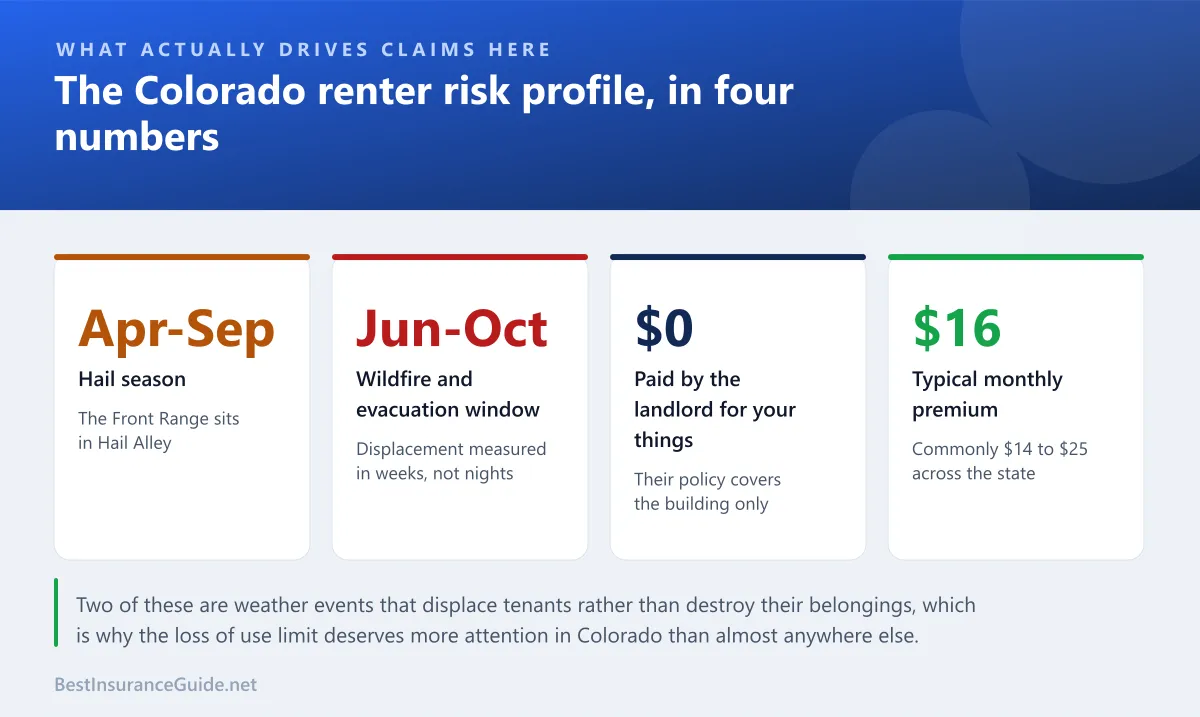
Two of those matter more here than almost anywhere.
Wildfire is covered, and that is not obvious
Wildfire is fire, and fire is a named peril. There is no wildfire carve-out on a standard renters policy, so belongings destroyed by wildfire are covered.
That is worth stating plainly, because renters frequently assume wildfire sits with flood and earthquake in the excluded category. It does not.
Colorado has made this concrete in recent years. The Marshall Fire in December 2021 destroyed over a thousand structures in Louisville and Superior, in ordinary suburban neighbourhoods rather than the mountain interface people picture. A great many of those affected were renters.
Three parts of the policy respond.
Personal property, for everything you owned.
Loss of use, for the additional cost of living elsewhere. In a tight Front Range rental market this frequently becomes the larger and longer-running part of the claim.
Civil authority coverage, which applies where an evacuation order prevents you accessing your home even if it was not damaged. It is usually time-limited, commonly around two weeks. Our guide to whether renters insurance pays for a hotel covers how loss of use and civil authority work in detail.
That last one matters in Colorado more than most places, because pre-emptive evacuations of unburned neighbourhoods are common and most tenants never think to claim.
Smoke damage without flame is also covered, which is relevant across a much wider area than the fire itself during a significant wildfire season.
Hail: covered, but mostly not your problem
Colorado sits in the most active hail region in the United States, and the Front Range takes the worst of it.
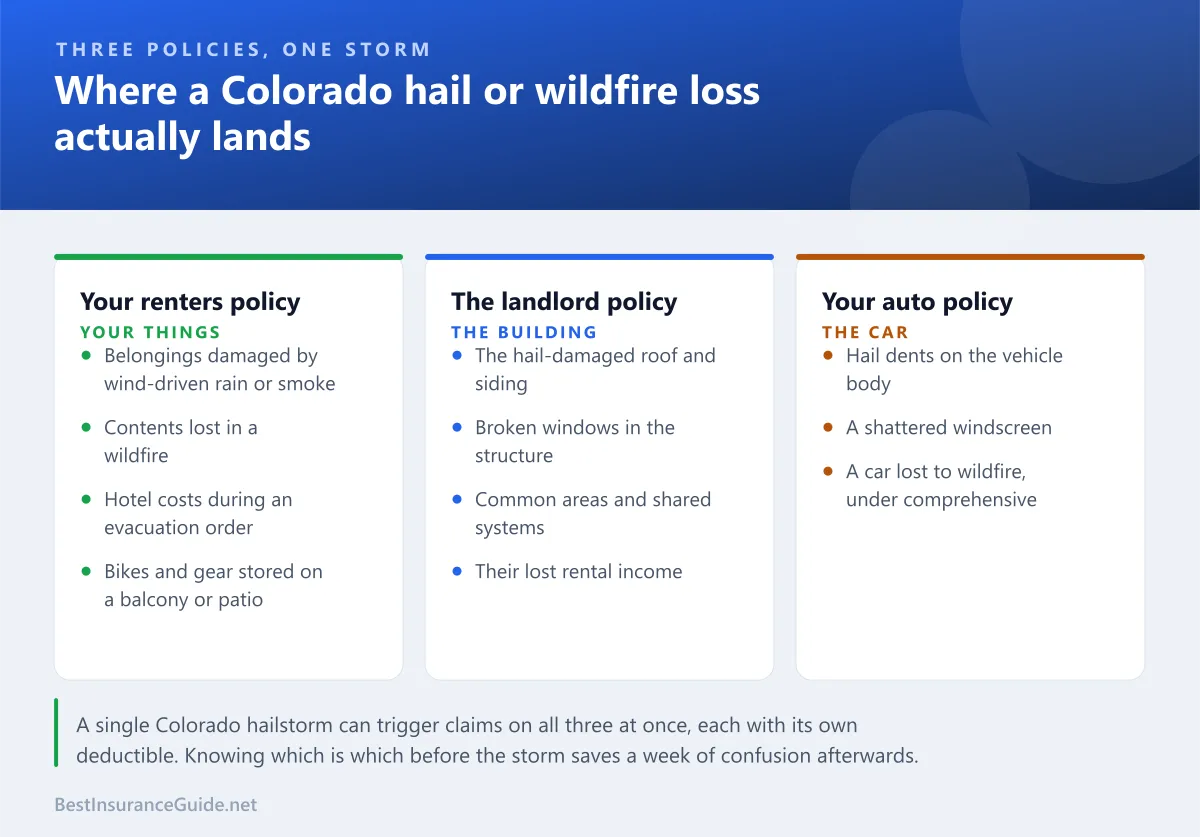
For a renter, the position is more limited than the headlines suggest.
The building is the landlord’s. Roof, windows, siding and gutters are their policy and their problem.
Your belongings are covered if hail damages them, which in practice means items on a balcony or patio, in an open carport, or damaged by water entering through a window the hail broke.
Your car is your auto policy, under comprehensive, never renters insurance. Colorado produces enormous volumes of auto hail claims, and carrying comprehensive is worth more here than in most states.
So hail matters to Colorado renters mainly in two ways: water entering after hail breaks a window, which is a covered loss to your contents, and the vehicle question, which is a different policy entirely.
If you park outside on the Front Range and have dropped comprehensive from an older car to save money, that is a decision worth revisiting.
The gap worth closing
Water backup from sewers and drains is excluded from every standard renters policy.
That matters in Colorado for two reasons: older housing stock in central Denver and other established neighbourhoods, and the prevalence of garden-level and basement units, which are common in Colorado rentals and are the first to take backup water.
The endorsement typically costs a small amount per year and is the single most worthwhile addition for a Colorado renter in a basement or garden-level flat.
Sump pump failure cover is frequently bundled with it, and if your unit relies on one, confirm which.
Flood remains excluded regardless, and Colorado does carry genuine flash flood and burn-scar flooding risk. Areas downstream of recent wildfire burn scars are at elevated flood risk for years afterwards, which is a real and under-appreciated exposure. Contents-only cover through the National Flood Insurance Program is available to renters and very few know it exists.
What it costs, and what moves it
Commonly $15 to $30 a month, with the usual drivers.
Denver, Boulder and Colorado Springs price above rural and Western Slope postcodes, following claim costs and theft rates.
Hail exposure influences pricing along the Front Range specifically.
Building age and construction matter, as does whether the unit is above or below ground.
Your deductible and contents limit, which you control.
Bundling with auto is the largest single saving, and given how much Colorado auto comprehensive is worth here anyway, most renters already hold a policy to bundle with.
Lease requirements
Colorado does not require renters insurance by law, and Colorado landlords increasingly do by contract.
Read the required liability limit before quoting. Commonly $100,000 or $300,000, and a policy at the wrong figure means redoing it.
Additional interested party is the normal request and costs nothing. It means the landlord is notified if the policy lapses.
Do not agree to additional insured status unless the lease genuinely requires it, since that extends your liability limit to protect the landlord as well.
Colorado also has an implied warranty of habitability, which is relevant when a unit becomes uninhabitable for reasons the landlord is responsible for. That is a landlord-tenant matter rather than an insurance one, but it interacts with loss of use: your policy responds when a covered peril made the home uninhabitable, not when the landlord failed to maintain it.
Colorado-specific things worth scheduling
Colorado renters own a disproportionate amount of expensive outdoor equipment, and most of it sits above a category sublimit or is poorly covered.
Bicycles, frequently subject to a sublimit that a decent mountain or gravel bike exceeds immediately. Our guide to whether renters insurance covers bike theft covers scheduling and the e-bike exclusion.
Ski and snowboard equipment, which is high value, frequently stored in shared areas, and often taken from vehicles at trailheads and resorts.
Climbing, camping and packrafting gear, which accumulates quietly into thousands of dollars.
Cameras, given how many Colorado renters photograph the outdoors seriously.
Two practical points. Off-premises theft is covered, so gear taken from a car at a trailhead is claimable, though the vehicle damage is your auto policy as our guide to car break-ins explains. And damage during use is not covered, so a ski broken skiing or a bike damaged in a crash is not a claim.
Preparing for the seasons
Before wildfire season: video every room and store it in cloud storage, keep a copy of the policy schedule off-site, and know your loss of use limit. Note also that insurers frequently restrict binding new cover or increasing limits while a fire is burning nearby, so buy in spring rather than when smoke is visible.
Before hail season: confirm you carry auto comprehensive, and move anything valuable off balconies and out of open carports when storms are forecast.
Before winter: know where your water shutoff is, and keep the heat on low if you travel, since frozen pipes are a covered sudden loss but pipes freezing because the heat was off is frequently excluded.
The short version
Colorado renters get better coverage than they expect on the state’s headline risk: wildfire is covered, because fire is a named peril with no carve-out, and loss of use plus civil authority cover frequently extend to evacuations of neighbourhoods that never burned.
Hail matters less to a renters policy than it seems, because the building is the landlord’s and the car is your auto policy. Where it reaches you is water entering after a broken window, and the auto comprehensive question is the bigger one.
The gap worth closing is water backup from sewers and drains, which is excluded by default and matters in Colorado’s many garden-level and basement units.
And schedule the outdoor equipment, because Colorado renters own more of it than their category sublimits allow for.
For the full list of what is and is not covered, see what renters insurance covers, and for whether to buy at all, do I need renters insurance.
After a Colorado wildfire
The claim process after a major wildfire differs from an ordinary loss, mainly because thousands of people are claiming simultaneously.
Report immediately, even before you know whether your unit survived. Insurers open files and release advance payments on that basis.
Ask for an advance. After a total loss most insurers will release funds quickly for immediate needs, frequently without a completed inventory. You do not have to wait.
Start the loss of use claim from day one of the evacuation, not from when the damage is confirmed. Civil authority coverage frequently applies from the order itself.
Do not wait for access to your unit before submitting an inventory. Work from your video, photographs, purchase records and memory, and revise it later.
Expect delays and be persistent. After a large event adjusters are stretched, and the claimants who follow up in writing tend to be processed faster than those who wait.
Keep every receipt from the first night, including clothing and toiletries bought because you left with nothing.
Check the loss of use limit early, because in a tight rental market after a major fire, rents rise sharply and the limit is consumed faster than expected.
Preparing before the season
Colorado’s risks are seasonal and predictable, which makes preparation unusually worthwhile.
Video every room now and store it in cloud storage rather than on a device that will be in the building. This is the single highest-value thing on the list.
Photograph serial numbers on electronics and any outdoor equipment worth scheduling.
Keep the policy schedule off-site, including the claims number, your deductible and your loss of use limit.
Buy or increase cover in spring, not when smoke is visible. Insurers frequently restrict binding new policies or increasing limits while a fire is active nearby, sometimes within a defined radius.
Know your evacuation plan, including where pets go, since pet boarding during a displacement is frequently claimable under loss of use.
Keep a go-bag with documents, medication and a change of clothes. Colorado evacuations are fast and often give an hour or less.
A note on figures
Premium figures here are illustrative ranges rather than quotes, and pricing varies considerably by postcode, building age and coverage selected. Endorsement availability, particularly for water backup, varies by insurer.
The Colorado Division of Insurance publishes consumer guidance and insurer complaint data, and after major wildfire events has published specific claims guidance for affected residents. That is the authoritative source rather than any article.
Getting a Colorado policy right
Three settings do most of the work here, and the local risk profile is what makes them matter more than they would elsewhere.
Replacement cost rather than actual cash value, which matters everywhere and matters more in a state where a single hail event or a wildfire evacuation can involve replacing a large share of a household at once.
Liability above the default, since Colorado renting skews towards multi-unit buildings in the Front Range corridor where a water escape reaches several neighbours.
A loss of use figure you have actually checked. Wildfire and evacuation displacement in Colorado is measured in weeks and occasionally months, not nights, and a percentage-of-contents limit runs out faster than people expect. Our guide to whether renters insurance pays for a hotel sets out how the two limit structures behave.
Two additions worth pricing.
Water backup coverage, for older buildings and garden-level units, which is excluded by default.
Scheduling for outdoor equipment. Skis, bikes, climbing gear and camera equipment are disproportionately represented in Colorado households and disproportionately likely to exceed a category sublimit or to be stolen from a vehicle at a trailhead.
How other states compare
Colorado’s issue is displacement rather than contents, because hail and wildfire evacuations remove people from homes for weeks.
Indiana shares the severe convective storm exposure and adds unusually thin statutory tenant remedies. Ohio shares the basement water problem that makes the backup endorsement worth carrying in any garden-level unit.
A note on scope
Premium figures here are illustrative ranges rather than quotes, and pricing varies by postcode, building, deductible and coverage selected. Endorsement availability varies by insurer.
Colorado landlord-tenant obligations, including the warranty of habitability, are set by state law and are a legal question rather than an insurance one. The Colorado Division of Insurance publishes consumer guidance and complaint data worth checking before buying from any insurer. This site is independent and not affiliated with any insurer.