Does Travel Insurance Cover Hurricanes? Only If You Bought It First
When travel insurance covers hurricane disruption, why a named storm becomes foreseeable, the common triggers, and how to protect a trip in storm season.

Table of contents
Hurricane cover on a travel policy is decided almost entirely by when you bought it, and the deadline is earlier than travellers expect.
The foreseeability rule
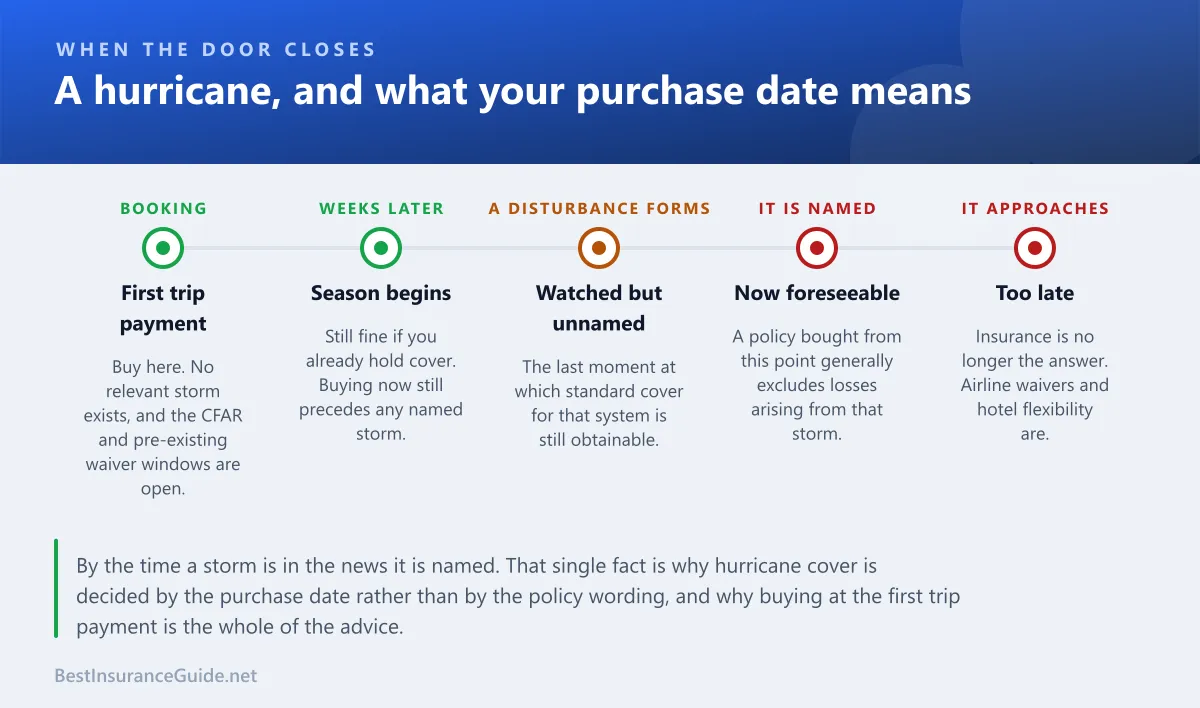
Insurers do not cover events that were already known when you bought the policy.
For tropical systems, the practical line is the point at which the storm is named by the National Hurricane Center. From that moment it is a foreseeable event, and a policy bought afterwards will generally exclude losses arising from it.
Three consequences.
Buying insurance because a storm is forming is too late. By the time it is in the news it is named.
Buying at the time of the first trip payment is early enough, and it is also when the other purchase windows are open.
A policy bought before the naming covers that storm for whatever the wording provides, which is the whole reason to buy early rather than at the last minute.
That single rule answers most of the question. What follows is what the cover actually does once you have it.
What actually triggers a claim
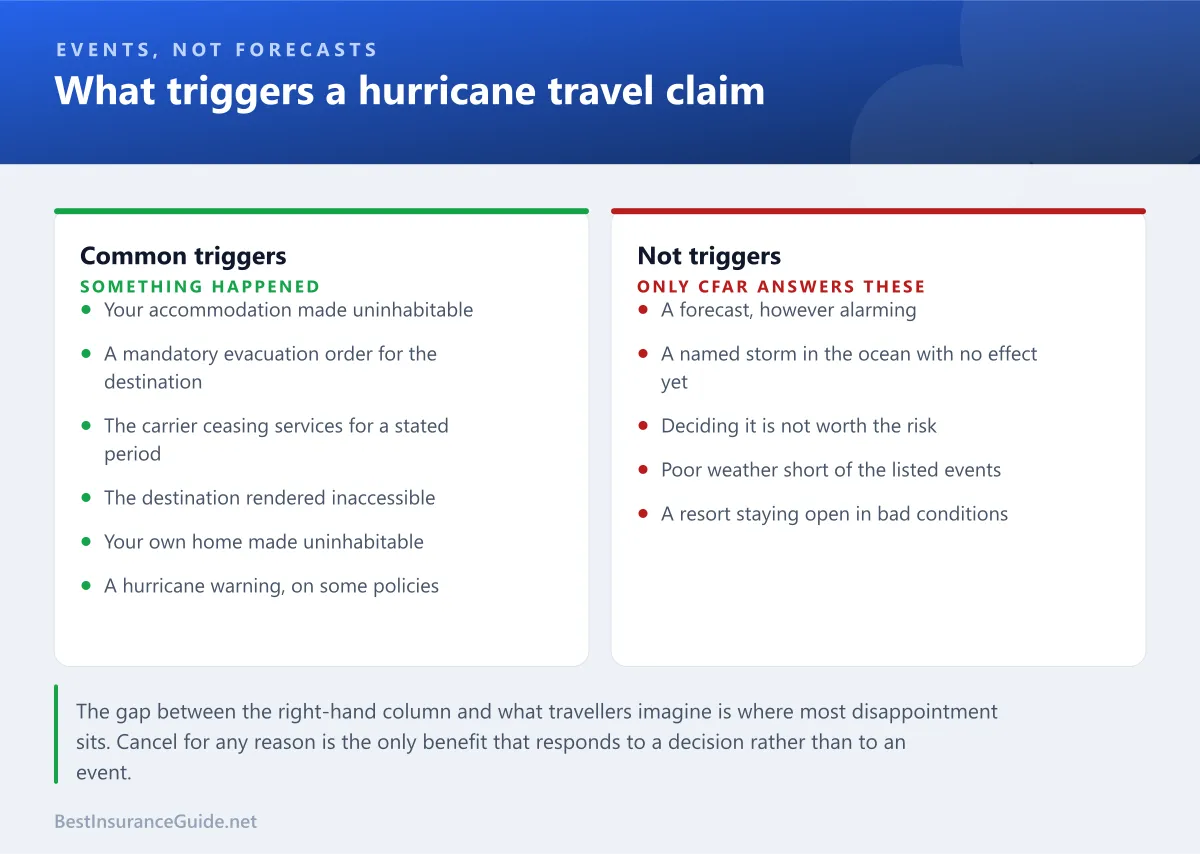
Standard hurricane cover responds to events, not to weather forecasts.
Common triggers:
Your accommodation is made uninhabitable by the storm. One of the clearest and most frequently used triggers.
A mandatory evacuation order is issued for the destination.
The carrier ceases services for a stated period, commonly 24 or 48 consecutive hours.
The destination is rendered inaccessible, or a common carrier cannot reach it.
Your home is made uninhabitable, which prevents you travelling.
A hurricane warning is issued for the destination, on some policies, within a stated period of departure.
What does not trigger it:
A forecast, however alarming.
A named storm somewhere in the ocean, without any of the above occurring.
Deciding it is not worth the risk.
Rain, wind or a disappointing week of weather short of the listed triggers.
A resort remaining open while conditions are poor.
That gap between the second list and what travellers imagine is where most disappointment sits, and it is why cancel for any reason exists.
Cancel for any reason, in storm season
For a trip during hurricane season this upgrade is more valuable than at any other time, because it is the only benefit that responds to a decision rather than an event.
It reimburses a percentage of prepaid non-refundable costs, commonly 50% to 75%.
It must be bought within a short window of the first trip payment, commonly ten to twenty-one days.
It usually requires insuring the full trip cost.
It has a cancellation deadline, commonly 48 hours before departure.
The trade is explicit: you pay more and recover less than a full cancellation claim, in exchange for not having to prove a covered reason.
For a trip to a hurricane-exposed destination in season, with substantial non-refundable costs, that is frequently the correct purchase.
Trip delay and interruption during a storm
Once you have departed, three benefits do the work.
Trip delay covers additional accommodation and meals once a delay exceeds the waiting period, subject to a daily limit and a total cap. In an evacuation this is what funds the nights in an inland hotel.
Trip interruption covers the unused portion of the trip plus the additional cost of getting home or rejoining the itinerary.
Emergency evacuation benefits differ between policies. Medical evacuation covers moving you for treatment; non-medical or security evacuation covers moving you out of a dangerous situation, and it is not present on every policy. For hurricane-season travel it is worth checking specifically.
Worked example: an evacuation mid-trip
A seven-night trip cut short on night three by a mandatory evacuation order.
| Covered by | |
|---|---|
| Four unused hotel nights | Trip interruption |
| Two non-refundable excursions | Trip interruption |
| Change fee and fare difference to fly home early | Trip interruption |
| Two nights in an inland hotel before the flight | Trip delay |
| Meals during those nights | Trip delay, to the daily limit |
| Transport to the evacuation destination | Depends on the policy and any evacuation benefit |
Six lines from one order, and a traveller who claims only the flights leaves most of it unrecovered.
Practical steps in storm season
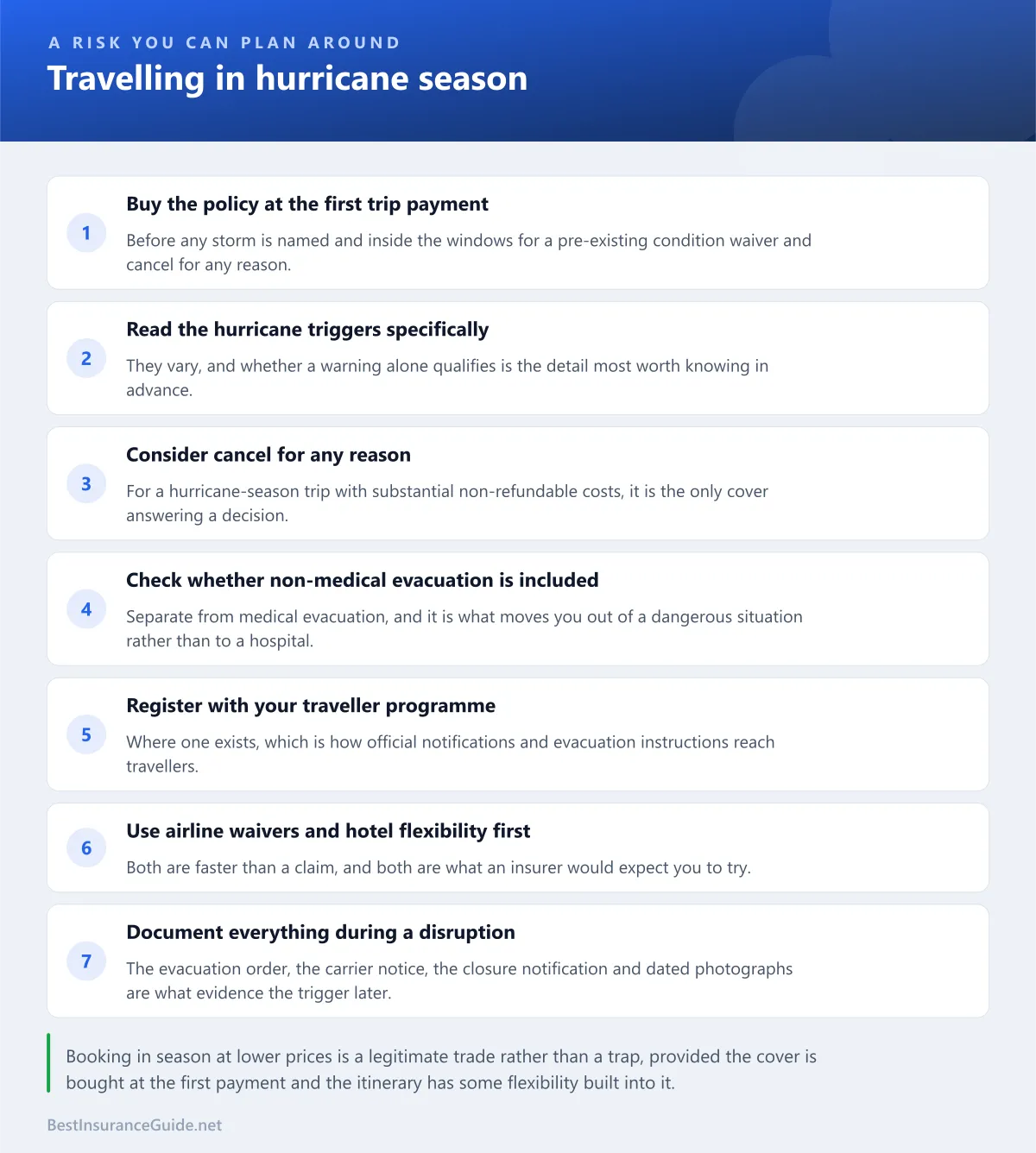
Buy the policy at the first trip payment, which is before any storm is named and inside the windows for waivers and upgrades.
Read the hurricane triggers specifically, because they vary, and note whether a warning alone qualifies.
Consider cancel for any reason for a hurricane-season trip with substantial non-refundable costs.
Check whether non-medical evacuation is included.
Register with your government’s traveller programme where one exists, which is how official notifications reach you.
Book refundable where the price difference is small, which reduces what needs insuring at all.
Keep the policy details reachable from your phone, along with the emergency assistance number.
During the trip, follow official instructions and keep every receipt, including transport, accommodation and meals.
Photograph conditions and keep the evacuation order or the carrier’s cancellation notice, which are what evidence the trigger.
The short version
Travel insurance covers hurricanes if you bought it before the storm was named. Once named, it is a foreseeable event and a policy purchased afterwards will exclude it. Timing decides this question more than wording does.
Once covered, standard benefits respond to events rather than forecasts: uninhabitable accommodation, mandatory evacuation, a carrier ceasing services, or the destination becoming inaccessible. Deciding not to risk it is not a covered reason.
Cancel for any reason is the only benefit that answers a decision rather than an event, and for a hurricane-season trip with large non-refundable costs it is frequently the right purchase. It must be bought within a short window of the first trip payment.
Buy early, read the triggers, check whether non-medical evacuation is included, and keep every receipt and every official notice during a disruption.
For the purchase windows, see when to buy travel insurance, and for flight disruption specifically, does travel insurance cover cancelled flights.
Destinations and seasons, practically
Hurricane season is a known period in known places, which makes this one of the few travel risks that can genuinely be planned around.
The Atlantic season runs through summer and autumn, with activity concentrated in the later months, affecting the Caribbean, the Gulf, the southeastern United States, Bermuda and occasionally further north.
The eastern Pacific season affects Mexico’s Pacific coast and Hawaii on a similar calendar.
Typhoon seasons in the western Pacific affect Japan, the Philippines, Taiwan and southeast Asia on their own timetable, and travel policies treat named typhoons the same way as named hurricanes.
Cyclone seasons in the southern hemisphere run through the southern summer, affecting northern Australia, the south Pacific and parts of the Indian Ocean.
Three planning consequences.
Book refundable where the premium for doing so is small, which reduces what needs insuring at all.
Buy the policy at the first payment, which for a trip booked months ahead is comfortably before any relevant storm exists.
Consider the shoulder of the season, where the risk is materially lower and prices frequently are too.
Worked example: two travellers, same destination
Both book a Caribbean trip for September.
| Booked and insured in March | Insured in August | |
|---|---|---|
| Storm named in late August | Not foreseeable at purchase | Foreseeable |
| Standard hurricane cover | Applies | Excluded for that storm |
| Cancel for any reason available | Yes, window open | Window closed |
| Options if the trip is disrupted | Full range of benefits | Whatever the airline and hotel allow |
Same destination, same storm, and a five-month difference in when the policy was bought.
Two things to check on your policy
The specific hurricane trigger wording, because policies differ on whether a warning alone qualifies or whether an event such as uninhabitable accommodation or a mandatory evacuation is required.
Whether non-medical evacuation is included, which is separate from medical evacuation and is what moves you out of a dangerous situation rather than to a hospital.
Two things to do when a storm is forecast
Contact the airline and the accommodation before the insurer. Airlines frequently issue travel waivers ahead of a forecast storm allowing free changes, and hotels frequently relax cancellation terms. Both are faster and better than any claim, and using them first is what an insurer would expect you to do anyway.
Document everything as it happens. The evacuation order, the carrier’s cancellation notice, the accommodation’s closure notification, and photographs of conditions. Those documents are what evidence the trigger, and reconstructing them after returning home is considerably harder than saving them at the time.
The answer, summarised
Buy at the first trip payment. That is before any relevant storm is named, and it is inside the windows for a pre-existing condition waiver and a cancel for any reason upgrade.
Read the trigger wording, because policies differ on whether a hurricane warning alone qualifies or whether an event such as uninhabitable accommodation or a mandatory evacuation is required.
Consider cancel for any reason for a hurricane-season trip with substantial non-refundable costs, because it is the only benefit that answers a decision rather than an event.
Check whether non-medical evacuation is included, which is separate from medical evacuation and is what moves you out of a dangerous situation.
Use the airline waiver and the hotel’s relaxed terms first when a storm is forecast, because both are faster than a claim.
What to do if the trip goes ahead anyway
Not every storm-season trip is disrupted, and travelling into a season with cover in place is a reasonable decision rather than a reckless one. Four things make it a well-managed one.
Register with your government’s traveller programme, where one exists, which is how official notifications and evacuation instructions reach travellers.
Keep the insurer’s emergency assistance number reachable from your phone, saved rather than in an email, since connectivity is the first thing to fail.
Know the accommodation’s storm procedure and whether the property has a shelter arrangement.
Follow official instructions rather than making independent judgements, both because it is safer and because a claim arising from ignoring an evacuation order is a much harder claim.
And keep every document generated during a disruption. The evacuation order, the carrier notice, the accommodation closure notification and dated photographs are what evidence a trigger months later when the claim is being assessed by somebody who was not there.
Two things worth knowing about the season
Hurricane season is predictable and the naming is public. Unlike most travel risks, this one can be checked before booking, before paying and before buying insurance, which makes it one of the few disruptions a traveller can genuinely stay ahead of.
Prices are lower in season for a reason, and that is a legitimate trade rather than a trap. A traveller who books in season, buys cover at the first payment, considers cancel for any reason and keeps the itinerary flexible has priced the risk deliberately. A traveller who books in season and insures a fortnight before departure has not.
Related reading
Does travel insurance cover cancelled flights covers the disruption benefits in more detail, including the waiting periods that decide whether a delay pays anything. Is Airbnb travel insurance worth it covers whether checkout cover is adequate for a trip with flights attached.
A note on scope
Nothing here is legal advice. Hurricane triggers, foreseeability rules, waiting periods, purchase windows and evacuation benefits vary considerably between policies and insurers and change over time.
The National Hurricane Center publishes storm naming and forecasts, your government’s travel advisory service publishes destination guidance and traveller registration, and your policy wording is the authoritative statement of what is covered and from when. This site is independent and not affiliated with any insurer.