Homeowners Insurance in Georgia: Two States in One Rating Map
Georgia homeowners insurance costs, coastal named-storm deductibles, north Georgia hail, lightning claims and what to check before you buy.

Table of contents
Georgia is priced as if it were two different states, because in insurance terms it is. The six counties on the coast are rated for tropical wind. The rest of the state is rated for hail, lightning and rebuilding cost. Buying the wrong policy for your half is the most expensive mistake available here.
What it costs
Georgia premiums sit above the national average and have risen sharply. Typical figures for a mid-priced home fall somewhere in the region of $1,800 to $3,200 a year, with a wide spread.
The spread is geographic and it is severe.
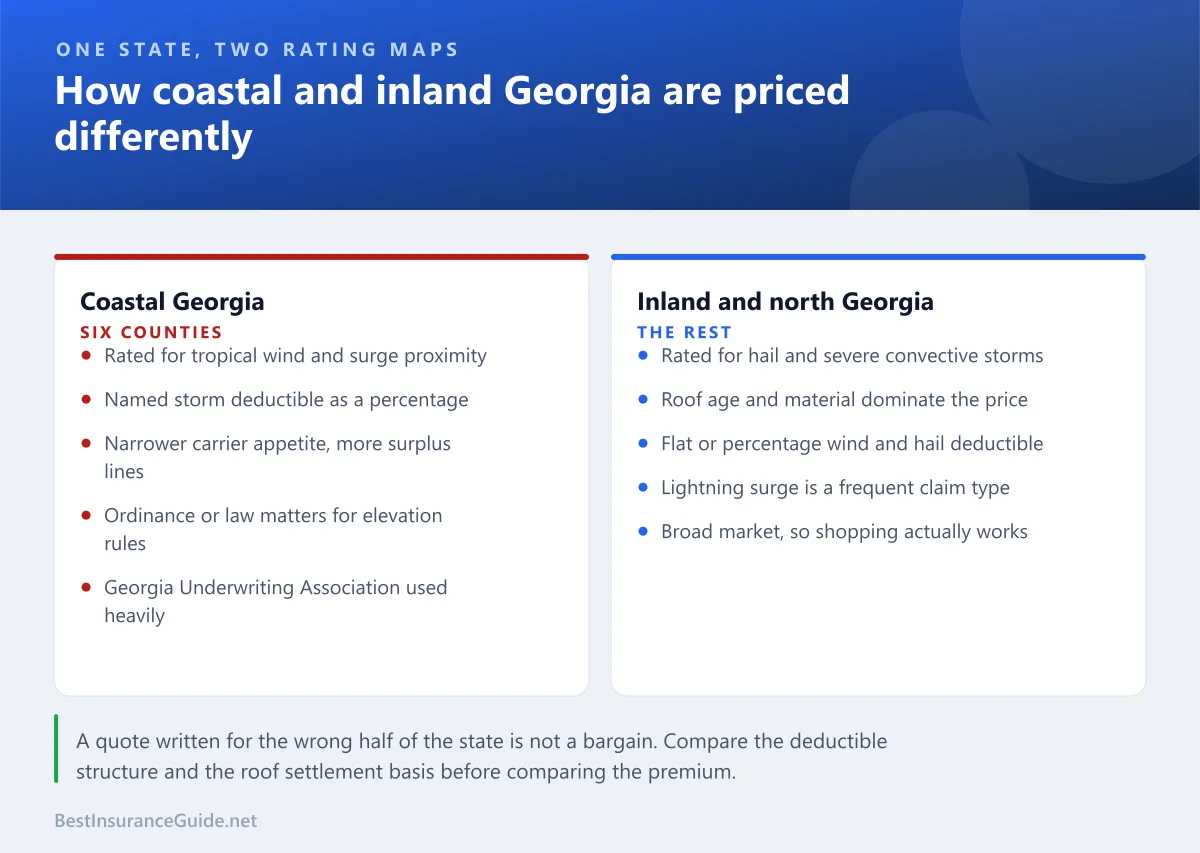
Coastal Georgia, meaning Chatham, Bryan, Liberty, McIntosh, Glynn and Camden counties, is rated for tropical wind and storm surge proximity. Premiums here run materially higher, named-storm deductibles are standard, and some carriers write little or no new business.
North Georgia and metro Atlanta is rated for severe convective storms. Hail is the driver, and the same roof-focused underwriting that has reshaped the Midwest applies here.
Middle and south Georgia away from the coast sits between the two, with tropical systems still reaching inland as wind and rain events long after they have weakened.
Three non-geographic factors move an individual premium as much as the county does: the roof, its age and material above everything else; the age and wiring of the house; and your claims history, which follows the address.
The named storm deductible
If you own on the Georgia coast, this is the line on your policy that matters most, and it is routinely misunderstood.
A named storm or hurricane deductible is a separate, larger deductible that applies only when the damage is caused by a tropical system that the National Hurricane Center has named. It is expressed as a percentage of the dwelling limit, not of the claim.
On a $450,000 dwelling limit:
| Deductible | Amount you pay first |
|---|---|
| 1% named storm | $4,500 |
| 2% named storm | $9,000 |
| 5% named storm | $22,500 |
| Flat $2,500, non-storm losses | $2,500 |
Three things people get wrong about it.
It is a percentage of the dwelling limit, not the loss. A 2% deductible on a $450,000 home is $9,000 whether the claim is $12,000 or $300,000.
It applies to the whole claim, including contents and additional living expense, not just the structure.
The trigger is the naming, not the severity. A named tropical storm that arrives as a strong wind event still triggers the hurricane deductible in most wordings. Read the trigger language, because some policies trigger on the naming and others on hurricane-force wind being recorded.
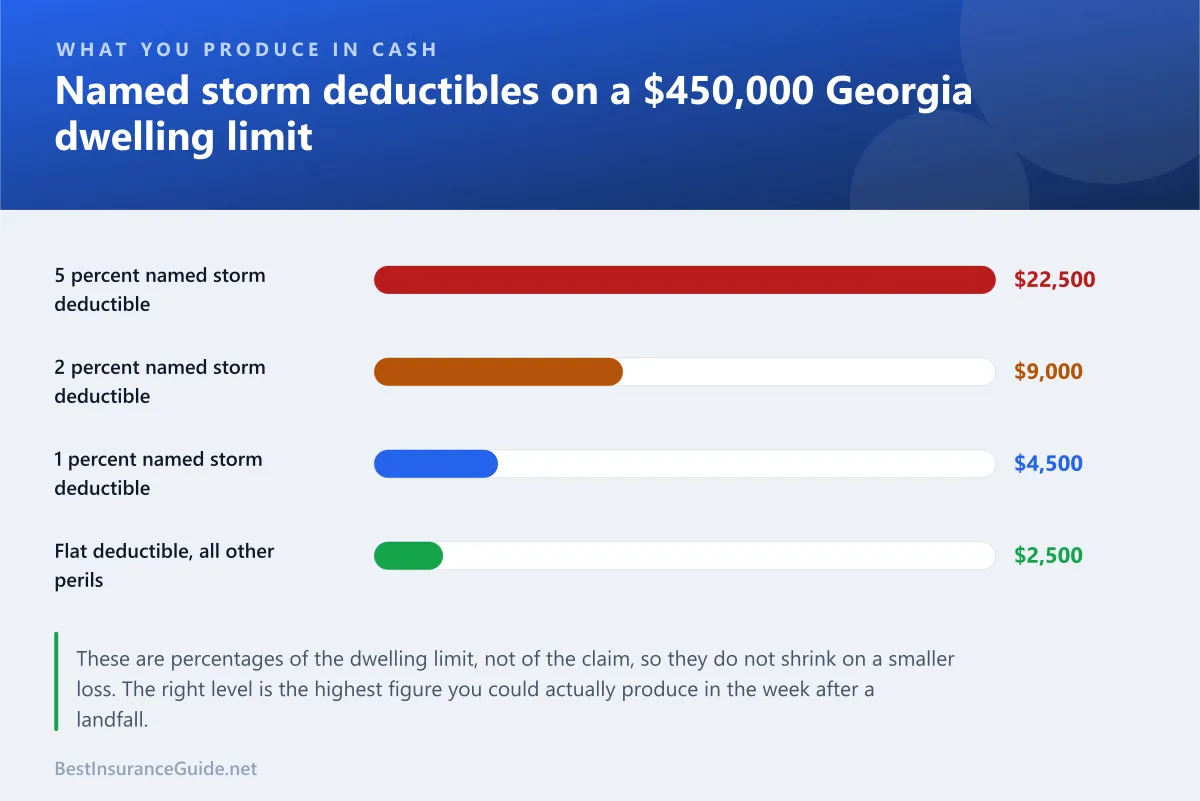
Reducing the percentage costs premium. Whether that trade is worth it depends entirely on whether you could actually produce the higher figure in the week after a storm, when contractors want deposits and nobody is lending.
The lightning exposure
This is the Georgia risk that never appears in the marketing and shows up constantly in claims files.
Georgia has one of the highest lightning strike densities in the country, a consequence of long, hot, humid summers producing near-daily afternoon convection across most of the state.
Lightning is a covered peril everywhere, so the coverage question is not whether but how much and on what basis.

Three loss patterns recur.
Direct strike causing structure fire. The expensive one, and unambiguously covered.
Surge damage to electronics and appliances. Televisions, computers, HVAC control boards, well pumps, security systems, EV chargers. Individually modest, collectively frequently five figures in a modern house. This is where the replacement cost versus actual cash value setting on personal property does real work.
HVAC and heat pump damage, which in a Georgia summer is not an inconvenience but an emergency, and which frequently sits at the boundary between covered lightning damage and excluded mechanical breakdown.
Two practical points. Whole-house surge protection at the panel costs a few hundred dollars installed and reduces the frequency of the second category substantially. And equipment breakdown coverage, a cheap endorsement, closes the gap where an insurer argues a failure was mechanical rather than lightning-caused.
Flood, which is not on your policy
Georgia’s flood exposure is larger than its flood insurance take-up, and the gap is widest inland rather than on the coast.
Storm surge is flood, not wind, and is excluded from every homeowners policy. On the coast that distinction decides whether a hurricane claim is paid at all, and the wind-versus-water argument after a landfalling storm is the single most contested issue in coastal claims.
Inland flooding is also flood. Tropical systems that reach north Georgia as rain events produce riverine and flash flooding well outside mapped zones, and metro Atlanta’s development has increased runoff into creek systems that were mapped decades ago.
A substantial share of flood claims nationally come from properties outside high-risk zones, where cover is cheap precisely because it is not required. Preferred risk flood policies for a low-risk-zone Georgia home are inexpensive relative to what they do.
The Georgia Underwriting Association
Georgia’s FAIR Plan exists for owners who cannot place cover in the standard market. It is used most heavily on the coast and for older properties.
It is a last resort rather than an option. Coverage is narrower, frequently written on a basic named-peril form, and liability is not always included. Owners who end up there usually have a fixable underlying problem: a roof past its serviceable life, an older electrical system, an unrepaired prior claim, or a period of vacancy.
Before accepting FAIR Plan terms, it is worth working through an independent agent who writes with surplus lines carriers, because the middle ground between the standard market and the FAIR Plan is larger in Georgia than most owners realise.
What to check on a Georgia policy
Which deductible applies to what. Flat, wind and hail, named storm. Many coastal policies carry all three.
The named storm trigger language, if you are coastal.
Your roof settlement basis, replacement cost or actual cash value, and whether a cosmetic damage exclusion applies.
Your dwelling limit against a current rebuild cost, which in Georgia has moved considerably in recent years.
Extended replacement cost, which provides margin above the dwelling limit when regional demand surge pushes rebuilding costs up after a widespread event.
Personal property on a replacement cost basis, which matters most for the lightning surge losses described above.
Whether you carry flood cover, and if not, what a preferred risk policy would cost.
Liability, with an umbrella above it if you have assets.
The short version
Georgia is two insurance markets. On the coast you are buying tropical wind cover with a percentage named-storm deductible, and the number that matters is what you would have to produce in cash the week after a landfall. Inland you are buying hail and lightning cover, and the numbers that matter are the roof settlement basis and whether your personal property is on a replacement cost basis.
Everywhere in the state, flood is a separate purchase and the exposure extends well beyond the mapped zones.
Check which deductibles apply to which perils, read the named-storm trigger, and price a flood policy even if nobody is requiring one.
For the coverage fundamentals, see what home insurance covers, and for the terminology, hazard insurance versus homeowners insurance.
Why Georgia premiums have moved so fast
Understanding the direction of travel makes the shopping decision easier, because the market is not behaving the way it did five years ago.
Four pressures are working at once.
Rebuilding cost inflation. Materials and labour costs across the Southeast have risen substantially, and a dwelling limit set three or four years ago is now frequently below what the house would actually cost to rebuild. Insurers have responded by raising limits automatically at renewal, which raises premium even where the rate has not changed.
Reinsurance cost. Insurers buy their own catastrophe cover, and the price of that cover has risen sharply across every hurricane-exposed market. That cost flows through to policyholders in coastal counties first and inland second.
Severe convective storm losses. Hail and straight-line wind losses across the Southeast have grown faster than hurricane losses in most recent years, which has pushed roof-focused underwriting inland to counties that never saw it before.
Litigation and claims cost, which varies by state and affects how insurers price and how readily they write new business.
The practical consequence for a Georgia homeowner is that shopping matters more than it used to, and that the cheapest quote is more likely than it used to be to be cheap because it covers less.
Worked example: two Atlanta quotes on the same house
A $420,000 rebuild cost in a northern suburb.
| Quote A | Quote B | |
|---|---|---|
| Annual premium | $2,240 | $2,760 |
| All-perils deductible | $2,500 | $1,000 |
| Wind and hail deductible | 2%, $8,400 | $2,500 flat |
| Roof settlement | Scheduled by age | Replacement cost |
| Extended replacement cost | None | 25% |
| Ordinance or law | 10% | 25% |
Quote A is $520 a year cheaper and would settle a $30,000 hail claim roughly $14,000 lower. Comparing premiums without comparing those four lines is not comparing anything.
The inland risks nobody prices for
Away from the coast, three Georgia exposures produce claims that owners do not anticipate.
Tropical remnants as rain events. A system that made landfall in Florida or the Gulf can reach north Georgia days later as a slow-moving rain event, producing flash flooding well outside any mapped zone. The wind cover on your policy does nothing for that.
Tree damage. Georgia’s tree canopy is dense and much of it is pine, which fails under saturated soil and wind in combination. Trees falling on the structure are covered; tree removal is subject to a small sublimit, commonly $500 to $1,000 per tree with an aggregate cap, and a large removal job runs well past it.
Termites and moisture. Not covered by any policy, and named here because they are the most common cause of the structural deterioration that later gets a claim declined as wear rather than damage. Georgia’s climate makes annual inspection genuinely worth the money.
Shopping a Georgia policy
Get three quotes at matched coverage, which means the same dwelling limit, the same deductible structure, the same roof settlement basis and the same extended replacement cost percentage. Anything less is not a comparison.
Use an independent agent for coastal property, because carrier appetite in the coastal counties changes frequently and a captive agent can only offer one answer.
Ask specifically about the wind and hail deductible rather than assuming the headline deductible applies to everything.
Ask whether the quote includes a cosmetic damage exclusion, which is now common on metal roofing and siding.
Price flood separately, and price it even if you are outside a mapped zone.
Check the insurer’s complaint record with the Georgia Office of Commissioner of Insurance and Safety Fire before binding, since claims handling matters more in a catastrophe-exposed state than anywhere else.
How other states compare
Georgia is priced as two states, and both halves have parallels elsewhere.
New Jersey shares the coastal half: named storm deductibles, a contested wind and water boundary, and flood as a separate purchase. Ohio shares the inland half, with hail driving roof-focused underwriting and percentage deductibles.
For the deductible structure that both halves depend on, see the AOP deductible explained, and for what the whole policy costs, homeowners insurance on a $400,000 house.
A note on scope
Premium figures here are illustrative ranges rather than quotes, and Georgia pricing varies enormously by county, distance from the coast, the age and construction of the house, roof condition and the deductible structure selected. Policy forms, deductible triggers and endorsements differ between insurers and change over time.
The Georgia Office of Commissioner of Insurance and Safety Fire publishes consumer guidance and rate comparison material, and the NAIC publishes comparative data on average premiums by state. Flood zone determinations come from FEMA. Your own declarations page is the authoritative statement of what you hold. This site is independent and not affiliated with any insurer.