Business Insurance in Michigan: The Auto Reform That Changed Commercial Fleets
Michigan business insurance requirements, workers compensation thresholds, the no-fault PIP choice for commercial vehicles, and what a programme should include.

Table of contents
Michigan changed its auto system substantially, and commercial vehicle owners now make a choice their predecessors never had to. Getting it wrong on a fleet policy is one of the more consequential decisions available in the state.
The auto reform, and what it means for a fleet
Michigan operates a no-fault auto system requiring personal injury protection, and following reform of that system, policyholders including businesses now elect a PIP medical coverage level rather than receiving unlimited benefits automatically.
The structure, broadly:
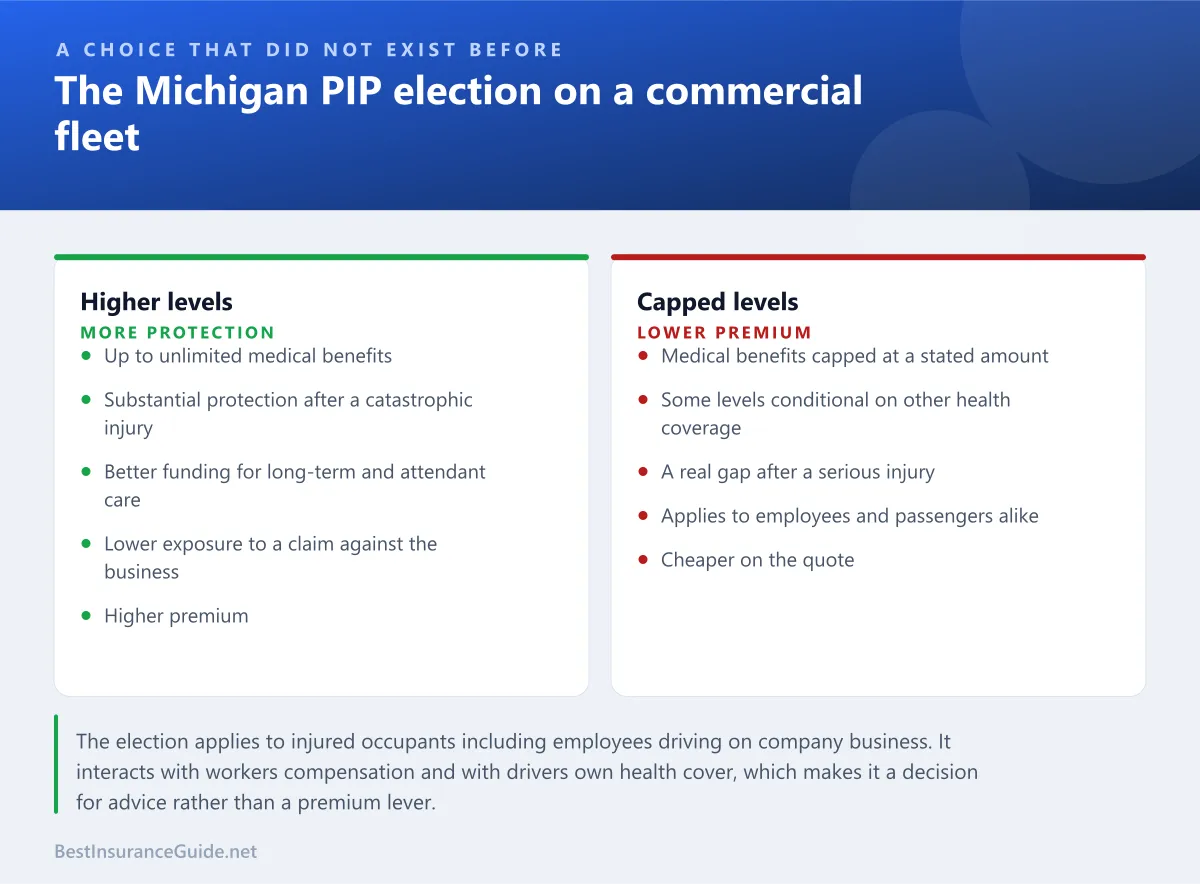
Higher levels, up to unlimited medical benefits, cost more and provide the most protection after a catastrophic injury.
Lower capped levels reduce premium and cap what is available for medical treatment following an auto injury.
Certain lower levels and opt-outs are only available where other qualifying health coverage exists, and the eligibility conditions are specific.
Three consequences for a business with vehicles.
The election applies to injured occupants, including employees driving on company business and passengers. A fleet policy written at a low PIP level after a catastrophic injury leaves a very large gap.
It interacts with workers compensation, since an employee injured in a work vehicle may have claims under both systems, and the coordination is not straightforward.
It interacts with employees’ own health coverage, since some elections are conditional on it, and a business cannot control what health cover its drivers hold.
The practical instruction: treat the PIP election as a considered decision with advice rather than as a premium lever, and understand it alongside your workers compensation position rather than separately. This is genuinely an area where a broker who knows Michigan commercial auto earns their fee.
Workers compensation thresholds
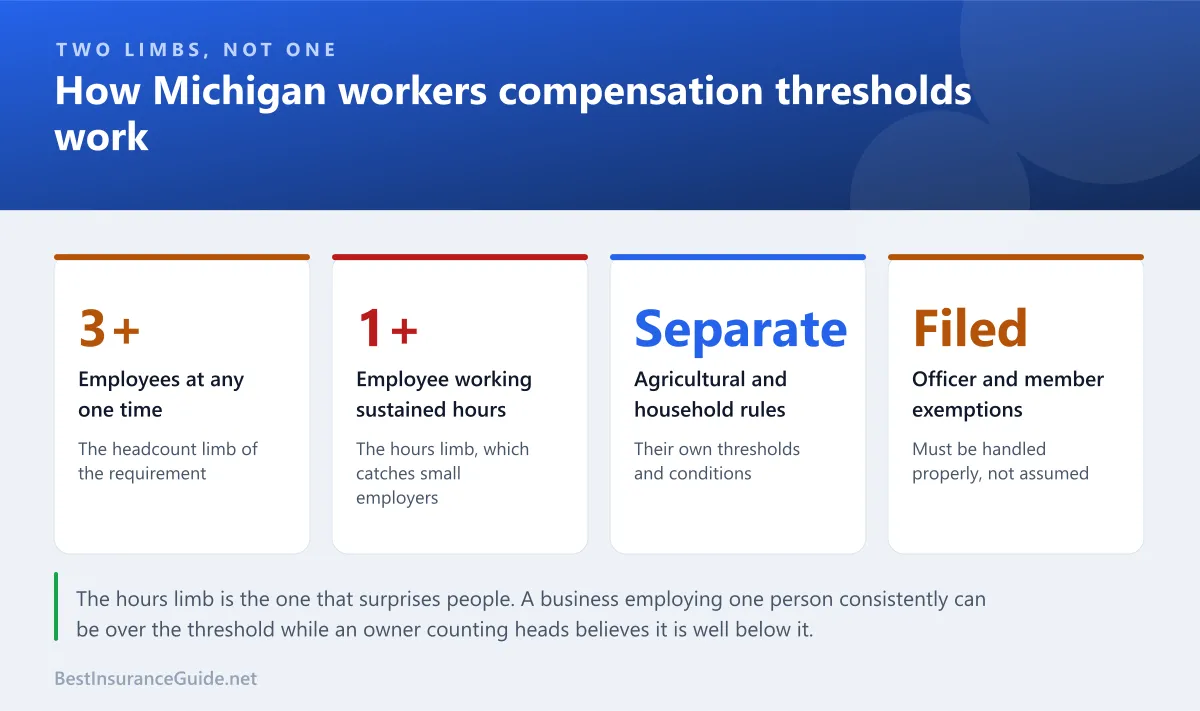
Michigan applies thresholds based on both headcount and hours, which is unusual.
A private employer generally must carry coverage with three or more employees at any one time, or with one or more employees working a specified number of hours a week for a sustained period.
That second limb catches businesses that never reach three employees but employ one person consistently, which is a common small-business shape.
Three further points.
Agricultural and household employment have separate rules.
Officers and members may be exempt in certain structures, and exemptions must be handled correctly rather than assumed.
Contractor classification is examined, and an uninsured subcontractor’s injured worker can become the responsibility of the business that engaged them. Certificates of insurance from every subcontractor, collected before work starts, remain the answer.
The winter exposure
Michigan’s property and liability profile is shaped by winter more than by anything else.
Ice dams, which back water up under roofing and into the structure. A frequent and expensive claim, and one that turns on maintenance and insulation as much as on weather.
Frozen and burst pipes, particularly in buildings that are unoccupied over a holiday period or heated inconsistently. Most policies cover this where reasonable care was taken to maintain heat and exclude it where the building was left unheated.
Roof snow load, which is a genuine structural risk on flat commercial roofs in a heavy winter.
Slip and fall claims, which concentrate sharply in winter and which are the most common premises liability claim in the state. Documented snow and ice procedures with dated records of clearing and treatment are both a defence and an underwriting positive.
Lake-effect snow, which produces sustained business interruption in the west of the state.
Severe convective storms and straight-line wind in summer, plus inland flooding that affects properties well outside mapped zones.
Two coverages follow from that list: business income and extra expense, which is the most under-bought line in Michigan as elsewhere, and service interruption cover, which responds where a utility failure off your premises stops operations.
Building the programme
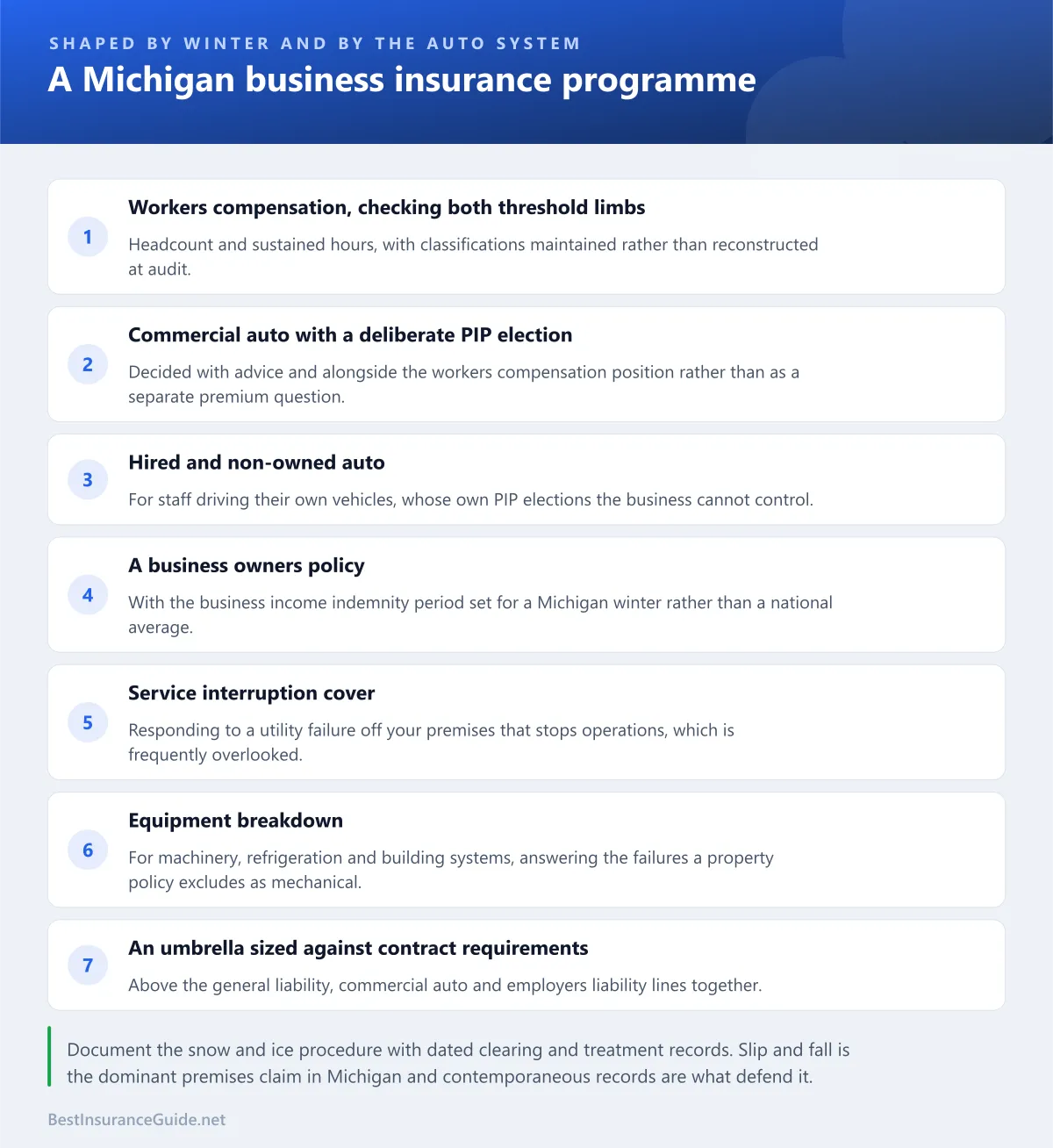
Workers compensation, per the thresholds, with correct classifications.
Commercial auto, with the PIP election made deliberately, plus hired and non-owned auto for employees driving their own vehicles.
A business owners policy, packaging general liability, commercial property and business income.
Business income and extra expense, with a realistic indemnity period given winter disruption.
Service interruption cover, for utility failures off premises.
Inland marine, for tools and equipment away from premises.
Cyber liability, for anybody taking payments or holding data.
Employment practices liability, once there are employees.
Professional liability, where advice is provided.
A commercial umbrella, sized against the highest contract requirement, which our guide to business umbrella insurance covers.
Managing the cost
Get the workers compensation classifications right, and manage the experience modification factor, which multiplies premium directly.
Document winter maintenance procedures with dated records. This is unusually valuable in Michigan because slip and fall is the dominant premises claim and contemporaneous records are what defend it.
Prevent frozen pipes properly: maintain heat, insulate vulnerable runs, and where a building will be unoccupied, either maintain heat or drain the system. The exclusion turns on reasonable care and the evidence of it.
Fit cameras and telematics on the fleet, which is now widely credited by carriers and which resolves disputed liability claims decisively.
Collect subcontractor certificates without exception.
Review the PIP election annually, alongside any change in the workforce or in the health cover available to drivers.
The short version
Michigan requires workers compensation on thresholds based on both headcount and hours, which catches businesses employing one person consistently as well as those reaching three.
The state-specific issue is the auto system. Following reform, commercial vehicle owners elect a PIP medical coverage level rather than receiving unlimited benefits by default, and that election determines what is available to an injured employee or passenger after a serious crash. It should be a considered decision with advice, not a premium lever.
Winter shapes the rest. Ice dams, frozen pipes, roof snow load and slip and fall claims dominate, and documented maintenance procedures are both a defence and an underwriting positive.
And business income cover, with a realistic indemnity period, is the line most commonly bought too thin in a state where winter disruption is measured in weeks.
For the excess layer, see business umbrella insurance, and for commercial vehicle pricing generally, commercial auto insurance cost.
Coordinating auto and workers compensation
Michigan’s structure creates an overlap that most states do not have, and getting the coordination right matters for a business with drivers.
An employee injured in a work vehicle may have a claim under workers compensation and a claim under the vehicle’s personal injury protection cover, and the interaction between the two systems is genuinely complex.
Workers compensation is generally the primary payer for a work-related injury, with the auto PIP position varying by circumstance and by the elections made.
The PIP level elected on the fleet policy determines what is available where PIP does respond, which after a catastrophic injury is a very large number or a capped one.
Employees driving their own vehicles on company business bring their own PIP election into the picture, over which the business has no control, alongside the hired and non-owned auto cover the business carries.
Three practical steps.
Discuss the PIP election with a broker who handles Michigan commercial auto, alongside your workers compensation position rather than separately.
Understand what your drivers hold personally where they use their own vehicles, and consider whether the business should require a minimum.
Document the business use policy, including who is authorised to drive on company business, in what vehicles, and under what conditions.
Worked example: a catastrophic injury in a work vehicle
| Higher PIP election | Capped PIP election | |
|---|---|---|
| Workers compensation medical benefits | Applies | Applies |
| Auto PIP medical benefits | Substantial or unlimited | Capped |
| Long-term care and attendant costs | Better funded | Gap more likely |
| Exposure to a claim against the business | Lower | Higher |
| Premium difference | Higher | Lower |
The election is a real trade rather than an obvious choice, which is exactly why it warrants advice instead of being set to whatever produces the cheapest fleet quote.
Two things to do before winter
Document the snow and ice procedure, with a dated log of every clearing and treatment. Slip and fall is the dominant premises claim in Michigan, and contemporaneous records are the difference between a defensible claim and an indefensible one.
Address freeze risk in any building that will be unoccupied. Either maintain heat with monitoring, or shut off and drain the system properly. The exclusion in most policies turns on whether reasonable care was taken, and a documented decision is what evidences it.
What to ask a broker
What PIP level is elected on my commercial auto policy, and why?
How does that coordinate with my workers compensation position for an employee injured in a work vehicle?
Do I have hired and non-owned auto, and what happens with an employee’s own PIP election?
Is my business income indemnity period realistic for a lake-effect winter?
Do I have service interruption cover for a utility failure off premises?
What would flood cover cost, given that inland flooding affects properties outside mapped zones?
What drives the cost in Michigan
Industry classification, with the manufacturing base producing a wide range of workers compensation classifications in a single business.
The PIP election on the fleet, which is a substantial component of commercial auto premium and a substantial component of what the policy provides.
Payroll by classification, which in a manufacturing or trade business needs maintaining rather than estimating.
Loss history and the experience modification factor, which multiplies workers compensation premium directly.
Property construction, protection class and roof condition, with snow load capacity relevant on flat commercial roofs.
Documented winter maintenance, which affects premises liability pricing and defensibility together.
Fleet telematics and cameras, credited by carriers and decisive in disputed liability claims.
The order to build it in
Workers compensation first, checking both the headcount and the hours limbs of the threshold.
Commercial auto next, with the PIP election made deliberately and with advice, alongside the workers compensation position rather than separately.
A business owners policy for liability, property and business income, with the indemnity period set for a Michigan winter rather than a national average.
Service interruption cover, which responds to off-premises utility failure and is frequently overlooked.
Then the contract requirements and the umbrella above them.
Two more things worth knowing
Manufacturing classifications need maintaining. A Michigan business with a mix of production, warehouse, clerical and delivery roles carries several workers compensation classifications, and the split between them is audited. Maintaining it through the year is considerably cheaper than reconstructing it afterwards.
Equipment breakdown cover is worth carrying in any business dependent on machinery, refrigeration or building systems. It answers the failures that a property policy excludes as mechanical, and the resulting business interruption is frequently larger than the repair.
How other states set the threshold
Michigan’s dual test on headcount and hours is unusual. Illinois and Pennsylvania attach from the first employee with no hours consideration, and New Jersey has no exemption at all.
Georgia and North Carolina use a straightforward three-employee count, and Florida varies its threshold by industry.
A note on scope
Nothing here is legal advice. Michigan workers compensation thresholds, exemptions, and the structure, levels and eligibility conditions of the no-fault PIP election are set by state law and regulation and have been subject to significant reform and continuing change.
The Michigan Workers’ Disability Compensation Agency publishes the authoritative coverage requirements, and the Michigan Department of Insurance and Financial Services publishes consumer and commercial guidance on the auto system including the PIP choices. Your policy documents and contracts are the authoritative statement of what you hold. This site is independent and not affiliated with any insurer.