How Long Can You Stay on Your Parents' Health Insurance? Until 26
The rules on staying on a parent's health plan until 26, what does not disqualify you, when coverage actually ends, and what to do next.

Table of contents

The headline rule is simple and widely known. What causes problems is the specific end date, the plans the rule does not reach, and the sixty days after it ends.
The rule
A health plan that covers dependent children must make that coverage available until the child turns 26.
That is the federal position and it applies broadly.

What is striking is the list of things that do not disqualify you.
Being married. A married adult child may remain covered until 26. Their spouse and children cannot join the parent’s plan, which is where this matters practically.
Living somewhere else, including another state.
Being financially independent, and not being claimed as a tax dependent.
Having a job, including one that offers its own health benefits, under current federal rules for most plans.
Not being a student, which was a condition under the old rules and is no longer.
Having a child of your own, though again the grandchild is not covered by the grandparent’s plan.
The narrowness of the disqualifications is the point. If you are under 26 and your parent’s plan covers dependents, you are generally eligible.
Where it gets complicated
Three situations produce most of the real problems.
The exact end date. This is the single most common cause of a coverage gap. Plans differ: some end coverage on the birthday, some at the end of the birthday month, some at the end of the plan year in which you turn 26. That is a difference of up to eleven months and it cannot be guessed. Ask the plan administrator in writing.
Network geography. A student or young worker living several states away may be technically covered and practically unable to use it, because the plan’s network does not reach them. Out-of-network care is dramatically more expensive, and for an HMO it may not be covered at all outside emergencies. Our guide to what out of network means sets out the cost consequences.
Self-funded employer plans. State extensions beyond 26 do not apply to self-funded plans, which are governed federally. A young adult relying on a state rule needs to know which kind of plan they are on, and many people have no idea.
What it costs the household
Adding an adult child to a parent’s plan is not free, and comparing it against the alternatives is worth doing rather than assuming.
Employer family coverage is usually tiered. Employee only, employee plus one, and family. If a household is already at the family tier, adding an adult child frequently costs nothing extra. If adding them moves the household from one tier to the next, the cost can be substantial.
Compare against the alternatives properly, including the young adult’s own employer plan and a marketplace plan with any subsidy they qualify for.
Worked example: which plan actually costs less
A 24-year-old earning modestly, offered coverage at work.
| Parent’s plan | Own employer plan | Marketplace with subsidy | |
|---|---|---|---|
| Monthly premium to the household | $0 to $280, depending on tier | $95 | Varies with income |
| Deductible | Family deductible applies | Individual | Plan dependent |
| Network reaches where they live | Sometimes not | Usually yes | Chosen locally |
| Counts toward parent family deductible | Yes | No | No |
There is no universal answer in that table, which is the point. The parent’s plan is the default rather than the automatic best choice, and a household at the family tier already has a strong case for it while one that would move tiers may not.
The month it ends
Turning 26 is a qualifying life event, which opens a special enrolment period, commonly 60 days.
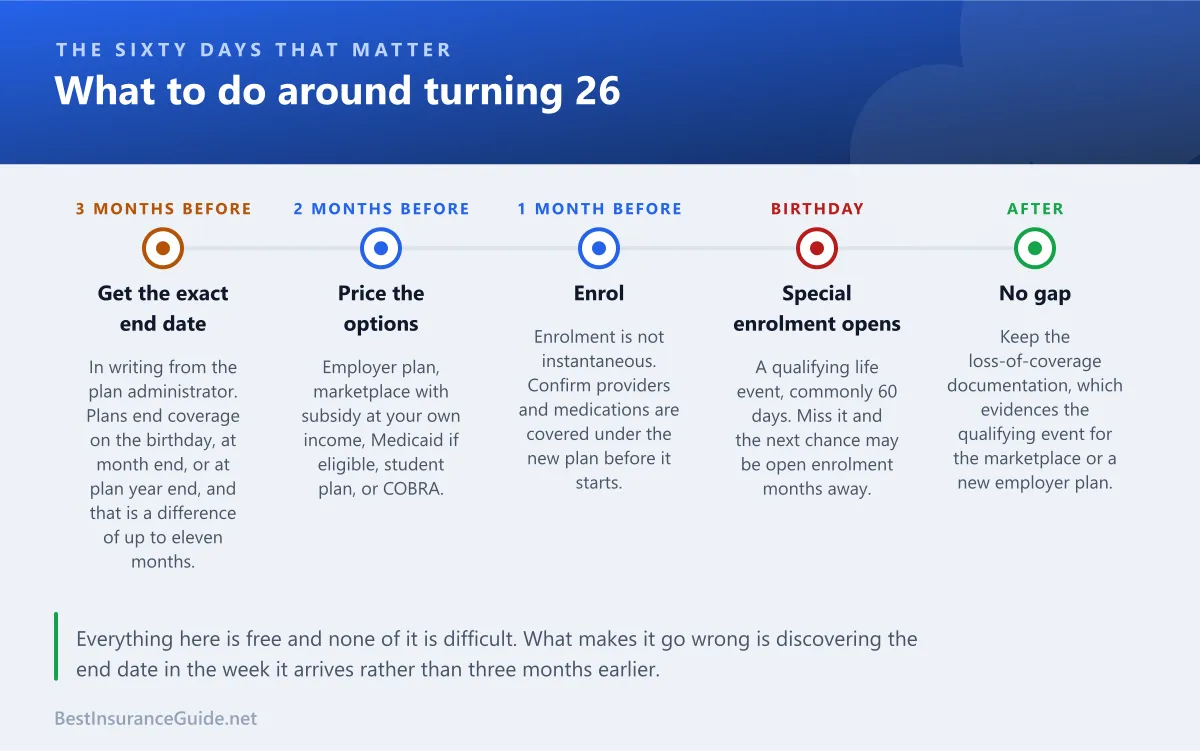
That window matters enormously. Miss it and, outside another qualifying event, the next opportunity to enrol in a marketplace plan is open enrolment, which may be months away.
Five routes after 26.
An employer plan, if you have one available. Losing other coverage is a qualifying event for employer enrolment too, so a job you already hold can usually be joined outside its normal enrolment window.
A marketplace plan, with subsidies depending on income. For a young adult earning modestly this is frequently more affordable than expected.
Medicaid, where income qualifies, which in expansion states covers adults up to a defined income threshold and has no enrolment window.
A student health plan, if enrolled at an institution that offers one.
COBRA continuation from the parent’s plan, which keeps the same coverage and network but at the full unsubsidised cost plus an administrative charge, and is time-limited. Our guide to COBRA insurance costs covers what that actually means.
What to do, and when
Three months before turning 26, ask the plan administrator in writing for the exact date coverage ends.
Two months before, find out what your employer offers and what it costs, and check what a marketplace plan would cost given your income.
One month before, make the decision and start the paperwork. Enrolment is not instantaneous.
Fill any prescriptions and complete any ongoing treatment where practical before the change, and confirm whether your providers are in the new plan’s network.
Do not let a gap open. Even a short gap means paying for everything out of pocket, and a serious event during it is financially catastrophic.
Keep documentation of the loss of coverage, which is what evidences the qualifying life event for the special enrolment period.
The short version
You can stay on a parent’s health plan until you turn 26, and almost nothing disqualifies you before then: not marriage, not a job, not living independently, not having your own child.
What goes wrong is the end date, which varies by plan from the birthday itself to the end of the plan year, and the network, which may not reach where you actually live.
Turning 26 opens a special enrolment period of about 60 days. That window is the whole thing. Find your exact end date three months in advance, compare the options, and enrol before coverage lapses rather than after.
For the terms you will meet comparing plans, see health insurance terms, and for the continuation option, COBRA insurance cost.
Enrolling and staying enrolled
Two administrative points cause more problems than the rules themselves.
Adding an adult child requires a qualifying event or open enrolment. Turning 26 removes somebody; adding somebody back on, for example a young adult who loses their own job coverage, requires either the loss of that coverage as a qualifying event or waiting for the parent’s open enrolment period. The loss-of-coverage route has a deadline, commonly 30 days for employer plans, which is shorter than the marketplace window.
Coverage is not automatic on the parent’s plan. A child on the plan continues to be listed, but a child who came off and wants to return has to be actively enrolled. Assuming they are still on it is a common and expensive error.
Using a plan from a distance
For students and young workers living away from the parent’s plan area, four practical steps make the coverage usable rather than theoretical.
Check the network where you actually live, not where your parents live, using the insurer’s directory and confirming with the insurer.
Find out what the plan does for urgent care away from home, which differs from emergency care and is where most young adults actually need it.
Establish a local primary care provider in network if one exists, before you need one.
Keep the insurance card image on your phone, and know the plan name and member number.
Understand what happens in an emergency out of area, which is generally covered at in-network cost sharing under federal protections. Our guide to what out of network means sets out those protections.
If the network genuinely does not reach where you live, the parent’s plan may be worse than a local marketplace or student plan even where it is free, and that comparison is worth making rather than defaulting.
The comparison worth doing at 24, not 26
Most young adults default onto a parent’s plan until the day it ends, then scramble. A better habit is to compare properly a couple of years earlier, because the answer is not always the parent’s plan.
Four things to compare.
The total cost to the household, which includes what the parent pays for the coverage tier and what the young adult would pay elsewhere.
The network where the young adult actually lives, which is frequently the deciding factor.
The deductible structure, since on a family plan the young adult’s spending contributes to a family deductible that may be considerably higher than an individual one.
The subsidy available on a marketplace plan given the young adult’s own income, which for somebody earning modestly can be substantial.
One thing that is not obvious. A young adult with their own low income may qualify for a marketplace subsidy or Medicaid based on their own household rather than their parents’, if they are not claimed as a tax dependent. That single fact changes the arithmetic materially and it is routinely missed.
The 60 days that matter most
Turning 26 opens a special enrolment period of about 60 days, and missing it is the most consequential error available here.
Diarise it three months ahead, not one.
Confirm the exact end date in writing from the plan administrator.
Enrol before coverage ends where possible, so there is no gap at all rather than a technically permitted one.
Keep the loss-of-coverage documentation, which is what evidences the qualifying event.
Do not assume COBRA is the default answer, because it is usually the most expensive of the options and it is time-limited.
Two things to check on the plan itself
Whether the plan covers dependants at all. The federal rule requires plans that cover dependent children to extend that to 26; it does not require a plan to cover dependants in the first place. Almost all employer plans do, and it is worth confirming rather than assuming.
How the deductible is structured. On many family plans an individual deductible applies within a family deductible, and understanding which applies to the young adult changes what care actually costs them. Our guide to deductible versus out-of-pocket maximum sets out how the two interact.
Neither takes long, and between them they determine whether the coverage is genuinely useful or merely present.
What happens to prescriptions and ongoing care
Two practical matters that catch people at the changeover.
Formularies differ between plans. A medication covered at a low tier on a parent’s plan may sit at a higher tier, require prior authorisation, or be excluded on the next one. Check the new plan’s formulary for anything you take regularly before enrolling, not afterwards, and ask the prescriber about alternatives if the answer is bad.
Ongoing treatment does not automatically transfer. A course of therapy, a specialist relationship or an authorised procedure approved under one plan needs to be authorised again under the next. Some plans offer continuity of care provisions for a limited period, and they have to be requested.
The practical sequence is to fill prescriptions and complete anything authorised before the change where possible, then confirm providers and medications under the new plan in the first week rather than at the next appointment.
Related reading
Two of the options at 26 have their own detail. How long COBRA coverage lasts covers the continuation route from the parent’s plan, and can I cancel my health insurance at any time covers the enrolment restrictions that make the 60-day window matter so much.
A note on scope
Nothing here is legal or medical advice. Federal rules on dependent coverage, state extensions, special enrolment periods and Medicaid eligibility vary and change over time, and self-funded employer plans are governed differently from state-regulated ones.
HealthCare.gov and your state marketplace publish the current enrolment rules, your state Medicaid agency publishes eligibility criteria, and your plan administrator is the authoritative source on the exact date coverage ends. This site is independent and not affiliated with any insurer.