Does Medicaid Cover Wisdom Teeth Removal? It Depends on Your State
Whether Medicaid covers wisdom tooth extraction for adults and children, how medical necessity works, prior authorisation, and what to do if it is denied.

Table of contents

This question has two answers depending on the patient’s age, and the adult answer depends on which state you live in.
Children and young people
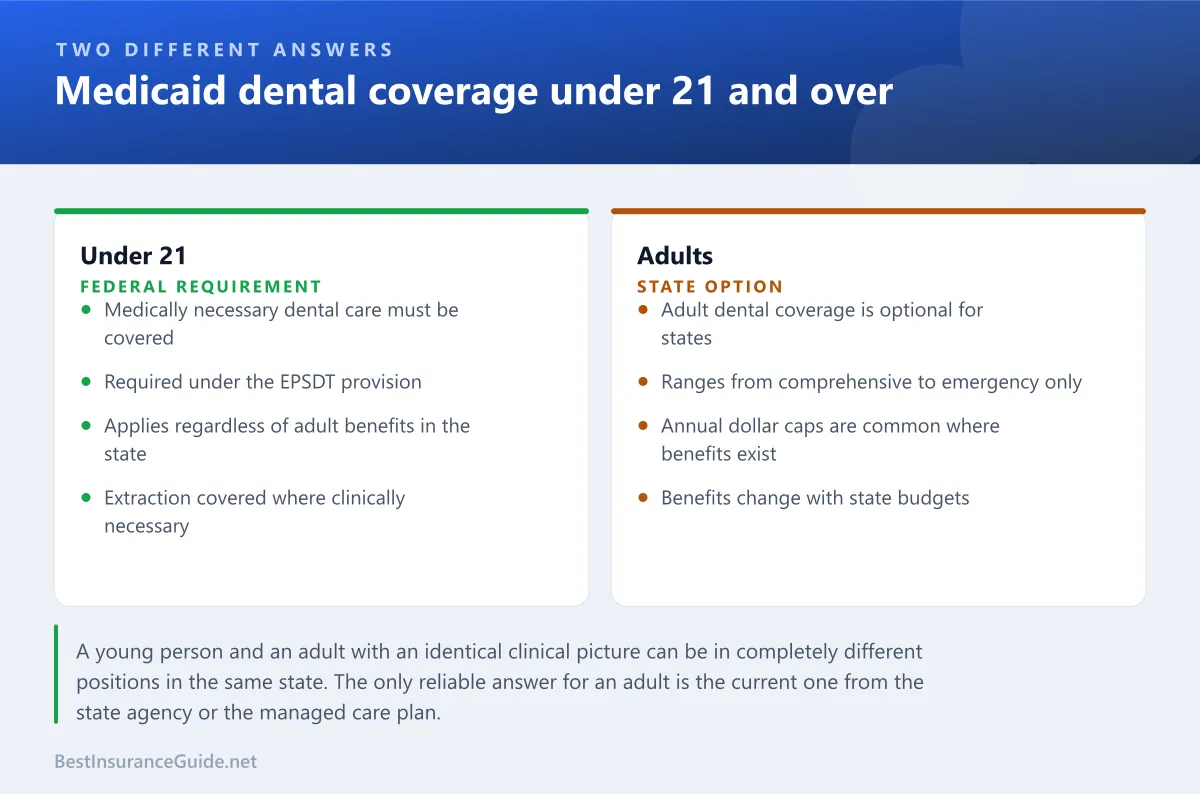
Under 21, the answer is generally yes where the extraction is medically necessary.
That is because of a federal requirement known as EPSDT — early and periodic screening, diagnostic and treatment — which obliges state Medicaid programmes to cover medically necessary services for people under 21, including dental care, regardless of whether the state covers those services for adults.
The practical effect is that a young person on Medicaid with impacted or symptomatic wisdom teeth is in a much stronger position than an adult with the identical clinical picture.
Adults, and why it varies
Adult dental coverage under Medicaid is optional for states, and they have taken very different approaches.
Broadly, states fall into four groups.
Extensive benefits. Preventive, restorative and surgical dental care, including extractions.
Limited benefits. A defined list of services, frequently with an annual dollar cap, which extraction may or may not fall within.
Emergency only. Relief of pain and infection, which usually includes extraction where a tooth is infected or causing acute pain, and excludes anything preventive or elective.
Very limited or none.
Two further complications. State benefits change with budgets, sometimes at short notice in either direction. And managed care organisations administer Medicaid in many states, which means the specific plan’s rules and provider network matter alongside the state policy.
The only reliable answer is the current one from your own state Medicaid agency or your managed care plan, and it is worth getting in writing.
Medical necessity, which decides most cases
Even in states with adult dental benefits, coverage for wisdom teeth generally turns on whether removal is medically necessary rather than elective.

Factors that support necessity:
Infection, including pericoronitis around a partially erupted tooth.
Symptomatic impaction, where the tooth cannot erupt properly and is causing problems.
Cysts or pathology associated with the tooth.
Damage to adjacent teeth, including resorption or decay caused by the position of the wisdom tooth.
Pain that cannot be managed by other means.
Decay that cannot be restored in that tooth.
What is less likely to qualify:
Prophylactic removal of asymptomatic teeth, meaning taking them out because they might cause problems later.
Removal to prevent orthodontic crowding, in most programmes.
The clinical distinction is genuine and it is the same one private dental insurers apply. What differs is how much documentation is required and how the appeal process works.
Prior authorisation
Surgical extraction usually requires prior authorisation, submitted by the dental practice.
What determines the outcome is documentation.
Radiographs showing the position, impaction and any associated pathology.
A clinical narrative explaining the symptoms, the findings and why extraction is the appropriate treatment.
A record of conservative management where relevant, showing that the problem has not resolved otherwise.
Correct procedure coding, which matters more than it should and is a common cause of denial.
A well-documented submission is approved considerably more often than a bare one, and this is worth raising with the practice rather than assuming they will do it thoroughly.
If it is denied
A denial is not the end, and many are overturned.
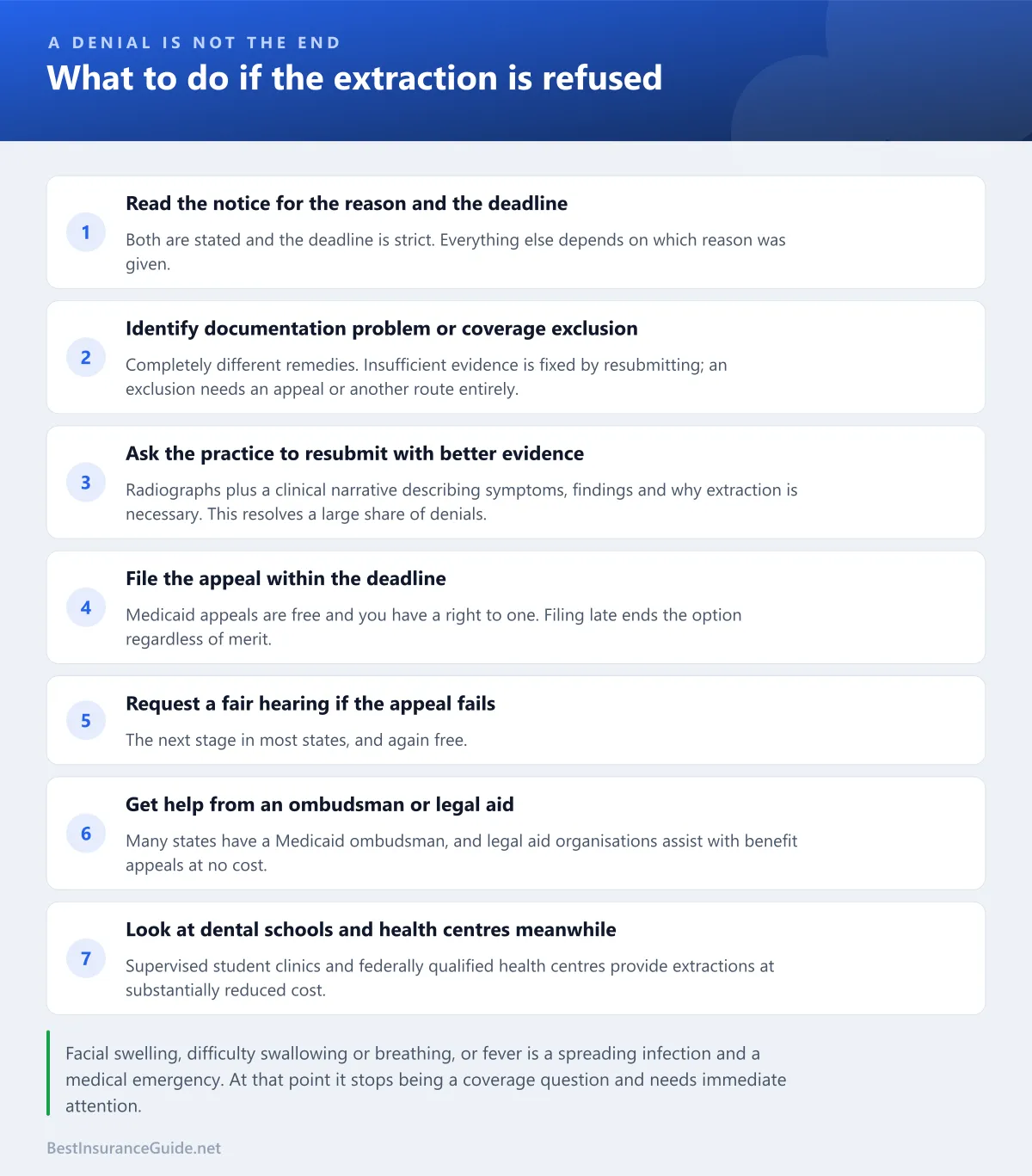
Read the denial notice carefully. It states the reason and the appeal deadline, and the deadline is strict.
Identify whether it was a documentation problem or a coverage exclusion. These have completely different remedies. Insufficient documentation is fixed by resubmitting; a coverage exclusion is fixed by appeal or by another route entirely.
Ask the practice to resubmit with better documentation where the issue was clinical evidence. This resolves a large share of denials without any formal appeal.
File the appeal within the deadline. Medicaid appeals are free, and you have a right to one.
Ask for a fair hearing if the internal appeal fails, which is the next stage in most states.
Get help. Many states have a Medicaid ombudsman, and legal aid organisations frequently assist with benefit appeals at no cost.
If it genuinely is not covered
Four routes worth knowing.
Dental schools. Supervised student clinics provide extractions at substantially reduced cost, with longer appointments and a waiting list.
Federally qualified health centres and community health centres, many of which have dental services and charge on a sliding scale based on income.
State or local dental assistance programmes, which exist separately from Medicaid in some states.
Payment plans through the practice, which many oral surgeons offer.
Two things to avoid. The emergency department does not perform routine extractions; it treats infection and pain and refers you back to dental care, which means paying for a visit that does not solve the problem. And untreated infection is genuinely dangerous — a dental infection that spreads is a medical emergency, and at that point the medical side of Medicaid, rather than the dental side, is engaged.
That last point is worth stating plainly. If there is facial swelling, difficulty swallowing or breathing, fever, or swelling spreading toward the eye or neck, that is an emergency and needs immediate medical attention rather than a coverage question.
The short version
For anyone under 21, medically necessary wisdom tooth extraction is generally covered under the federal EPSDT requirement, whatever the state does for adults.
For adults, it depends entirely on the state, because adult dental coverage under Medicaid is optional and ranges from comprehensive to emergency-only. Even where benefits exist, coverage usually turns on medical necessity rather than on prophylactic removal.
Prior authorisation is common and documentation decides it. Radiographs and a clear clinical narrative are what get approvals.
If denied, read the notice for the reason and the deadline, resubmit with better documentation where that was the issue, and appeal where it was not. Many denials are documentation problems rather than coverage exclusions.
For the programme comparison, see Medicare versus Medicaid, and for the vocabulary, health insurance terms.
Finding out what your state actually covers
The answer changes by state and over time, so the useful skill is knowing where to look.
Your state Medicaid agency website publishes the adult dental benefit, usually as a covered services list or a provider manual. The provider manual is more detailed and is public.
Your managed care plan’s member handbook, if your Medicaid is administered through a plan, which it is in most states. The plan’s benefit can differ in detail from the state description.
The member services line on your card, and ask for the answer in writing or with a reference number.
A dental office that accepts Medicaid, which deals with the current rules daily and frequently knows them better than any published document.
Two things to ask specifically.
Whether surgical extraction of an impacted tooth is covered, which is a different procedure code from a simple extraction and is sometimes treated differently.
Whether there is an annual dollar cap on adult dental benefits, and how much of it you have used.
Worked example: the same tooth, three states
An adult with a symptomatic impacted lower wisdom tooth and an infection.
| Comprehensive benefit state | Limited benefit state | Emergency-only state | |
|---|---|---|---|
| Examination and radiographs | Covered | Covered | Covered as emergency |
| Surgical extraction | Covered with authorisation | Covered, may hit annual cap | Likely covered, infection present |
| Sedation | Covered with justification | Frequently not | Rarely |
| Follow-up review | Covered | Covered | Sometimes not |
Note that the infection improves the position in every column. That is medical necessity doing its work, and it is why documenting symptoms properly matters so much.
Finding a provider who accepts it
A separate and real problem. Medicaid dental reimbursement rates are low in many states, and provider participation is correspondingly limited.
Ask the plan for a current list rather than relying on an online directory, which is frequently out of date.
Call and confirm they are accepting new Medicaid patients, which is different from accepting Medicaid.
Try dental schools and federally qualified health centres, which participate more consistently than private practices.
Ask about oral surgery specifically, since a general dentist may accept Medicaid while the oral surgeon they would refer you to does not.
Preparing for the appointment
A few things make approval considerably more likely and they cost nothing.
Describe symptoms specifically and in order. When the pain started, what it feels like, whether it wakes you, whether there has been swelling, whether swallowing is affected, and what you have already tried. A clinical note built from a specific history supports necessity far better than one built from “it hurts”.
Mention any previous episodes, including antibiotics prescribed by another provider, which establishes that the problem is recurrent rather than new.
Ask the practice to submit radiographs with the authorisation, and to include a narrative rather than codes alone.
Ask what the expected decision time is, and whether the practice will chase it.
Ask what happens if it is denied, specifically whether they will resubmit with additional documentation.
Confirm the oral surgeon accepts your plan before the referral rather than after, since a general dentist accepting Medicaid does not mean their usual referral does.
When it becomes urgent
Coverage questions stop mattering at a certain point, and it is worth recognising it.
Facial swelling, particularly spreading toward the eye or under the jaw, difficulty swallowing or breathing, fever, or inability to open the mouth are signs of a spreading dental infection. That is a medical emergency rather than a dental appointment, and it is treated as such on the medical side of Medicaid rather than the dental side.
Emergency departments treat infection and pain but do not perform routine extractions, so the tooth still needs dealing with afterwards. What they do is stop something dangerous, and at that point cost is not the question.
Two things to do before booking
Get the benefit position in writing. Call the number on your card, ask specifically whether surgical extraction of an impacted third molar is covered for adults on your plan, whether prior authorisation is required, and whether an annual dollar cap applies. Note the reference number and the date.
Find a provider who is currently accepting Medicaid patients, which is different from one who accepts Medicaid, and confirm the same for any oral surgeon they would refer you to.
Doing both before the appointment avoids the most common outcome in this area, which is a treatment plan that cannot be funded and a referral that cannot be used.
Related reading
How long Medicaid approval takes covers the application itself, including the retroactive coverage provision that may apply to treatment already received. For the wider comparison, Medicare versus Medicaid sets out which programme applies to whom.
A note on scope
Nothing here is medical, dental or legal advice. Medicaid adult dental benefits are set by each state and change over time, managed care plans administer benefits differently within a state, and medical necessity determinations depend on individual clinical circumstances.
Your state Medicaid agency and your managed care plan publish the current benefit schedule and appeal procedures, and the federal EPSDT requirement is described by the Centers for Medicare and Medicaid Services. Your dental provider is the appropriate source on clinical necessity. This site is independent and not affiliated with any insurer.